

As the demand for sensitive skincare continues to rise, soothing and anti-irritant efficacy has become a primary focus in cosmetic R&D. Simultaneously, industry requirements for the scientific rigor of efficacy claims and evaluation evidence are steadily increasing. Establishing scientific, objective, and reproducible efficacy evaluation methods has become a critical topic in cosmetic ingredient innovation and product development.
Recently, the Industry Standard Cosmetic Efficacy Evaluation—Determination of TRPV1 Activity Based on a Capsaicin-Induced Calcium Influx Model in Human Epidermal Keratinocytes (Standard No.: T/GDICST 016—2026), released by the Guangdong Cosmetic Science and Technology Research Association, was officially published on the China National Information Platform for Association Standards and implemented as of July 27, 2026. Plamed Green Science Group, as a drafting organization, participated in the formulation of this standard, collaborating with industry research institutions and industrial partners to drive the standardization of TRPV1 activity assay methods and provide a unified and standardized methodological framework for cosmetic soothing efficacy evaluation.
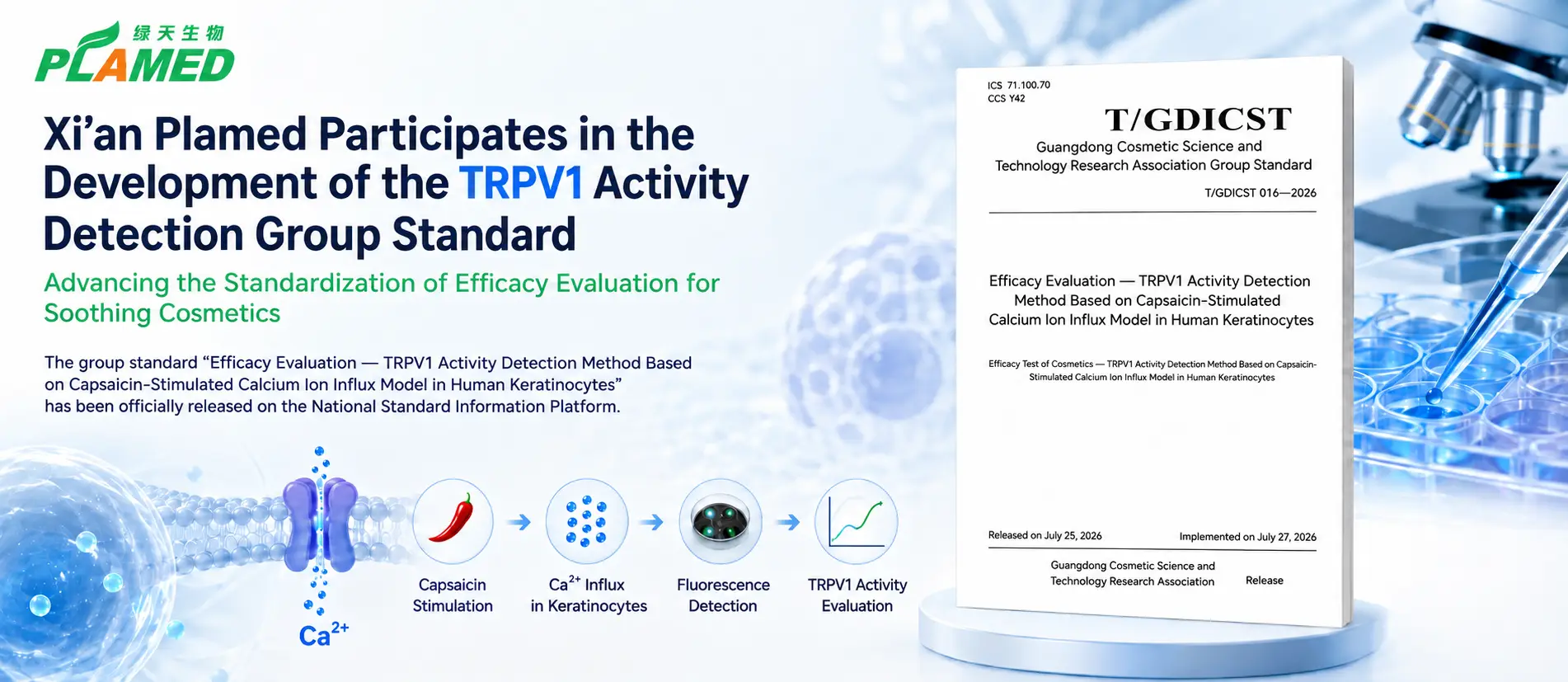
The release of this standard not only further enhances the evaluation system for cosmetic soothing efficacy but also reflects the industry trend of transitioning from "empirical evaluation" to "standardized evaluation," providing more scientific and reliable technical support for ingredient innovation and product R&D.
Focusing on the TRPV1 Target to Establish a Scientific Soothing Efficacy Evaluation System
Transient Receptor Potential Vanilloid 1 (TRPV1) is a vital ion channel widely expressed in skin sensory nerves and keratinocytes, serving as a key molecular target for sensing thermal, chemical, and inflammatory stimuli. Upon activation by external stimuli such as capsaicin, TRPV1 triggers rapid intracellular calcium influx, inducing the release of neuro inflammation-related signals and resulting in reactions like burning and stinging. Consequently, TRPV1 has emerged as an essential evaluation indicator for soothing and anti-irritant research.
Historically, the evaluation of cosmetic soothing efficacy relied primarily on In Vivo Tests. While these directly reflect product performance, they are limited by long research cycles, high costs, significant individual variability among subjects, and reliance on subjective perceptions. These limitations make it challenging to meet the demand for rapid, objective, and quantifiable evaluation during ingredient screening and formulation development stages.
Furthermore, as TRPV1 becomes a central target for soothing research, discrepancies among laboratories in cell model construction, stimulation conditions, detection protocols, and data analysis have led to a lack of unified evaluation criteria. This not only affects data comparability between studies but also hinders the efficient transformation of scientific research and industry technical exchange.
In response, this Industry Standard establishes a TRPV1 activity assay based on a capsaicin-induced calcium influx model in skin keratinocytes. By utilizing capsaicin as a classic TRPV1 agonist to induce channel opening and intracellular Ca²⁺ influx, combined with real-time monitoring via calcium fluorescent probes, the method quantitatively evaluates the regulatory capacity of cosmetic ingredients or formulations on TRPV1 activity. Compared to traditional methods, this approach enables more rapid and quantifiable efficacy evaluation in vitro. By unifying the experimental model, detection process, and evaluation methods, it provides a comprehensive technical foundation for different laboratories, enhancing the consistency repeatability and comparability of experimental results and promoting the standardized application of TRPV1 activity detection.
From Mechanism Research to Evaluation Standards: Enhancing the Neural Anti-irritation Research System
For active ingredients, a scientific mechanism of action and a reliable evaluation system are indispensable. Mechanism research explains "why it works," while evaluation standards demonstrate "how it is scientifically proven to work." Together, they form the cornerstone of innovative ingredient R&D.
Plamed Green Science Group continues to conduct systematic research on neural anti-irritation mechanisms, building an R&D system that integrates mechanism research, efficacy evaluation, model validation, and product development.In fundamental research, Plamed, in collaboration with industry partners, released the White Paper on Beauty AP Neural Anti-irritation Pathway, proposing a systematic research framework that offers a new theoretical perspective for soothing research. Regarding standard development, Plamed actively participated in the formulation of the TRPV1 activity assay Industry Standard to promote more scientific and regulated evaluation methods. In technical validation, we have established a multi-level validation system—including cell models, HET-CAM (Hen's Egg Test on Chorioallantoic Membrane), zebrafish models, and In Vivo Tests—to conduct systematic research on innovative ingredients from mechanism to efficacy.
From fundamental mechanism research to the establishment of evaluation methods and multi-model validation systems, Plamed is committed to transforming scientific research into standardized and regulated applications, providing the industry with comprehensive and credible technical support.
Strengthening the Efficacy Evaluation System Through Standard Development
As the cosmetic industry moves toward scientific and refined development, standardized evaluation methods have become a vital bridge connecting fundamental research, product development, and commercial application.The release of the TRPV1 activity assay Industry Standard provides a harmonized technical reference for soothing and anti-irritant efficacy evaluation. It facilitates the comparability and repeatability of detection results across laboratories, promotes data sharing, and provides a standardized application basis for organizations to conduct ingredient screening, formulation optimization, and efficacy claims.
The significance of standards lies not only in regulating detection processes but also in establishing a common evaluation language for the industry, providing a reliable technical basis for innovative ingredient R&D and driving the transition from empirical evaluation to mechanism-based and quantitative evaluation.
Deepening Scientific Innovation to Drive High-Quality Industry Development
Participating in industry standard development is both a reflection of accumulated research and a responsibility to promote collective growth.
Plamed Green Science Group remains committed to scientific innovation as its core, conducting persistent research in the neural anti-irritation field. We actively participate in public technical platforms and standard systems, driving the transition of research achievements from the laboratory to industry-wide sharing.
From drafting the TRPV1 Industry Standard to releasing the White Paper on Beauty AP Neural Anti-irritation Pathway and the ongoing R&D of the innovative soothing ingredient PMSoothe® Kava97, Plamed is building a neural anti-irritation research system encompassing Mechanism—Evaluation—Validation—Ingredient Innovation.
In the future, Plamed Green Science Group will continue to rely on scientific research, utilizing standard development as a bond and innovation as a guide. We aim to refine the cosmetic efficacy evaluation system and promote the transformation of more research findings into industry standards and applications, collaborating with partners to foster an industry that is more scientific, regulated, and possesses stronger global competitiveness.