Q: Can PMSoothe® Kava-Oil be dissolved in alcohols?
A:Yes, PMSoothe® Kava-Oil can be successfully dissolved in polyols (such as glycerin, propanediol, and butanediol) for adding into the formulation directly.
Q:How is the 10% concentration in PMSoothe® Kava-Oil defined in terms of raw materials?
A: The 10% concentration does not refer to the raw botanical powder input. Instead, it represents the actual weight percentage of the pure Kava extract—obtained through supercritical fluid extraction and Caprylic/Capric Triglyceride (GTCC) extraction—within the final product.
Q: Can PMSoothe® Kava-Oil undergo high-temperature heating during manufacturing?
A: Yes, it exhibits excellent thermal stability and can withstand short-term hot processing:
Short-term Processing: Active ingredient levels remain perfectly stable at 85°C for up to 10 minutes.
Long-term Heat Stability: Testing shows no significant changes in component content or appearance after 3 months at 45°C.
Q: Will PMSoothe® Kava-Oil freeze or solidify at low temperatures (5°C)?
A: No. The carrier solvent for PMSoothe® Kava-Oil is GTCC, which has a freezing point of approximately -15°C. Our low-temperature stability tests confirm no solidification or separation after more than 6 months at 4°C.
Q: How does PMSoothe® Kava-Oil perform in foundations? What is the recommended dosage?
A: It delivers exceptional anti-irritation and skin-barrier repair benefits in makeup bases:
System Match: Since foundations are predominantly Water-in-Oil (W/O) systems, this oil-soluble Kava-Oil is highly recommended.
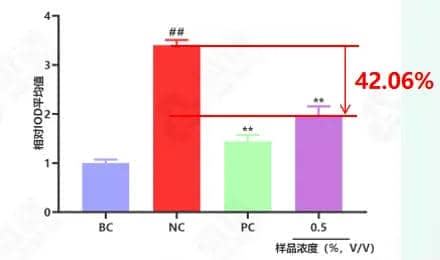
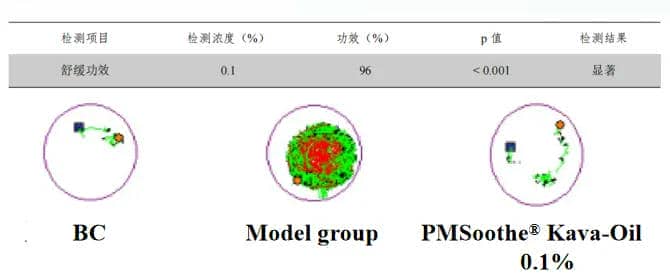
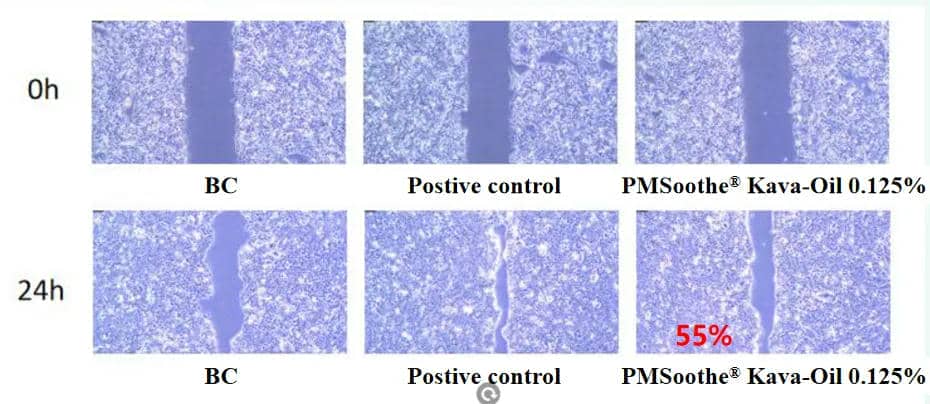
Dosage Principle: The usage depends on the irritation levels of the formulation’s ingredients rather than the product type itself. If the formulation contains no strong irritants, a dosage of 0.1% – 0.5% is sufficient to provide robust anti-irritation and repair effects.
Q: What is the compatibility of PMSoothe® Kava-Oil with different cosmetic oils?
A: We have conducted comprehensive oil compatibility testing. Please note the following guidelines:
Synthetic Esters & Natural Plant Oils: Displays excellent compatibility at the recommended formulation usage (up to 10%).
Silicone Oils: Poor compatibility. It is not recommended for pure silicone oil systems, as it carries a risk of hazing or precipitation.
Synthetic/Plant Alkanes: Reducing usage dosage. In systems containing Hydrogenated Polyisobutene or Squalane, we recommend keeping the dosage ≤3% and avoiding low-temperature storage to prevent potential hazing risks.
Q: Our formulation appeared precipitation after 1 month at room temperature with 0.2% Kava-Oil. The formulation also contains Tea Tree, Angelica, and Licorice oils. Could Kava-Oil be the cause?
A: Based on our technical compatibility data, it is highly unlikely that PMSoothe® Kava-Oil is the cause:
Precipitation Morphology: True Kava extract precipitates present as characteristic smooth, glossy particles, not as white gels or flakes.
Dosage Threshold: At a low concentration of 0.2%, Kava-Oil remains highly stable. It can remain perfectly stable at up to 10% in standard vegetable and synthetic oils.
Troubleshooting: The issue may stem from incompatibility between other botanical oils or emulsifiers. We highly recommend running a blank control test (omitting Kava-Oil) to accurately isolate the cause.
Q: The raw material has a distinct odor. Is this from the Kava itself or the solvent? How can we reduce it?
A: The odor is entirely a natural characteristic of the Kava active components, not the solvent. We suggest the following approaches to manage the odor:
Matrix Encapsulation: In finished formulations, components like emulsifiers and thickeners present in the formulation physically encapsulate and “mask” a portion of the Kava odor. We recommend making a complete formula sample to evaluate the final scent.
Dosage Control: Keeping Kava-Oil’s dosage ≤0.5% will significantly dilute and lighten the natural odor.
Process Update: Our R&D team is currently exploring advanced processing techniques (such as concentration and vacuum stripping) to further optimize the raw material’s odor without compromising active components.