Package: Packed in 25kg paper drums with two plastic bags inside.
Storage: Stored in a cool and dry place and away from direct sunlight and oxidizing agents.


Plamed Vision: Become the leader of natural cosmetic ingredients for sensitive skin.
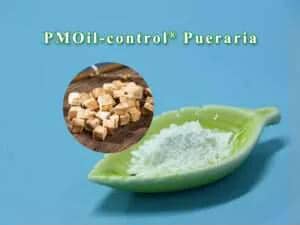
Pueraria lobata is one of the most common traditional Chinese medicines, and has a long history of clinical use. It was first recorded in the “Shen Nong’s Materia Medica” of the Han Dynasty in ancient China. Pueraria lobata is rich in a variety of natural plant compounds, it’s a beneficial source of isoflavone, genistein, and daidzein that have been show to improve signs of ageing. In 1959, Shibata et al. first reported puerarin as a unique component of Pueraria lobata. Song et al. have reviewed in detail the research on the chemical components of Pueraria lobata published before 2014, mainly including flavonoids, triterpenes, coumarins, saponins and other compounds. Studies have shown that Pueraria lobata has the functions of promoting cerebrovascular and retinal blood flow, and spasmolyzing, anti-cancer, lowering blood sugar and blood pressure, antioxidant, etc.. Plamed found that Pueraria lobata has a strong inhibitory effect on 5α-reductase. Therefore, we develop PMOil-control® Pueraria which is a natural cosmetic raw material for oil control.

| Product Name | INCI Name | Content | |
| PMOil-control® Pueraria
|
PUERARIA LOBATA EXTRACT | 10%~40% | |
| HYDROXYPROPYL CYCLODEXTRIN | 60%~90% | ||
| Minimal Package | Minimal Order Quality | ||
| 1KG | 1KG | ||
Pueraria lobata, also named Kudzu, is the dry root of Leguminosae family. It mainly grows in Henan, Shaanxi, Anhui, Zhejiang of China. Shaanxi is the largest producer of pueraria in the north. The plant contains many medicinal ingredients. Kudzu root is a homologous plant of medicine and food, which has a history of more than 3000 years in Chinese folk food, and has a long history of thousands of years as a precious Chinese medicinal material. It is an important medicinal material for clearing heat and detoxifying, and protecting liver and kidney. It can be used in medicine, health care products and cosmetics.

| Items | Specification |
| Part used | Root |
| Organoleptic Tests | |
| Appearance | Off white to white powder |
| Odor | Characteristic |
| Taste | Characteristic |
| Physical Characteristics | |
| Moisture | ≤10.0% |
| Ash content | ≤7.0% |
| Pueraria flavones | ≥15% |
| Heavy Metals | |
| Pb | ≤10ppm |
| As | ≤2ppm |
| Hg | ≤1ppm |
| Cd | ≤5ppm |
| Microbiological Tests | |
| Total of bacteria | ≤1000cfu/g |
| Yeast & mold | ≤100cfu/g |
| Pseudomonas aeruginosa | Not detected |
| Staphylococcus aureus | Not detected |
| Heat-resistant escherichia coil | Not detected |
PMOil-control® Pueraria Mechanism & Function
1. Inhibition of 5α-reductase
5α-reductase is a membrane protease that relies on reduced coenzyme II (NADPH). It is an important androgen metabolism enzyme in the skin. It can irreversibly convert testosterone into dihydrotestosterone (DHT). DHT is the most active androgen and can induce excessive sebaceous glands. Secrete oil. Therefore, reducing DHT levels by inhibiting 5α-reductase activity can effectively alleviate excessive oil secretion by sebaceous glands.
Plamed also submitted for testing the 5α-reductase inhibition rate of PMOil-control® Pueraria and PCA zinc.
The test results of sample PMOil-control® Pueraria are as follows:
| Groups | Inhibition rate of 5α-reductase | P value |
| Blank control group | 0.00 | / |
| Positive group | 69.36 | <0.001 |
| 1.0% PMOil-control® Pueraria | 96.71 | <0.001 |
| 0.5% PMOil-control® Pueraria | 75.78 | <0.001 |
| 0.1% PMOil-control® Pueraria | 57.83 | <0.001 |
The test results of sample PCA zinc are as follows:
| Groups | Inhibition rate of 5α-reductase | P value |
| Blank control group | 0.00 | / |
| Positive group | 69.36 | <0.001 |
| 1.0% PCA zinc | 80.40 | <0.001 |
| 0.5% PCA zinc | 46.29 | <0.001 |
Test results show that 1% PMOil-control® Pueraria has an inhibitory rate of 96.71% on 5α-reductase, which is better than the mainstream synthetic ingredient PCA zinc on the market.
2. Inhibition of lipid droplets
PMOil-control® Pueraria can significantly reduce the content of lipid droplets in human sebaceous gland cells, revealing its significant oil control effect.
| Groups | Relative IOD value | SD | P-value | Inhibition rate |
| BC | 1.00 | 0.02 | / | / |
| NC | 2.49 | 0.14 | 0.002## | / |
| PC | 1.05 | 0.02 | 0.003** | / |
| PMOil-control® Pueraria 0.008% | 1.47 | 0.02 | 0.008** | 40.96% |
| PMOil-control® Pueraria 0.016% | 1.23 | 0.02 | 0.005** | 50.6% |
| PMOil-control® Pueraria 0.25% | 1.12 | 0.05 | 0.001** | 55.02% |
| PMOil-control® Pueraria 0.5% | 1.07 | 0.02 | 0.004** | 57.03% |
The inhibition rates of PMOil-control® Pueraria on the formation of lipid droplets in human sebaceous gland cells were 40.96%, 50.6%, 55.02% and 57.03% at the concentrations of 0.008%, 0.016%, 0.25% and 0.5%, respectively.
| Application | Recommended Dosage |
| Masque, cleanser, lotion, toner, serum, essence, cream, etc. | 0.1%~1.0% |


Plamed done the stability test of PMOil-control® Pueraria for months, it showed that its water solution and powder for each batch is stable.
Also, PMOil-control® Pueraria has good pH stability in the range of 4-6.

Package: Packed in 25kg paper drums with two plastic bags inside.
Storage: Stored in a cool and dry place and away from direct sunlight and oxidizing agents.
Plamed focuses on natural cosmetic ingredients for more than 10 years. We have founded four subsidiary companies, which respectively develops different kinds of cosmetic raw material. Plamed is a company whose CEO is designated as the first secretary general of Shaanxi Plant Extraction Association.
A: Regrettably, we cannot provide this statement. To comply with rigorous regulatory safety standards for cosmetic ingredients both domestically and internationally, this material underwent mandatory full-scale safety and toxicological assessments. Since these legally required toxicological evaluations inevitably involve animal studies, a cruelty-free statement cannot be issued.
A: Extracting high-purity puerarin (up to 80%) is a highly mature traditional process in China. To overcome its inherent dissolution limits in formulations, Plamed utilizes a proprietary supramolecular encapsulation technology. This ensures a high content of active puerarin while significantly enhancing its water solubility and stability in aqueous systems.
A: Clinical tests show that 0.5% PMOil-control® Pueraria alone delivers excellent results in human oil control and acne reduction. Since its primary mechanism targets the root cause of excess sebum (oil control), and acne is often triggered by multi-factorial causes, we recommend synergistically compounding it with exfoliating agents (e.g., Salix Alba Bark Extract), anti-inflammatory, or antibacterial ingredients (e.g., Magnolia Officinalis Bark Extract) for a comprehensive, fast-acting anti-acne solution.
A: The core mechanisms and targeting scopes differ: molecular imprinting technology focuses on the precise identification and extraction of a “single specific molecule.” In contrast, Plamed’s supramolecular capture technology efficiently enriches a “class of functional components sharing specific physicochemical properties,” such as low-polarity molecular groups with molecular weights between 400–600, linear structure or a number of fused rings around 5.
A: Pueraria flavonoids generally consist of four core flavonoid components. In our PMOil-control® Pueraria, through directional capture and supramolecular processing, the primary active ingredient driving the core oil-control and anti-acne efficacy is high-purity Pueraria.
A: Yes. The core encapsulation technology and application of this product have been officially submitted to the National Intellectual Property Administration as an invention patent application, which is currently under official review and pending authorization.
Click the button to get the full product report.