Skin repair has become one of the vital directions in modern skincare research and development. From sensitive skin care to post-aesthetic skin repair, and from barrier maintenance to daily skin stabilization, repair ingredients are continuously attracting significant market attention. In this field, classic repair actives represented by Centella Asiatica extract and madecassoside have gained widespread recognition through long-term research and application validation, and have been formulated into numerous repair products. For brand development, these classic ingredients provide a reliable foundation for skin repair. However, high-purity madecassoside comes with a high cost, with a market price of approximately 2,800–2,900 USD/kg, which to some extent restricts its application scope in certain formulation.
Building upon this, Plamed continues to focus on a more fundamental question: Are there other unexplored ingredients that possess valuable skin-repairing activity? And can these ingredients establish a practical, applicable relationship with classic ingredients?
Driven by this thinking, Plamed has conducted a series of studies centered on skin repair. From discovering new repair ingredients to validating their combined application value, we aim to explore not just whether a single ingredient is effective, but how to enable repair raw materials to generate greater value.
The First Globally to Conduct Research on the Repair Value of Kava Pepper Root Extract
The Repair Potential of Kava Pepper Root Extract
In related research, we have long focused on the actual performance of active ingredients from different sources during the skin repair process. We noticed that certain active ingredients derived from botanical systems possess potential repair efficacy. Therefore, we expanded our research scope to Kava Pepper Root Extract (PMSoothe® Kava97) and systematically evaluated its application potential in skin repair.
We conducted observations at both the cellular and organismal levels. In a cell scratch assay, we tested the cell migration rates of three samples: PMSoothe® Kava97, PMRepair® Centella (70% Total Triterpenes), and PMRepair® Centella-WS (90% Madecassoside). At the same concentration, all three samples achieved a migration rate of 50–60%, with PMSoothe® Kava97 showing performance close to that of the classic Centella Asiatica actives (Figure 1). For damaged tissues, cell migration is a crucial step in the repair process, and the results typically reflect the fundamental capacity for skin reconstruction.
In a zebrafish tail fin repair model, PMSoothe® Kava97 also demonstrated excellent tissue repair capability. At the same concentration, it achieved a tail fin repair rate of over 30% alongside the two Centella Asiatica extracts, performing close to or even exceeding the 90% madecassoside (Figure 2).
These results indicate that Kava Pepper Root Extract possesses fundamental value for further research and application in the field of skin repair.
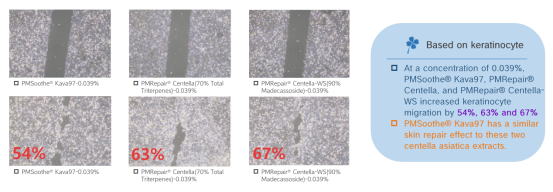
Figure 1 Cell Migration Rate Results
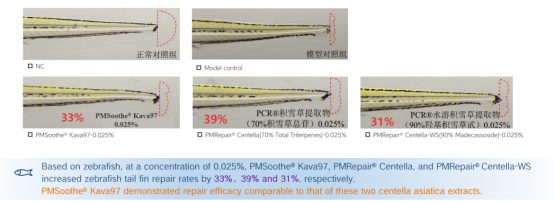
Figure 2 Zebrafish Tail Fin Repair Results
Synergistic Application Validation of the New Repair Ingredient and Classic Ones
After completing observations on the single active, we further focused on its performance when combined with classic repair ingredients.
Consequently, Plamed conducted a joint application study of PMSoothe® Kava97 and madecassoside. Tissue morphology and barrier-related indicators were evaluated in a 3D skin model.
The research results showed that the combination group outperformed the individual applications in both viable epidermal layer thickness and the expression level of Claudin-1, which is closely related to skin barrier integrity (Figure 3). Further verification through Combination Index (CI) analysis confirmed a synergistic enhancement effect between the two.
The core significance of this result lies not in a simple stacking of efficacy, but in demonstrating that the combination methods of different repair actives can influence the final repair performance. Through continuous research, we have not only discovered a new repair active but also unlocked the potential for classic repair ingredients to deliver greater value. This translates into more formulation design space and more flexible choices for repair solutions. In certain application scenarios, this combination can also help optimize the usage costs of high-purity raw materials while maintaining product repair performance, thereby achieving a better balance between efficacy and cost. For instance, the market price of Kava97 is approximately 450 USD/kg. Combining it with Centella Asiatica can significantly lower the usage cost of madecassoside, achieving a reduction of about 45.5%.
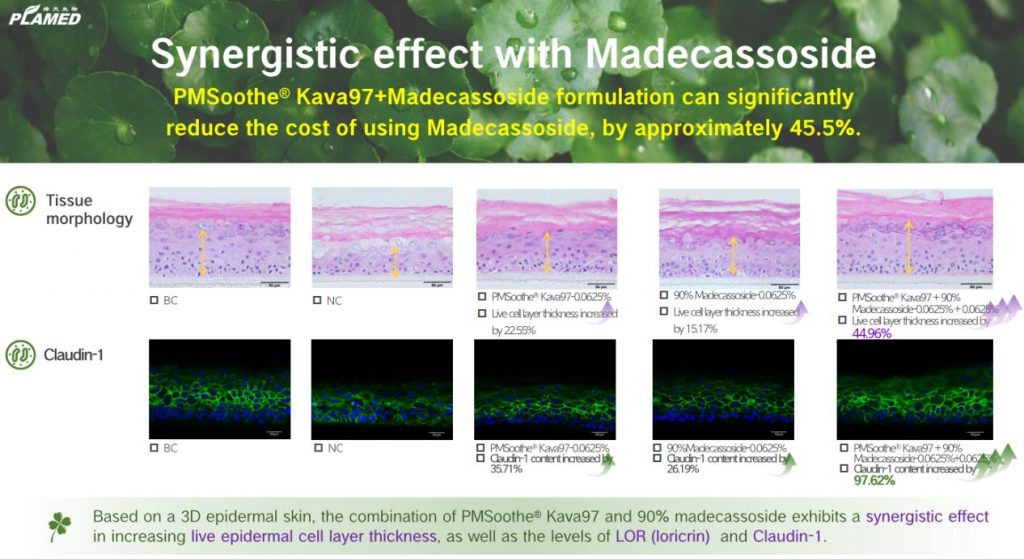
Figure 3 Validation Results of Tissue Morphology and Barrier-Related Indicators
Observation on the Application Performance of the Classic Centella Asiatica Ingredients
Centella Asiatica actives have long been a core component of the skin repair field. Among them, madecassoside has received focused attention due to its high purity. However, during our research, we found that under identical study conditions, total triterpenes of Centella Asiatica also exhibited excellent repair performance (Figure 4).
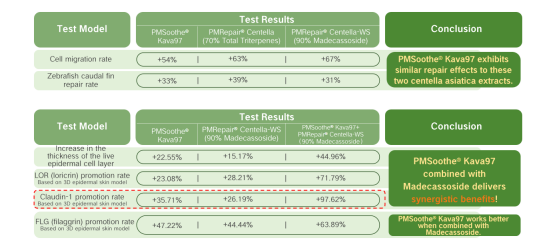
Figure 4 Synergistic Repair Efficacy Results
This outcome reminds us that the application value of a repair raw material depends not only on a single purity level but also requires a comprehensive evaluation integrated with specific application goals and formulation systems. Scientifically selecting the appropriate repair active is sometimes more important than purely pursuing higher purity.
From Research Discovery to Skin Repair Solutions
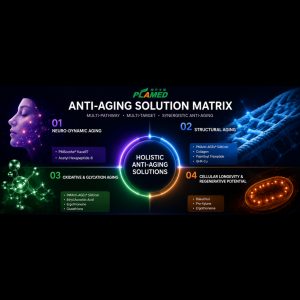
Repair is not a single, isolated process. From tissue recovery and cellular protection to skin condition maintenance, different active ingredients can provide their respective support. Based on existing research achievements and product accumulation, Plamed has established a diversified solution system covering various repair needs:
PMSoothe® Kava97 provides a new active choice for repair products.
PMRepair® Centella (Total Triterpenes) and PMRepair® Centella-WS (Madecassoside) constitute the important foundation of the classic repair ingredient.
Ectoin provides environmental adaptation support for the skin by protecting and stabilizing cell states.
Bisabolol serves as a soothing auxiliary ingredient to help refine the overall repair system.
These active ingredients do not replace one another; instead, they can be reasonably combined according to different product positionings and application scenarios to collectively serve repair product development. For Plamed, skin repair research is not merely about validating the effects of new repair ingredients. More importantly, through systematic research, it aims to understand the application relationship between new repair ingredients and classic repair ingredients, and to explore their combination value in actual product development. In the future, we will continue to conduct research around skin repair to explore more possibilities worthy of validation and application.