

Yes. Plamed's characterization results indicate that its supramolecular extracts form inclusion complexes rather than simple physical mixtures. TEM and XRD provide complementary structural evidence supporting this conclusion.
In the cosmetic raw material industry, "supramolecular technology" is far more than simply mixing two ingredients together. Genuine supramolecular inclusion involves the structural encapsulation of drug molecules by an inclusion material, allowing the drug molecules to enter the spatial structure formed by the material, ultimately yielding an inclusion complex with distinct structural characteristics.
To verify and confirm whether the drug molecules have truly formed an inclusion structure with the inclusion material, Plamed did not rely on a single testing method. Instead, we performed cross-validation from two distinct angles:
● Transmission Electron Microscopy (TEM): To observe the microscopic morphology of the samples;
● X-ray Diffraction (XRD): To analyze the internal crystalline structural characteristics of the samples.
Concurrently, our R&D team prepared four sets of control samples for comparative characterization: the pure drug molecules, the inclusion material, the inclusion complex, and a physical mixture of the inclusion material and drug molecules.
Experimental Design: Four Sample Groups
Sample | Purpose |
Pure drug molecules | Reference sample |
Inclusion material | Reference for the inclusion material |
Inclusion complex | Sample for structural characterization |
Physical mixture | Control for simple physical mixing |
1. Transmission Electron Microscopy (TEM): Morphology of the Inclusion Complex Resembles the Inclusion Material
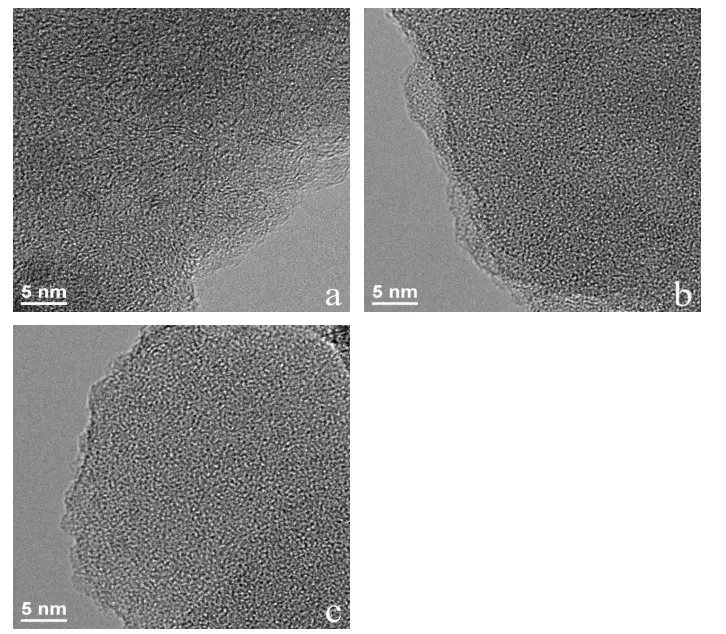
Figure 1. TEM images of (a) drug molecules, (b) inclusion material, and (c) inclusion complex
Transmission Electron Microscopy (TEM) is employed to observe the morphological features of samples at the microscopic scale.
As shown in the images, the pure drug molecules exhibit distinct morphological features compared to the inclusion inclusion material. In contrast, the micro-morphology of the inclusion complex is much closer to that of the inclusion material, with both presenting relatively uniform, white spherical structures.
This indicates that upon the formation of the inclusion complex, the original independent microscopic morphology of the drug molecules underwent a clear change, with the overall structural appearance closely resembling the inclusion material. In other words, the drug molecules do not merely exist in a simple free state; instead, they are encapsulated and influenced by the structure of the inclusion material.
Key finding: The TEM results show that the morphology of the inclusion complex is closer to that of the inclusion material than to the original drug molecules.
2. X-ray Diffraction (XRD): Absence of Characteristic Peaks of Drug Molecules in the Inclusion Complex
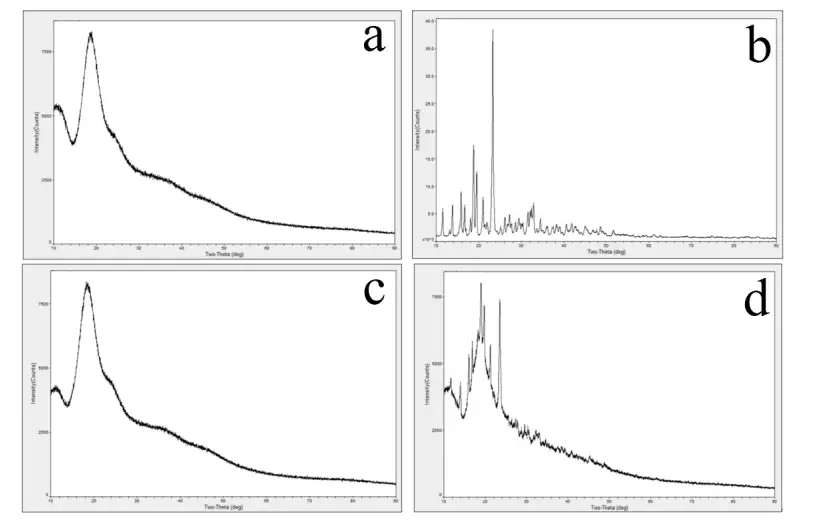
Figure 2. XRD patterns of (a) host material, (b) drug molecules, (c) inclusion complex, and (d) physical mixture of inclusion material and drug molecules
X-ray Diffraction (XRD) reflects the internal crystalline structural characteristics of substances. Different substances typically exhibit unique diffraction peak profiles, which can be utilized to evaluate whether the sample still retains its original crystalline structural information.
As shown in the patterns, the drug molecules and the inclusion material exhibit distinctly different X-ray diffraction peak profiles.
When the two components are simply mixed physically, the resulting physical mixture still preserves the respective characteristic peaks of both the drug molecules and the inclusion material. This suggests that simple mixing does not alter the original structural characteristics of the drug molecules.
However, in the XRD pattern of the inclusion complex, the characteristic peaks of the drug molecules are completely absent. The overall peak profile closely resembles that of the inclusion material, with only minor local differences.
This result stands in sharp contrast to the physical mixture, indicating that the drug molecules no longer exist in their original independent crystalline form, but have instead entered the structural system formed by the inclusion material.
Key finding: The XRD results show that the characteristic diffraction peaks of the drug molecules disappear in the inclusion complex.
3. Two Characterization Techniques Point to One Unified Conclusion
From microscopic morphology to crystalline structure, the TEM and XRD analyses yielded mutually reinforcing results. From the physical mixture to the inclusion complex, the control samples also demonstrated clear and distinct differences.
Consequently, Plamed supramolecular extracts are not simple physical mixtures of drug molecules and inclusion materials. Instead, they form genuine supramolecular inclusion complexes with structural encapsulation characteristics through advanced inclusion technology.
This serves as a vital R&D foundation for Plamed to validate and confirm its supramolecular structures. Such structural encapsulation provides a solid technical foundation for improving the subsequent application performance of drug molecules. Supramolecular inclusion may help protect drug molecules and potentially improve their practical properties, including solubility, stability, and bioavailability.
By executing this cross-validation using "two testing methods and four sets of control samples," Plamed ensures that supramolecular inclusion moves beyond a mere concept, establishing tangible, observable, and comparable structural proof.