
Key Takeaway: T/GDCA 088-2026 establishes an ELISA-based evaluation method for the anti-irritation efficacy of cosmetic ingredients, providing a standardized methodological reference for ingredient R&D and efficacy validation.
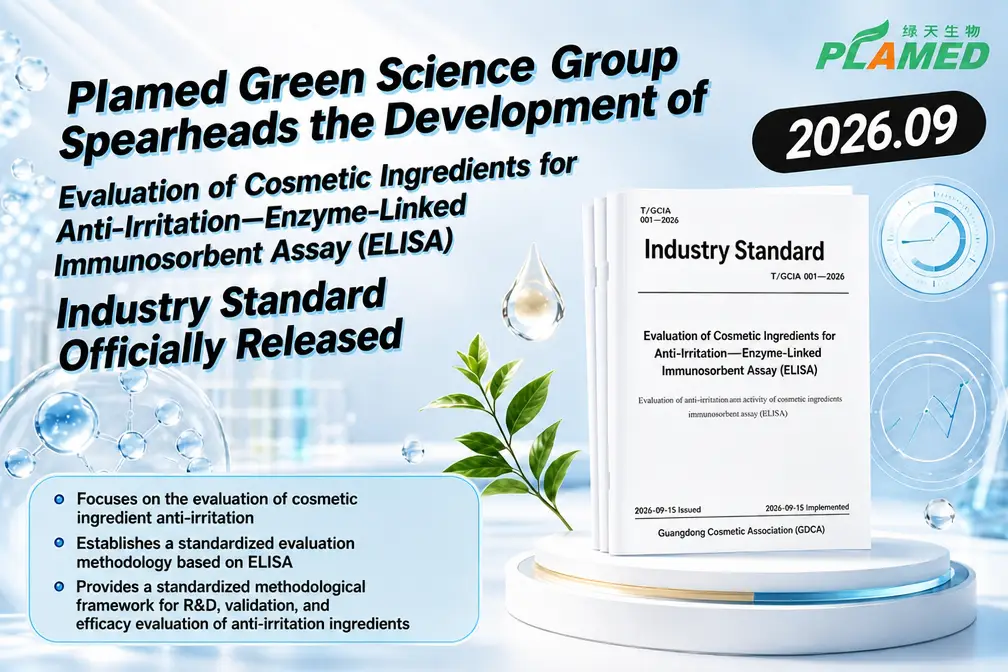
Recently, the Guangdong Cosmetic Association (GDCA) issued an official announcement that the Industry Standard, Evaluation of Cosmetic Ingredients for Anti-Irritation — Enzyme-Linked Immunosorbent Assay (ELISA) (Standard No. T/GDCA 088-2026), led by Plamed Green Science Group, has been officially approved and published. The standard has officially came into effect on September 10, 2026.
Recommended structure
Item | Information |
Standard | T/GDCA 088-2026 |
Standard Title | Evaluation of Cosmetic Ingredients for Anti-Irritation — Enzyme-Linked Immunosorbent Assay (ELISA) |
Issuing Organization | Guangdong Cosmetic Association (GDCA) |
Effective Date | September 10, 2026 |
Technical Method | Enzyme-Linked Immunosorbent Assay (ELISA) |
Application | Anti-irritation evaluation of cosmetic ingredients |
Led by | Plamed Green Science Group |
From “Soothing” to “Anti-Irritation”
For a long time, a key conceptual misconception has existed in the cosmetics industry: the soothing efficacy claims of finished cosmetic products are often directly equated with the anti-irritation efficacy of cosmetic ingredients. In reality, the two differ in their mechanisms of action and the nature of their efficacy.
According to the official interpretation of the National Medical Products Administration (NMPA), the regulatory definition of “soothing” is “helping to improve skin irritation and other related states.” Its core concept is “relief,” focusing on discomfort after skin irritation has already occurred. By helping alleviate existing stress responses such as redness stinging, and burning sensations, soothing falls under the category of “post-irritation intervention.” The key question is how can the skin be improved after irritation has occurred?
In contrast, the “anti-irritation” efficacy of cosmetic ingredients generally refers to their ability to prevent, reduce, or alleviate irritation responses and related physiological and biochemical reactions triggered after irritants act on the skin. This approach focuses on intervening at the source by reducing the generation and transmission of irritation signals, thereby lowering the probability of skin being affected by external stimuli, and helping prevent the skin from entering a state of irritation-related stress. It represents a “pre-emptive prevention” approach, with greater emphasis on the ingredient’s ability to directly modulate the irritation response itself.
Focusing on the evaluation of anti-irritation efficacy in cosmetic ingredients, the newly published Industry Standard marks the first time that anti-irritation efficacy in cosmetic ingredients has entered a standardized evaluation phase. Using Enzyme-Linked Immunosorbent Assay (ELISA) as its core technical approach, the standard establishes an evaluation methodology and provides a standardized methodological reference for the R&D, validation, and efficacy evaluation of anti-irritation cosmetic ingredients.
Aspect | Soothing | Anti-Irritation |
Main focus | Improving existing irritation-related conditions | Preventing or reducing irritation responses |
Intervention | Post-irritation intervention | Pre-emptive intervention |
Application context | Finished cosmetic efficacy claims | Cosmetic ingredient efficacy evaluation |
Evaluation focus | Improvement of irritation-related conditions | Modulation of irritation responses |
From Sensitive Skin Anti-irritant Mechanism Research to Evaluation Method Development
Anti-irritation is an important area in sensitive skin care and the development of active skincare ingredients. As consumers and brands increasingly seek more clearly defined and scientifically validated anti-irritation efficacy, establishing scientific, standardized, and reproducible evaluation methods has become an important technical challenge for the industry.
The publication of this Industry Standard represents a further step toward standardizing evaluation methods for anti-irritation.
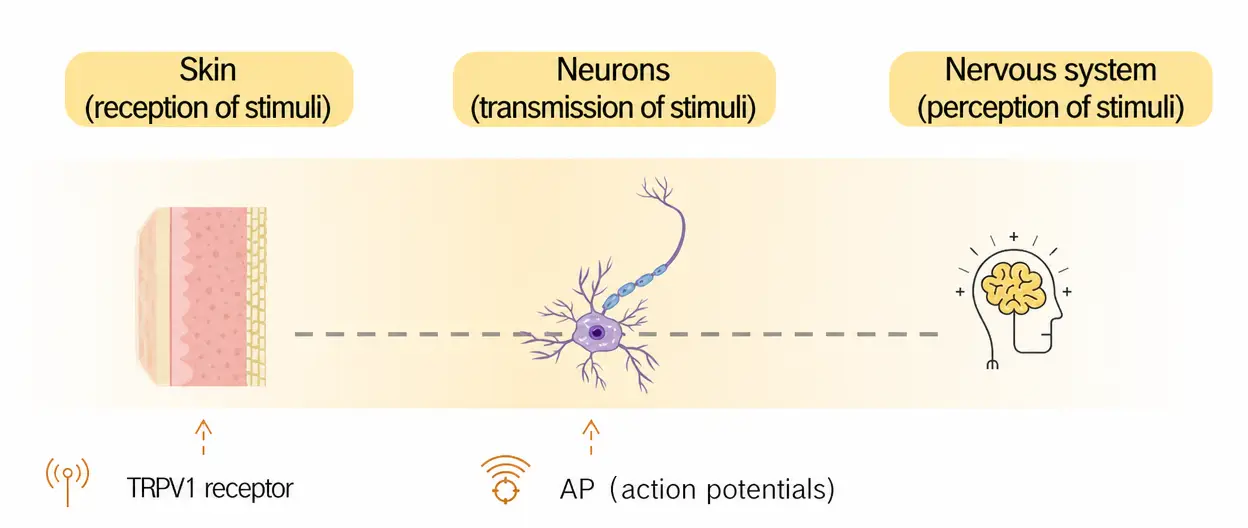
As the organization leading the development of this standard, Plamed has built extensive expertise in anti-irritation ingredients through long-term research and development. The company has identified the Action Potential (AP) neural signaling pathway as one of the key directions of its anti-irritation research.
Previously, Plamed collaborated with its industry partner, Inoherb, to publish the White Paper on Cosmetic AP Neural Anti-Irritation Pathway, systematically clarifying for the first time the core mechanism of the AP signaling pathway in skin anti-irritation. Plamed continues to explore the entire pathway, from irritation perception and neural signal transmission to anti-irritation intervention. This accumulated research has provided a technical foundation for the company’s further exploration and development of standardized evaluation methods for anti-irritation.
Making Anti-Irritation Evaluation More Scientific and Quantifiable
From cosmetic ingredient R&D to finished product applications, evaluating anti-irritation efficacy requires going beyond simply asking whether an ingredient or product “soothes” the skin. It also requires answering three key questions:
l How should anti-irritation efficacy be evaluated?
l What should be measured?
l How can stable and comparable data be obtained?
The newly released Industry Standard provides a methodological approach based on Enzyme-Linked Immunosorbent Assay (ELISA) for these evaluations, offering a new standardized reference for the R&D, validation, and efficacy research of anti-irritation ingredients.
For ingredient manufacturers, the continuous improvement of evaluation methods can help move anti-irritation efficacy from conceptual claims toward mechanism-based research, experimental validation, and data-driven support.
About Plamed Green Science Group
Founded in 2013, Plamed Green Science Group is a National High-Tech Enterprise driven by scientific and technological innovation, with natural cosmetic active ingredients at its core. The company is committed to becoming a leader in natural active ingredients for anti-irritation and anti-aging applications.
Plamed has independently developed its proprietary SPEX® “Supramolecular Capture” technology, which significantly improves the purity, efficacy, water solubility, and stability of natural raw materials. Based on this technology, the company has developed a range of signature ingredients, including PMSoothe® Kava97, PMRefresh® Willow, and Centella Asiatica Extract, covering multiple application areas such as sensitive skin care, anti-irritation, anti-wrinkle, skin repair, and oil-control.
In terms of technological innovation, Plamed was the first in the industry to propose the AP anti-irritation mechanism, pioneered endogenous exfoliation technology, and launched the first cosmetic-grade Kava Root Extract in China.
Plamed has been recognized as a National High-Tech Enterprise and has served as the Secretary-General Organization of the Shaanxi Plant Extraction Industry Association and a Vice President Organization of the China Plant Extract Association. Several of its products have received prestigious industry honors, including the Ringier Technology Innovation Award and the “China’s Best Ingredient” Award.