
PMAnti-AGEs® Silibinin for ECM-Focused Anti-Aging Skincare
PMAnti-AGEs® Silibinin is a standardized silymarin powder extracted from milk thistle (Silybum marianum) seed, with a silibinin A+B marker specification of ≥80%. This water-insoluble botanical active is pre-dispersed in glycols and used at 0.1%–0.5% in firming, anti-wrinkle and anti-glycation skin care formulations.
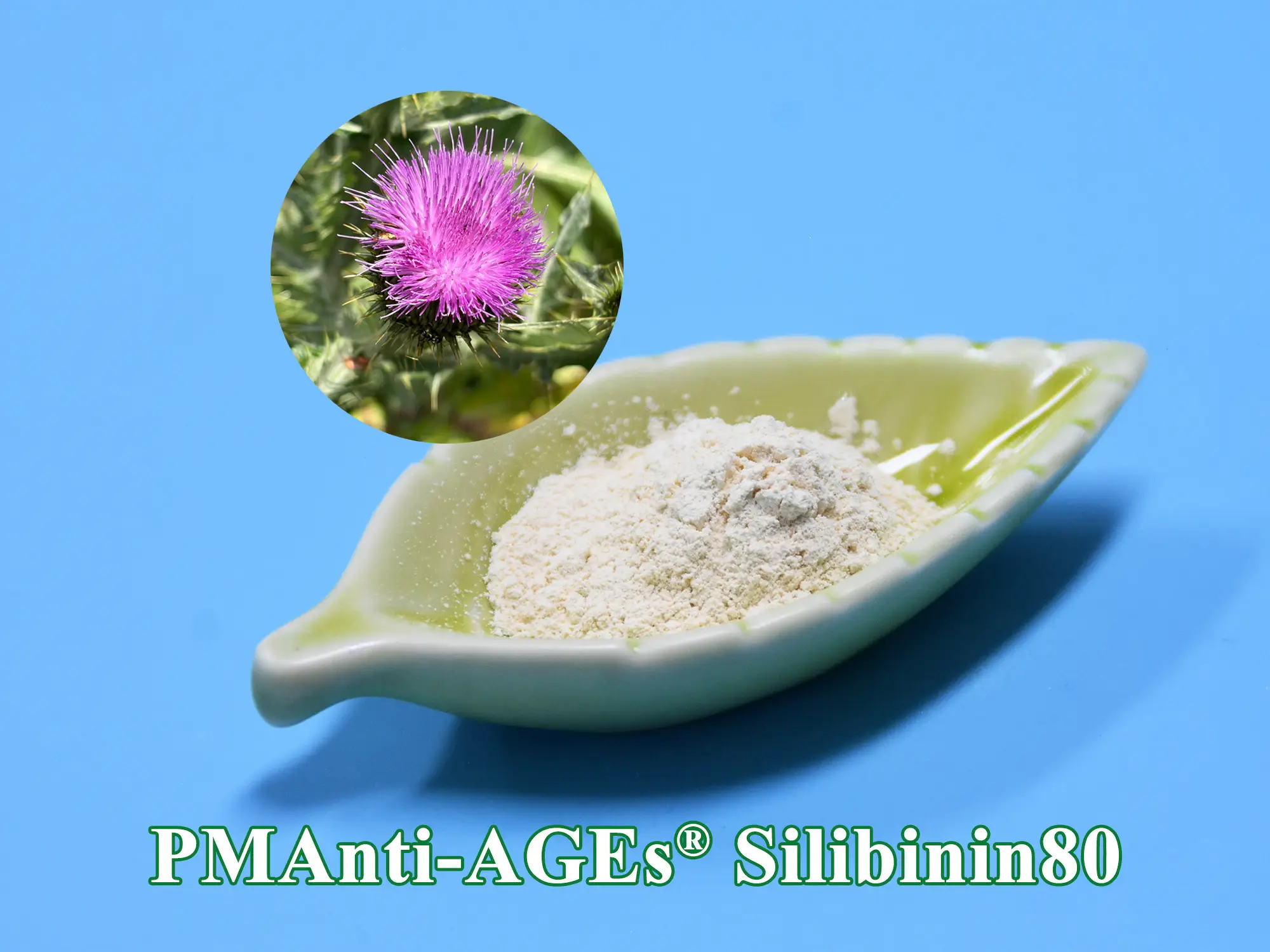
PMAnti-AGEs® Silibinin
PMAnti-AGEs® Silibinin is a silibinin extract-based active ingredient derived from Silybum marianum (milk thistle), designed to support extracellular matrix (ECM) homeostasis and skin structural integrity. As one of the targeted anti glycation skin care ingredients, it helps inhibit glycation-induced ECM cross-linking and structural stiffening, supporting the management of skin aging.
By focusing on ECM stability and controlling glycation-related structural damage, this active ingredient helps address visible signs of structural aging, including skin sagging and reduced elasticity. These mechanisms help explain the potential milk thistle benefits for skin and the role of silibinin in advanced anti-aging skincare formulations.
At a glance
Item | Detail |
Product name | PMAnti-AGEs® Silibinin |
Product identity | Silymarin |
INCI | Silymarin |
Botanical source | Silybum marianum seed |
Active marker | Silibinin A+B |
Marker specification | ≥80% |
Appearance | Light yellow to light brown powder |
Product form | Powder |
Water solubility | Insoluble; pre-disperse in a glycol system |
Recommended use level | 0.1%–0.5% reference range |
Primary applications | Serums, essences, emulsions, creams, lotions, masks |
Supplier | Plamed Green Science Group |
Shelf life | 36 months when stored properly |
PMAnti-AGEs® Silibinin is a standardized silymarin extract derived from Silybum marianum (milk thistle) seeds, with a silibinin A+B content of ≥80%. This botanical active is developed for anti-aging skincare, focusing on skin firmness, elasticity, wrinkle appearance and glycation-related skin aging.
As a plant-derived option for anti aging ingredients and milk thistle for skin formulations, it is suitable for serums, creams, lotions and other skincare products. The water-insoluble powder should be pre-dispersed in a glycol system before incorporation, with a recommended use level of 0.1%–0.5%.
Milk Thistle Botanical Source and Silymarin Extraction
Item | Description |
Common name | Milk thistle |
Botanical name | Silybum marianum |
Family | Asteraceae |
Plant part used | Mature seeds |
Native region | Europe and the Mediterranean region |
Active compound class | Flavonolignan complex |
Key active constituent | Silibinin |
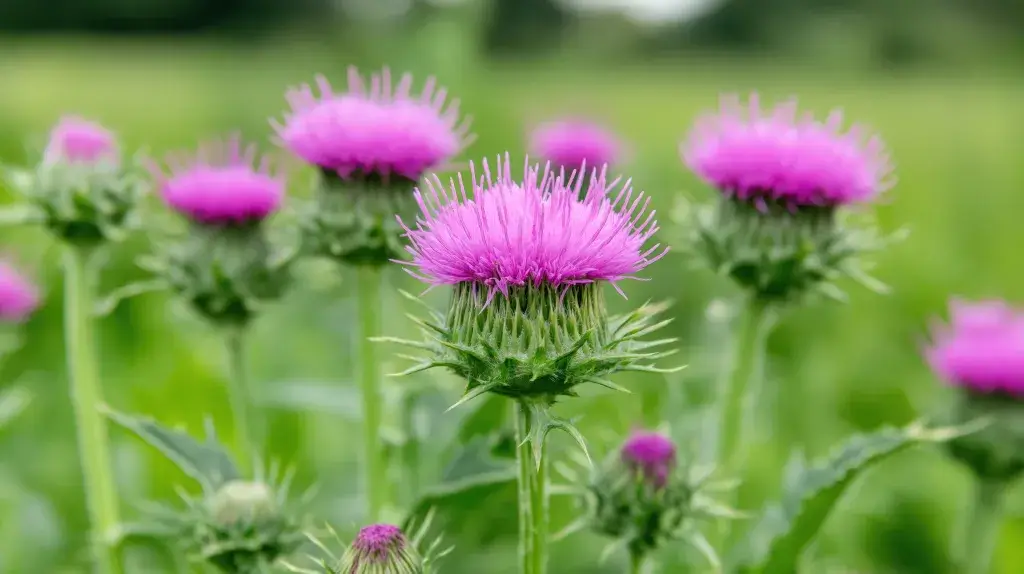
Silybum marianum, commonly known as milk thistle, is the botanical source of this silymarin powder. The silybum marianum extract used here is obtained from mature seeds through a controlled extraction and purification process, the silymarin extraction step, to give a standardized silybum marianum milk thistle extract in the form of a fine silybum marianum powder.
On terminology. Botanical and pharmacopoeial literature describes milk thistle material both as silybum marianum fruit extract and as seed extract; the fruit of Asteraceae species is a seed-bearing structure and the two names are frequently applied to the same commercial material. This product is the seed-derived, silibinin-standardized grade. Formulations that reference silybum marianum fruit extract for skin benefits are generally describing this same flavonolignan complex.
Silibinin Mechanism of Action: ECM, MMP and Anti-Glycation Pathways
The silibinin mechanism of action is studied along two main routes: support of the extracellular matrix (ECM), and glycation-related pathways. This is also the practical answer to how silymarin works in a cosmetic formulation context.
1. Skin-Firming and ECM Support
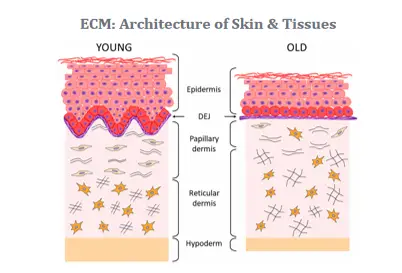
The extracellular matrix is the structural framework associated with skin firmness, elasticity and resistance to visible aging. Its principal components include collagens, elastin, fibrillin and other structural proteins.
PMAnti-AGEs® Silibinin is supported by multidimensional extracellular-matrix-related research relevant to skin firmness, elasticity and wrinkle-appearance care. Where ECM degradation is associated with wrinkle formation, skin laxity, dryness and loss of elasticity, this research direction addresses the structural side of the aging process.
2. Glycation-Related Research
Advanced glycation end products (AGEs) form when reducing sugars react with proteins, and they are associated with collagen fiber stiffening, elastin fragmentation and ECM disorganization — changes that contribute to the visible signs of skin aging.
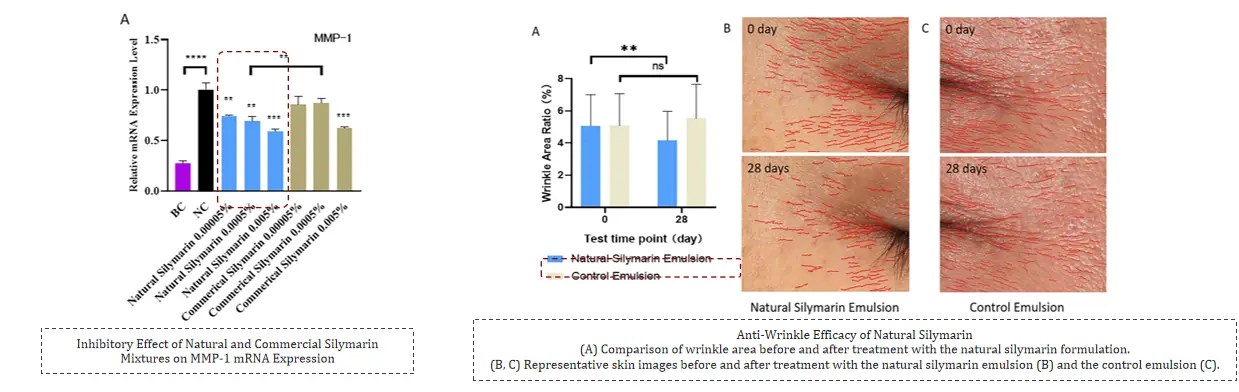
PMAnti-AGEs® Silibinin is supported by AGEs/CML-related research relevant to glycation-related skin appearance care and anti-aging formulation concepts. This is the research direction behind most anti glycation skin care ingredients work, and the reason the material is positioned for glycation-related appearance concerns rather than for antioxidant claims alone.
3. Standardized Silymarin Profile
The ingredient is based on a standardized silymarin botanical profile with a silibinin A+B specification of ≥80%. Standardizing on a two-component marker instead of total silymarin content gives formulators a specification that can be verified batch by batch.
4. Botanical Processing
A controlled botanical processing approach is used to obtain a standardized silymarin-based active from Silybum marianum seeds. Processing conditions are documented, and the supporting documentation set is listed in the Documents tab.
Milk Thistle Benefits for Skin: Firming, Anti-Wrinkle and Anti-Glycation
The milk thistle benefits for skin most often discussed in formulation work fall into four groups: firming, wrinkle appearance, elasticity and glycation-related appearance. The skin benefits of PMAnti-AGEs® Silibinin summarized below are documented research directions rather than finished-product claims. In the silymarin benefits for skin literature, attention concentrates on the flavonolignan complex, and within it, on silibinin.
Research support | What it addresses in a formula | Formulation statement |
Extracellular-matrix-related research, including collagen and structural-protein directions | Skin firmness and elasticity-focused care | Supports cosmetic formulations using skin firming ingredients for improved skin firmness and elasticity-focused care |
Firming and wrinkle-appearance efficacy research | Fine lines and wrinkles | Supports the development of cosmetic products featuring anti-wrinkle ingredients for fine lines and wrinkles |
Research related to elastin, fibrillin and skin structural components | Elasticity and firmness care | Supports formulations designed for skin elasticity and firmness care |
AGEs/CML-related glycation research | Glycation-related skin appearance | Supports cosmetic concepts focused on glycation-related skin appearance concerns |
Silibinin A+B standardization at ≥80% | Batch-to-batch predictability | Provides a standardized silymarin botanical active for anti-aging formulations |
Glycol-based dispersion and formulation support | Processing in polyol systems | Supports glycol-based pre-dispersion and anti-aging formulation development |
For a natural skin firming ingredients position, the documented botanical origin and vegan statement supply the supporting paperwork a synthetic alternative usually cannot. Firming ingredients for skin are all the same functional request, and all are covered by the ECM research direction above.
Because the material is active at low addition levels within the 0.1%–0.5% range, it leaves room in the formula for the rest of the ingredients that fight fine lines and wrinkles that a mature-skin brief usually needs.
Specifications of PMAnti-AGEs® Silibinin
This silymarin powder is a single standardized grade supplied as a silibinin powder with a silibinin A+B marker of ≥80%. Buyers sometimes describe the same material as a silymarin extract powder or as a silybum marianum powder; the specification basis is the silibinin A+B content, and it is the one number worth putting in a request for quotation.
1. Identity and Specifications
Item | Specification |
Trade name | PMAnti-AGEs® Silibinin |
Product identity | Silymarin |
INCI | Silymarin |
CAS number | 22888-70-6 |
Botanical source | Silybum marianum seed |
Active marker | Silibinin A+B |
Marker specification | ≥80% |
Appearance | Light yellow to light brown powder |
Odor | Characteristic |
Product form | Powder |
2. Quality Specifications
Parameter | Limit |
Moisture | ≤10.0% |
Ash | ≤7.0% |
Lead (Pb) | ≤10 ppm |
Arsenic (As) | ≤2 ppm |
Mercury (Hg) | ≤1 ppm |
Cadmium (Cd) | ≤5 ppm |
Total plate count | ≤1,000 CFU/g |
Yeast and mould | ≤100 CFU/g |
Pseudomonas aeruginosa | Not detected |
Staphylococcus aureus | Not detected |
Heat-resistant Escherichia coli | Not detected |
3. Solubility
Solvent | Solubility |
Water | Insoluble |
1,3-Propanediol | 1.0 ≤ X < 1.1 g/100 g (room temperature, ultrasonic dissolution conditions) |
1,3-Butanediol | 1.0 ≤ X < 1.1 g/100 g (room temperature, ultrasonic dissolution conditions) |
1,2-Pentanediol | 0.3 ≤ X < 0.4 g/100 g (slightly soluble) |
1,2-Hexanediol | 0.1 ≤ X < 0.2 g/100 g (slightly soluble) |
GTCC | < 0.01 g/100 g (practically insoluble) |
4. Storage
Item | Information |
Storage Conditions | Store at room temperature in an airtight container |
Shelf Life | 36 months when stored properly |
Recommended Use Level | Reference range: 0.1%–0.5% |
Recommended Dosage and Glycol Pre-Dispersion Guidance
PMAnti-AGEs® Silibinin is insoluble in water. It should be pre-dispersed or dissolved in a suitable glycol-based solvent system before incorporation into the final formulation.
Recommended use level
Item | Value |
Recommended Use Level | 0.1%–0.5% reference range |
Water Solubility | Insoluble |
Dispersion Media | Glycol-based solvent system |
Dispersion guidance
1,3-Propanediol and 1,3-butanediol may be considered as primary dispersion or dissolution media.
Extended stirring or ultrasonic dispersion may be required at room temperature.
Suitable heating may accelerate dissolution.
The product is practically insoluble in GTCC and is not recommended for pure-oil systems.
Workable starting procedure
1. Weigh the powder and combine it with 1,3-propanediol or 1,3-butanediol at the intended ratio.
2. Disperse with extended stirring or ultrasonication at room temperature until the dispersion is uniform.
3. If needed, apply gentle heating to accelerate dissolution.
4. Add the pre-dispersion to the batch under stirring, and avoid reformulating into pure-oil systems.
ECM and Anti-Glycation Research Data
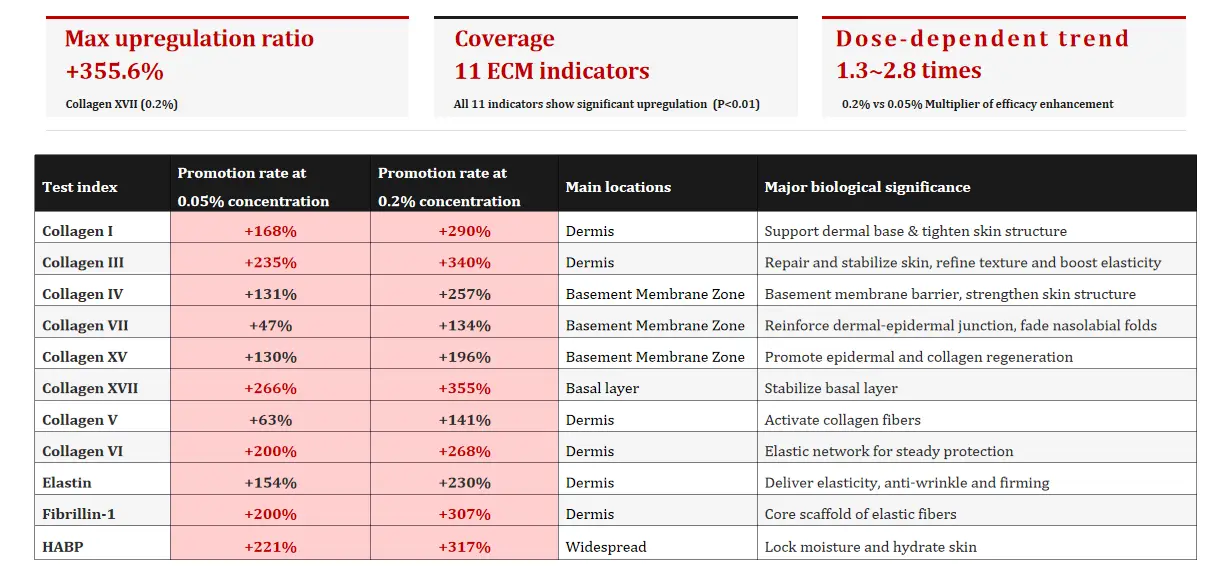
Research support for PMAnti-AGEs® Silibinin is organized in two directions, and the extracellular-matrix direction is backed by a dataset covering 11 test indicators.
Extracellular matrix
Multidimensional ECM-related research relevant to skin firmness, elasticity and wrinkle appearance. The structural-protein directions studied include collagens, elastin, fibrillin and related skin structural components — the framework that determines firmness and elasticity.
In this research set, all 11 ECM indicators show significant upregulation (P < 0.01), with a clear dose-dependent trend: promotion rates at 0.2% run 1.3–2.8 times those at 0.05%. The maximum upregulation ratio is +355.6% (Collagen XVII, 0.2%).
ECM promotion data (promotion rate vs. untreated control).
Glycation
AGEs/CML-related research relevant to glycation-related skin appearance care. This direction addresses the glycation pathway associated with collagen fiber stiffening, elastin fragmentation and ECM disorganization. Glycation test data are provided together with test conditions on request.
For formulators evaluating science backed skincare ingredients, the useful test is not whether a material has published literature, but whether it comes with documentation a formulator can act on: a defined marker, a solubility profile, an application verification protocol and a formulation support path. Those documents are listed in the Documents tab and are provided on request.
Where evidence on ingredient effectiveness is needed, application verification and human and technical efficacy documentation are supplied directly rather than summarized on this page. Detailed test methods and supporting compliance documents are available on request.
Silymarin Skin Care Applications and Anti-Aging Ingredient Concepts
Category | Information |
Application Markets | Skin care; anti-aging skin care; premium skin care; elasticity-focused skin care |
Primary Applications | Serums; essences; emulsions; creams; lotions; masks |
Functional Concepts | Skin-firming care; wrinkle-appearance care; elasticity support; glycation-related skin care |
Formulation Scenarios | Anti-aging products; firming products; mature-skin-care products; premium botanical active formulations |
Recommended Use Level | 0.1%–0.5% reference range |
Product Form | Powder; pre-disperse in a glycol system before incorporation |
PMAnti-AGEs® Silibinin is designed for silymarin skincare formulations, and for anti-aging concepts that need a documented botanical active rather than an unstandardized botanical extract.
Typical formats are anti-aging serums, essences, emulsions, creams, lotions and masks, plus firming, mature-skin and premium botanical active concepts.
Where a brief specifies anti wrinkle face cream ingredients, this material can occupy the botanical slot in the formula; the anti wrinkle natural ingredients positions rest on the same documentation set.
A typical anti-aging product brief combines a structural active, an antioxidant and a humectant. PMAnti-AGEs® Silibinin covers the structural position within a 0.1%–0.5% use range, which leaves room in the formula for the remaining ingredients that anti aging products usually require.
Silymarin Powder Manufacturer, Supply, Samples and Documentation
Plamed Green Science Group supplies PMAnti-AGEs® Silibinin as a standardized silymarin powder and silibinin extract derived from Silybum marianum seed, with samples and the full documentation set available for formulation evaluation.
1. Supply and Samples
Field | Information |
Supplier | PLAMED |
Company | Plamed Green Science Group |
Product form | Powder |
Supply region | Confirmed per destination according to regulatory, import, documentation and shipping requirements |
Shelf life | 36 months when stored properly |
Storage | Room temperature in an airtight container |
Samples | Available for formulation evaluation |
2. Compliance and Supporting Documentation
Compliance area | Available information |
Product quality | Technical Data Sheet; Technical Specification; Certificate of Analysis |
Marker analysis | Silibinin A+B analytical support; specification ≥80% |
Safety documentation | Safety Data Sheet and raw-material safety information |
Source documentation | Source Origin Statement |
Vegan / non-animal support | Vegan and Non-animal Statement |
Manufacturing documentation | Manufacturing Flow Chart |
Application support | Application verification and formulation-related support |
Solubility support | Solubility and formulation-compatibility information |
Available Document of PMAnti-AGEs® Silibinin
Technical Specification
Certificate of Analysis
Safety Data Sheet
Composition Breakdown Statement
Source Origin Statement
Vegan and Non-animal Statement
Manufacturing Flow Chart
Product Quality and Safety Information
Solubility Support Documentation
Application Verification Documentation
Human and Technical Efficacy Documentation
To request a quote or a sample, contact Plamed Green Science Group here.
Q: What are the respective content ratios of Silybin A and Silybin B in PMAnti-AGEs® Silibinin? Is it strictly controlled?
A: Currently, our quality control and Certificate of Analysis (COA) monitor the combined total content of Silybin A + B, without strict restrictions on the individual ratios of A and B (as commercial reference standards in the industry are mostly mixed standards). Once individual standard samples for A and B are procured, we will test multiple batches to monitor stability and consider incorporating finer internal control standards based on client feedback. PMAnti-AGEs® Silibinin is a silibinin extract developed from Silybum marianum, also known as milk thistle.
Q: Will the ratio between Silybin A and B fluctuate across seasons? Does it significantly impact skincare efficacy?
A: Tracking data demonstrates that the ratio between Silybin A and B fluctuates negligibly with seasonal changes and remains stable overall, thereby posing no adverse impact on the final skincare efficacy. This consistency supports the use of milk thistle-derived ingredients in formulations targeting the skin benefits of milk thistle, including anti-aging and skin-conditioning applications.
Q: How is the solubility of the two specifications of PMAnti-AGEs® Silibinin? What solvents can be referenced?
A: Both specifications of PMAnti-AGEs® Silibinin are water-insoluble. Based on our reference tests with a high-purity (98%) benchmark on the market, it can achieve a clear 1% solubility in propanediol and butanediol, which formulators can use as a processing reference during sample preparation. These solubility characteristics are important when developing formulations containing silymarin extract for skin care.
Q: At the in vitro efficacy tests (at 0.05% and 0.2%), how was the raw material dissolved into the test system?
A: For cell-based assays, we first completely dissolved PMAnti-AGEs® Silibinin using Dimethyl Sulfoxide (DMSO) to prepare a highly concentrated stock solution, which was subsequently diluted with the cell culture medium to the final test concentrations of 0.05% and 0.2%. These tests help evaluate the potential of milk thistle-derived actives as anti glycation skin care ingredients.
Q: Is PMAnti-AGEs® Silibinin heat-resistant? Can it withstand conventional emulsification production at around 80°C?
A: According to authoritative literature data, silymarin fundamentally maintains excellent physicochemical stability under temperatures below 80°C. Plamed is currently arranging further laboratory testing to monitor high-temperature discoloration and content stability. Understanding how silymarin works under different processing conditions is important for maintaining ingredient quality in finished skin care formulations.
Q: Why do trace black small particles (impurities) or precipitates sometimes appear when PMAnti-AGEs® Silibinin80 is dissolved in polyols?
A: This is a normal processing occurrence. These trace black particles are primarily caused by slight uneven heating and mild carbonization during the industrial spray-drying process. It is a physical phenomenon that is difficult to completely avoid in natural high-purity plant extraction processes and typically does not affect the core efficacy.
Q: Is there a risk of precipitation if Silymarin is directly incorporated into an emulsion after dissolution or dispersion? How should it be processed?
A: Given that silymarin has extremely low solubility in water, a certain risk of precipitation does exist. In actual formulation production, many insoluble materials exist stably in a “dispersed state.” It is recommended to thoroughly disperse Silymarin in polyols (e.g., pentanediol, recommended ratio 1:10) until uniform, and then introduce it into the pre-emulsified emulsion batch under thorough stirring. Tests show that at typical dosages of 0.2% to 0.5%, the cream formula remains highly uniform with no visible precipitation. This processing approach is relevant to formulators exploring silymarin for skin applications and developing stable silymarin skin care products.
Q: Will adding Silymarin into a cream system cause severe odor or formulation stability issues?
A: Regarding Odor: Lower-purity silymarin does carry a characteristic botanical odor, whereas the higher-purity specification (e.g., 98%) has an extremely faint smell. Since Silymarin is highly effective at low dosages, its addition level is typically low, making the odor easy to mask with fragrances or base ingredients. These characteristics may be relevant when evaluating milk thistle benefits for skin in finished cosmetic formulations.
Regarding Stability: When dispersed in cream or lotion configured with polymers or thickeners, its dispersed phase remains highly stable and will not trigger visible separation or stability issues. Formulation stability is an important consideration when developing products targeting silymarin skin benefits.
Q: Why does Plamed currently recommend the 80% specification for the existing efficacy trials, instead of conducting a full suite of tests on the 98% spec?
A: This is a differentiated commercial strategy. While the 98% ultra-high purity silymarin indeed exhibits better anti-discoloration and physicochemical stability, conducting a full suite of efficacy tests directly on a generic 98% specification would make the public data easily exploitable by competitors. Therefore, we chose the cost-effective 80% specification to back our current data set, while reserving the 98% specification as a premium starting material to develop our proprietary second-generation Silymarin ingredient, which will be fully backed by its own exclusive efficacy portfolio. This strategy supports the development of differentiated silymarin skincare ingredients with a focus on the potential milk thistle skin benefits relevant to cosmetic applications.