
Recombinant Collagen (Type III) | Humanized Collagen for Skin Repair and Firmness
A humanized recombinant type III collagen with 100% sequence homology to the functional domain of human skin collagen III, a collagen raw material designed for barrier repair, collagen renewal and premium anti-aging formulas.
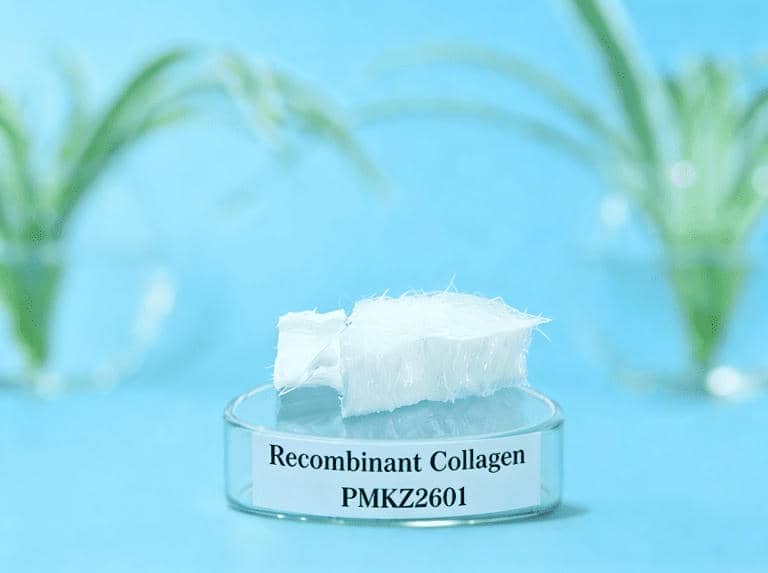
Recombinant Collagen
A humanized recombinant collagen protein with 100% sequence homology to human Type III collagen, designed to support skin barrier repair, collagen renewal, and skin rejuvenation.
Plamed combines 100% sequence coverage validation with ultra-low endotoxin control to help preserve collagen bioactivity while meeting high safety standards. It provides a reliable ingredient solution for skin repair formulations and premium anti-aging skincare products.
At a glance
Item | Detail |
Product | Recombinant Collagen (recombinant human collagen type III) |
Product ID | PMKZ2601 |
INCI name | SOLUBLE COLLAGEN |
Other names | Recombinant type III humanized collagen; humanized collagen III; recombinant collagen iii |
CAS number | 9007-34-5 |
Molecular formula | C1969H3088N664O675S4 |
Molecular weight | 47 kDa |
Purity | ≥90.0% (HPLC) |
Content | ≥90.0% |
Bacterial endotoxin | <0.5 EU/mg |
Appearance | White to off-white powder or spongy solid |
pH value | 4.5–7.0 |
Solubility | ≥100 mg/mL in water |
Reference dosage | 0.01%–0.2% |
Minimal package | 10 g bottle |
Storage | 2–8 °C, sealed, protected from strong light |
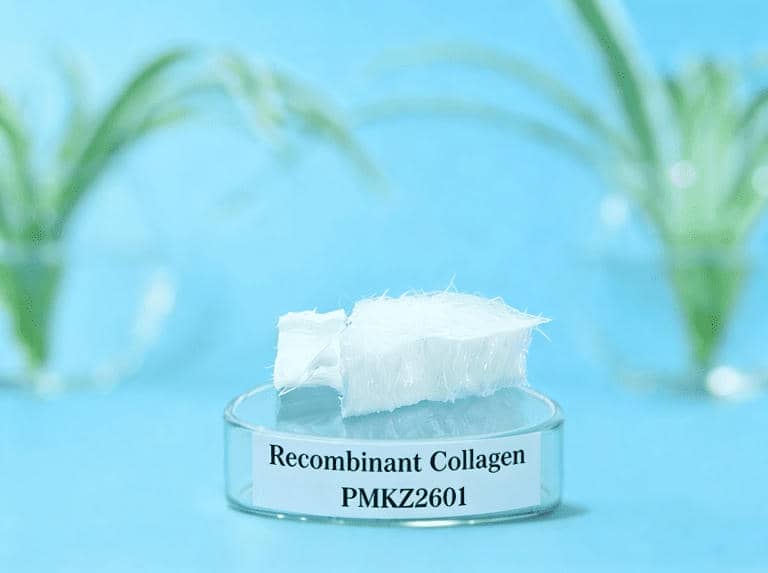
Recombinant Collagen (INCI: SOLUBLE COLLAGEN; CAS 9007-34-5) is a humanized recombinant type III collagen, its amino acid sequence is 100% homologous to the functional domain of natural human skin type III collagen. Plamed produces it by genetic engineering recombination: high-density fermentation, followed by separation and purification, yielding a high-purity, high-activity collagen raw material for cosmetic use.
Where it sits in a formula: recombinant collagen for skin works on the repair-and-rebuild side. It specifically binds integrin receptors on the cell surface and activates cell signaling pathways; it supplements type III collagen lost in the dermis, promotes fibroblast proliferation and migration, and upregulates the gene and protein expression of type I/III collagen and elastin. It also promotes keratinocyte proliferation, migration and adhesion, the cellular basis of barrier repair, and has been shown in vitro to inhibit LPS-induced inflammatory response by downregulating pro-inflammatory factor release.
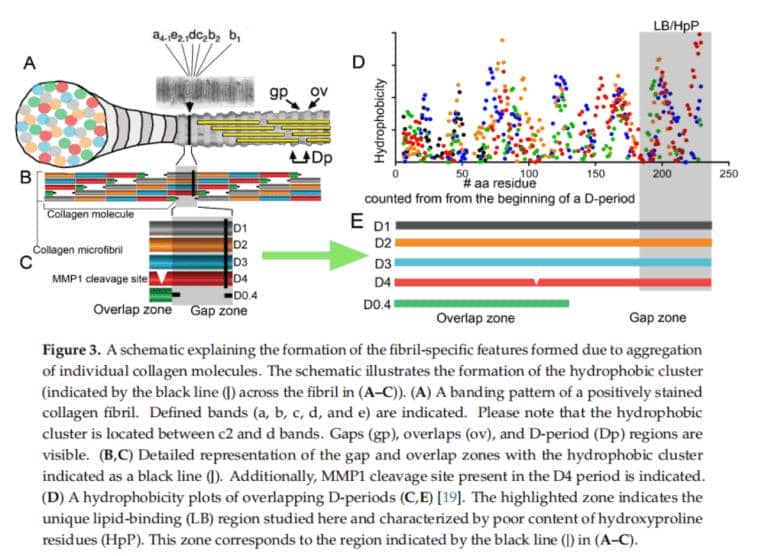
Why the 47 kDa size is deliberate. Traditional animal-derived collagen is hundreds of kDa and cannot penetrate the stratum corneum; small collagen peptides (<1000 Da) dissolve easily but lose the complete triple-helix activity. Through sequence design, this material keeps complete functional domains at 47 kDa, retaining the cell-adhesion and repair sequences and a stable triple helix, while staying water-soluble (≥100 mg/mL) with skin-penetration potential. It resolves the industry trade-off between transdermal delivery and intact biological activity.
Cosmetic-medicine-grade endotoxin control. An extreme control system for bacterial endotoxin reaches <0.5 EU/mg, far below ordinary cosmetic grade, supporting use in barrier-repair, post-procedure and hypersensitive-skin positioned products.
Dual structural confirmation. Each lot is verified by 100% peptide sequence coverage plus terminal amino acid sequence consistency, confirming the material is the designed humanized type III sequence rather than a mixed hydrolysate, the documentation basis for regulatory filing and efficacy claims in major markets.
Recombinant vs animal-derived vs hydrolyzed collagen: what is the difference?
Collagen ingredients for cosmetics fall into three classes. Recombinant humanized collagen III is the gold-standard raw material for premium skincare, with the strongest compliance, safety and activity profile.
| Recombinant Collagen | Animal-Derived Extracted Collagen | Hydrolyzed Collagen Peptides |
Source & preparation | Genetic engineering; aseptic fermentation, precise purification, freeze-drying; sequence 100% homologous to human collagen III | Bovine/porcine skin or fish-scale tissue; enzymatic hydrolysis, extraction, deodorization | Small molecular peptides below 1000 Da |
Process | Raw materials → biosynthesis → microfiltration → ultrafiltration → column chromatography → ultrafiltration → column chromatography → freeze-drying → packaging | Tissue pretreatment → acid/enzymatic extraction → salting-out purification → refining | Strong acid/alkali/enzymatic hydrolysis of animal-derived collagen |
Advantages | 100% humanized sequence, no immunogenicity risk; dual confirmation; ultra-low endotoxin; animal-origin-free process; excellent solubility (≥100 mg/mL); stable batches | Relatively low cost; natural source | Small molecular weight, transdermal |
Limitations | High technical requirement and R&D investment, higher cost | Several hundred kDa, cannot penetrate skin; strict quarantine requirements and filing risk; immunogenicity and animal-virus risk; significant batch variation | No complete activity; cannot support collagen repair/anti-aging claims; hydrolysis fluctuations cause batch activity differences |
Recombinant Collagen Specifications: Purity, Endotoxin and Structural Confirmation
Items | Specification |
Purity | ≥90.0% (HPLC) |
Content | ≥90.0% |
Formula weight | 47 kDa |
Bacterial endotoxin | <0.5 EU/mg |
Peptide sequence coverage | 100% as specified |
Terminal amino acid sequence | Consistent with theoretical sequence |
Appearance | Powder or spongy solid |
Color | White to off-white |
Odor | Characteristic |
pH value | 4.5–7.0 |
Solubility | ≥100 mg/mL |
Loss on drying | ≤10.0% |
Ignited residue | ≤2.0% |
Pb | ≤1 ppm |
As | ≤0.1 ppm |
Hg | ≤0.1 ppm |
Cd | ≤0.1 ppm |
Cr | ≤2 ppm |
Total plate count | ≤100 cfu/g |
Yeast & mould count | ≤10 cfu/g |
Pseudomonas aeruginosa | Not detected |
Staphylococcus aureus | Not detected |
Heat-resistant Escherichia coli | Not detected |
Methanol | ≤100 ppm |
What These Specifications Mean for Your Formulation
Dual confirmation is the identity check, 100% sequence coverage plus terminal sequence consistency proves the powder is the designed humanized type III collagen, not a mixed hydrolysate; this is the document basis behind "recombinant type iii humanized collagen" positioning and efficacy claims.
Endotoxin <0.5 EU/mg, cosmetic-medicine-grade internal control, the specification that matters for barrier-repair, post-procedure and infant-skincare concepts.
Purity and content both ≥90.0%, consistent protein content per gram for dosage calculation at the recommended 0.01%–0.2% use level.
pH 4.5–7.0 and ≥100 mg/mL solubility, fits weakly acidic-to-neutral leave-on systems in the aqueous phase.
How is recombinant collagen made?
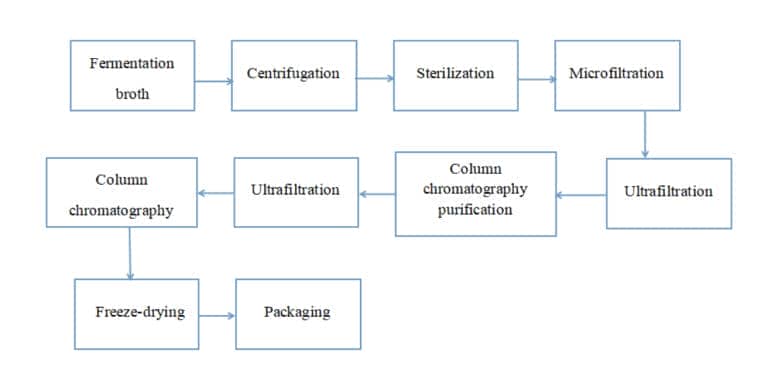
Recombinant collagen manufacturing at Plamed is a fermentation-based recombinant protein production process, not an extraction from animal tissue. The recombinant type III collagen production line runs as follows:
Production flow
Gene-designed strain → high-density fermentation (biosynthesis) → centrifugation and sterilization → microfiltration → ultrafiltration → column chromatography purification → ultrafiltration → column chromatography → freeze-drying → packaging → QC release.
Control points
Animal-origin-free process, biosynthesis replaces animal-tissue extraction, removing the quarantine, virus and immunogenicity risks listed in the Source comparison.
Double chromatography + double ultrafiltration, two polishing stages support the ≥90.0% (HPLC) purity and controllable impurity profile.
Endotoxin control throughout, aseptic fermentation and purification keep bacterial endotoxin below 0.5 EU/mg.
Freeze-drying, the spongy freeze-dried solid protects the triple-helix structure; white to off-white appearance is a release check.
Quality control at release
Each lot is released against the specification in the Manufacturer Specifications tab, purity by HPLC, content, endotoxin, sequence coverage, terminal sequence, heavy metals and microbiological limits, with a Certificate of Analysis per lot.
Recombinant Collagen Benefits for Skin: Barrier Repair, Firming, Soothing and Moisture
1. Skin barrier repair
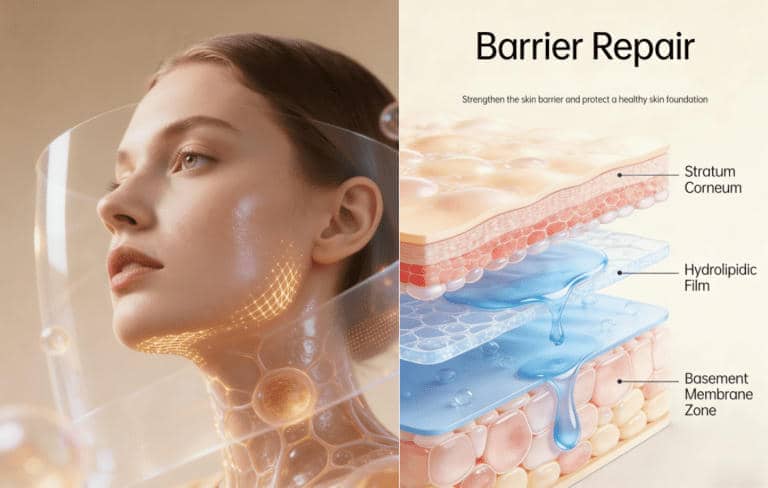
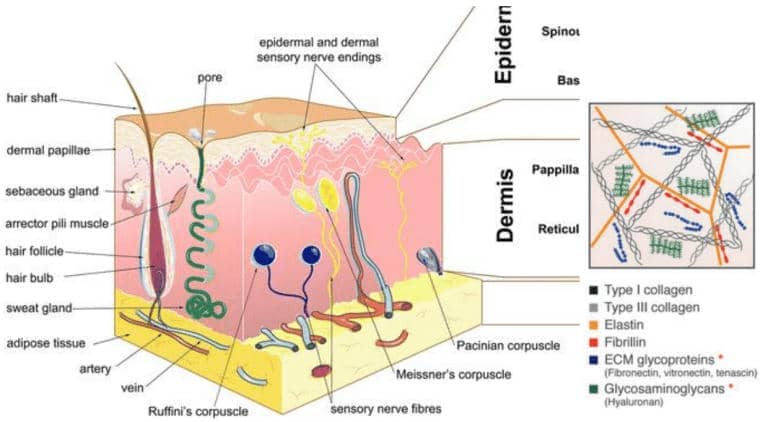
Type III collagen is the core structural protein of young skin, the "wound repair collagen". Recombinant collagen III supports barrier repair from three directions: it directly supplements type III collagen lost with age; in vitro studies show it promotes the proliferation, migration and adhesion of human keratinocytes, the cellular basis of epidermal wound healing; and it strengthens barrier function, reducing transepidermal water loss (TEWL) and improving resistance to external stimuli. Animal studies further confirm accelerated barrier-injury healing with reduced inflammatory factor release, and it supports healthy extracellular-matrix synthesis and dermal-epidermal junction repair.
2. Anti-aging and firming
Skin ageing is marked by the loss and structural disorder of dermal type III collagen. Recombinant collagen for skin works on both sides of the collagen economy: it supplements collagen III directly and promotes fibroblasts to synthesize more endogenous type I/III collagen and elastin, supporting dermal density and thickness, filling static lines and improving the appearance of sagging. It also carries a defence mechanism, with free-radical-scavenging activity that helps protect collagen fibres from UV-induced oxidative stress. A randomized controlled clinical study on facial skin rejuvenation reported significant improvement in wrinkles and texture.
3. Anti-inflammatory and soothing
At the cellular level, collagen III inhibits LPS-induced inflammatory response, downregulating pro-inflammatory factors (TNF-α, IL-1β, IL-6) and upregulating the anti-inflammatory factor IL-10, the background behind its use in sensitive-skin and post-procedure soothing concepts.
4. Deep water-locking and moisturizing
The peptide chains are rich in hydrophilic groups: they form a water-retaining film on the skin surface for immediate relief, while barrier repair reduces water loss at the source, the shift from "surface moisturizing" to "deep repair" described in the Overview's 47 kDa design note.
Anti-aging ingredients to look for
Among anti-aging skincare ingredients, collagen-pathway actives are one of the three roles formulators shortlist (alongside neural-modulating peptides and antioxidant/humectant systems). Recombinant human collagen skincare topical concepts occupy the "structure and repair" slot; when judging a collagen raw material, check sequence identity proof, endotoxin limit, and a per-lot COA, claims such as "best collagen" are search language, not specification.
How to Use Recombinant Collagen: Dosage and Formula Notes
Application area | Typical products | Why the ingredient fits |
Sensitive-skin repair | Serums, creams | Barrier repair + TEWL reduction; ultra-low endotoxin |
Post-aesthetic-treatment repair | Lyophilized powders, gels | "Wound repair collagen" positioning; soothing support |
Premium anti-aging | Serums, creams | Type I/III collagen and elastin expression support |
Infant moisturizing & repair | Lotions, creams | High safety margin; no irritation/sensitization in tests |
Gentle acne repair | Gels, spot treatments | Inflammatory-factor downregulation; acne-mark repair |
Hydrating masks & emulsions | Masks, emulsions | Water-retaining film + long-lasting moisture |
Reference dosage: 0.01%–0.2% (Recombinant Collagen, purity ≥90.0%).
Formulation notes
Recombinant collagen is a protein active, add at the end of the process after cooling.
When compounding with carbomer/acrylic thickeners that need neutralization, add only after the thickener is fully neutralized.
Do not compound with metal complexes, oxidizing agents, acids or alkalis.
Finished products containing collagen are best stored refrigerated for a longer shelf life.
Recombinant Collagen Safety and Regulatory Status
Regulatory status
l China: SOLUBLE COLLAGEN is listed in China's IECIC, the Inventory of Existing Cosmetic Ingredients in China (2021 edition, CFDA/NMPA). Buyers should verify the current edition for the latest status.
l United States: listed by the Personal Care Products Council (PCPC, formerly CTFA) as a cosmetic ingredient.
l EU / Japan / South Korea: EU notification pathway and JCIA/MFDS directory status, see the confirmation note below before making directory claims.
Safety data
Verified by multiple skin-irritation tests, sensitization tests and human clinical tests: no skin irritation, no eye irritation, no sensitization, no phototoxicity, no immunogenicity, and no toxic or side effects at normal use concentrations.
Which ingredients combine with recombinant collagen?
Recombinant collagen is water-soluble and is dosed in the aqueous phase at 0.01%–0.2%. It is commonly paired with hyaluronic acid and glycerin for hydration, with panthenol and ectoin for barrier repair, and with peptide signal actives for firmness.
Related peptide actives from Plamed:
Copper Tripeptide-1 (PMKZ3201)
Palmitoyl Tripeptide-1 (PMKZ3001)
Palmitoyl Tetrapeptide-7 (PMKZ2901)
Palmitoyl Pentapeptide-4 (PMKZ2801)
Acetyl Hexapeptide-8 (PMKZ2701)
Recombinant Collagen Wholesale: Price, MOQ and Supply
Supply, packaging and samples
Item | Detail |
Product | Recombinant Collagen (recombinant human collagen type III) |
Product ID | PMKZ2601 |
INCI name | SOLUBLE COLLAGEN |
Specification | Purity ≥90.0% (HPLC); endotoxin <0.5 EU/mg; 47 kDa |
Form / solubility | Powder or spongy solid; ≥100 mg/mL in water |
Reference dosage | 0.01%–0.2% |
Minimal package | 10 g bottle with sterile aluminium-foil seal |
MOQ | 0.1 kg |
Samples | Complimentary samples for laboratory evaluation and pilot trials |
Lead time | 3–5 working days after payment for standard items |
Storage | Cool and dry place, 2–8 °C, away from strong light; use up soon after unpacking |
What Recombinant Collagen Offers
Dual confirmation, intact activity, dual verification of 100% peptide sequence coverage plus terminal amino acid sequence consistency, ensuring full retention of the native repair and anti-aging activity of human type III collagen.
Cosmetic-medicine-grade endotoxin control, internal control standard <0.5 EU/mg, an extreme safety margin for hypersensitive-skin, infant-skincare and post-procedure repair products.
Animal-origin-free biosynthesis, fermentation-based recombinant protein manufacturing removes animal-tissue quarantine, virus and immunogenicity risks, with controllable batch-to-batch consistency.
47 kDa with complete functional domains, cell-adhesion and repair sequences retained in a stable triple helix, water-soluble at ≥100 mg/mL with skin-penetration potential.
Consistent batch quality, purity, content, sequence coverage, heavy metals and microbiological limits released against one published specification, with a COA per lot.
Available Document of Recombinant Collagen
Certificate of Analysis (COA)
Material Safety Data Sheet (MSDS)
Composition Statement
Certificate copies: ISO 9001:2015
Halal certification
Regulatory support dossier (EU / US MoCRA / MFDS)
To request a quote or a sample, contact Plamed Green Science Group here.
Recombinant Collagen Manufacturer and Wholesale Supplier
Plamed is a collagen manufacturer and recombinant protein supplier based in Shaanxi, China, producing recombinant human collagen type III for cosmetic formulation and premium barrier-repair and anti-aging skincare development. For brands, distributors and ingredient buyers looking to source recombinant collagen wholesale, we offer direct factory enquiries to discuss specifications, order quantities and export requirements.
Recombinant Collagen Pricing and Wholesale Supply
Recombinant collagen price per kg depends on order volume, purity specifications, packaging requirements and the documentation needed for the destination market. Whether you are sourcing a collagen raw material for a formulation or evaluating collagen suppliers for long-term wholesale purchasing, share your target quantity and destination market to receive a tailored quotation.
Why Source Recombinant Collagen from Plamed?
Plamed's Recombinant Collagen features ≥90.0% purity (HPLC), 100% peptide sequence coverage with terminal sequence confirmation, and cosmetic-medicine-grade endotoxin control below 0.5 EU/mg, supplied as a 47 kDa humanized type III collagen. We provide batch-specific COA documentation to support material evaluation and quality review. Contact our team to request the product specification, discuss sample availability and evaluate its suitability for your formulation.
Q1. What is recombinant collagen?
A: Recombinant collagen is a collagen raw material produced by genetic engineering rather than animal-tissue extraction. Plamed's Recombinant Collagen (INCI: SOLUBLE COLLAGEN; CAS 9007-34-5; Product ID PMKZ2601) is a recombinant human collagen type III, 100% homologous to the functional domain of natural human skin collagen III, supplied as a white-to-off-white powder or spongy solid with ≥90.0% purity (HPLC) and bacterial endotoxin <0.5 EU/mg.
Q2. What does recombinant collagen do for skin?
A: Recombinant collagen for skin works on the repair-and-rebuild side: it supplements type III collagen lost with age, promotes fibroblast proliferation and migration, upregulates type I/III collagen and elastin expression, promotes keratinocyte proliferation and adhesion for barrier repair, reduces TEWL, and has been shown in vitro to downregulate LPS-induced pro-inflammatory factors. In finished products it targets damaged barrier, sensitive redness, dry fine lines, sagging, and acne and acne marks.
Q3. What is the difference between recombinant collagen, animal-derived collagen and collagen peptides?
A: Animal-derived collagen (hundreds of kDa) is natural but cannot penetrate the stratum corneum and carries immunogenicity, animal-virus and batch-variation risks. Hydrolyzed collagen peptides (<1000 Da) penetrate easily but lose the complete triple-helix activity, so they cannot support repair and anti-aging claims. Recombinant humanized collagen III keeps complete functional domains at 47 kDa, a stable triple helix plus water solubility (≥100 mg/mL) and penetration potential, resolving the size-versus-activity trade-off.
Q4. Why does endotoxin control matter for a cosmetic collagen raw material?
A: Bacterial endotoxin is a pyrogenic contaminant of fermentation processes. At <0.5 EU/mg, cosmetic-medicine-grade internal control, the material is suited to barrier-repair, post-procedure, infant-skincare and hypersensitive-skin concepts where ordinary cosmetic-grade collagen is not. This is one of the two specifications (with sequence confirmation) that separate a premium recombinant collagen from a commodity collagen powder.
Q5. How is recombinant collagen manufactured?
A: By a fermentation-based recombinant protein production process: a gene-designed strain is fermented at high density, then the target protein is purified through microfiltration, ultrafiltration and double column chromatography, and freeze-dried. This biosynthesis route is animal-origin-free; each lot is released against published specifications with 100% peptide sequence coverage and terminal sequence confirmation, with a COA per lot.
Q6. What is the recommended use level and formulation practice?
A: 0.01%–0.2% for the ≥90.0% purity grade. As a protein active, add it at the end of the process after cooling; add it only after carbomer/acrylic thickeners are fully neutralized; avoid metal complexes, oxidizing agents and strong acids or alkalis; refrigerate finished products for a longer shelf life.
Q7. Is recombinant collagen safe for sensitive skin?
A: Multiple skin-irritation tests, sensitization tests and human clinical tests report no skin irritation, no eye irritation, no sensitization, no phototoxicity and no immunogenicity at normal use concentrations. The <0.5 EU/mg endotoxin limit is precisely the safety parameter that matters for sensitive-skin and post-procedure products.
Q8. How do I judge a collagen supplier's claims?
A: Four checks, in this order: 1) sequence identity proof, 100% peptide sequence coverage plus terminal sequence, not just a purity number; 2) endotoxin limit, published per lot; 3) formulation-relevant data, solubility, pH window, molecular weight and functional-domain integrity; 4) documentation, a COA per lot against the same published specification. A collagen manufacturer that publishes these four is easier to qualify than one that quotes marketing claims.
Q9. Recombinant collagen: where to buy, and what about MOQ, price and samples?
A: Directly from Plamed as a raw material to formulators and brands, wholesale recombinant collagen manufacturing enquiries are not served through retail channels. Send your target quantity, destination market and required documents; price is quoted per project against volume. Standard package is a 10 g bottle; complimentary samples are available for laboratory evaluation and pilot trials, with standard lead time 3–5 working days after payment.
Q10. What documentation is available, and what is the regulatory status in China, the EU and the US?
A: We issue a Technical Data Sheet, Certificate of Analysis, Material Safety Data Sheet and Composition Statement per lot, plus ISO 9001:2015 and Halal certificate copies and regulatory support dossiers. SOLUBLE COLLAGEN is listed in China's IECIC (2021 edition) and by PCPC in the US; for EU, Japan and South Korea directory status, contact our team for the current regulatory support dossier for your destination market.