

As we look toward 2026, the real shift in cosmetic ingredient trends isn't about finding the next hype ingredient, it's about fundamentally rethinking how active ingredients are evaluated. They are defined by how cosmetic ingredients are evaluated. Natural and botanical extracts still attract consumer interest, but brands, formulators, and distributors now weigh them against efficacy evidence, formulation compatibility, ingredient stability, and supplier technical support. A high-value skin care active in 2026 requires a defined botanical identity, a validated mechanism, and proven formulation performance—natural origin alone is no longer enough.
For beauty brands, formulators, and distributors, identifying genuine market trends in raw materials is a much harder task than it first appears.
Every year the beauty industry introduces new concepts, plant-based and naturally derived ingredients, sensitive skin care, anti-aging actives, microbiome-friendly formulation, sustainable sourcing, and biotechnology-driven raw materials. A trending concept, however, does not automatically mean an ingredient suits product development. Plenty of well-publicized raw materials never make it past the second formulation trial.
In 2026, the cosmetic ingredients market is moving past the simple question of whether an ingredient is "natural." More weight is being placed on efficacy, scientific evidence, formulation compatibility, ingredient quality, and technical support.
Consumer research confirms the shift. According to Mintel, 59% of Chinese women rank ingredient dosage (how much of an active a product actually contains) among the key factors influencing their beauty and personal care purchases. Audiences increasingly read ingredient labels like technical buyers, and they reward claims that can survive that scrutiny.
Rather than chasing short-term popularity, product teams are focusing on practical feasibility: Does this active carry the technical evidence, formulation stability, and regulatory backing required for a reliable commercial launch?
That shift is the real story behind the 2026 cosmetic ingredient trends.
What Are the Key Cosmetic Ingredient Trends in 2026?
The most important cosmetic ingredient trends in 2026 are not limited to specific ingredients. They reflect a broader change in how brands and formulators evaluate raw materials.
Trend | What the market is looking for | What it means for product development |
Natural and botanical ingredients | Plant-based, botanical, and naturally derived ingredients | Natural origin still matters, but origin alone is no longer enough |
Efficacy evidence | Mechanism research, efficacy testing, and supporting data | Brands increasingly need evidence behind functional claims |
Formulation compatibility | Solubility, stability, compatibility, and ease of use | An effective ingredient must also work in a real formulation |
Ingredient technology | Extraction, delivery, encapsulation, and biotechnology | Technology can improve the performance and usability of botanical actives |
Technical support | Specifications, application data, documentation, and formulation guidance | Ingredient sourcing is becoming more solution-oriented |
These trends are closely connected. A high-value botanical active increasingly has to answer five questions at once:
Where does it come from?
What makes it effective?
What evidence supports it?
How can it be formulated?
What technical support does the supplier provide?
1. Natural Cosmetic Ingredients Still Matter, But Natural Origin Is Only the Starting Point
Plant-based and natural cosmetic ingredients continue to attract attention from both consumers and formulators.
Terms such as botanical, plant-based, natural, and naturally derived are easy for consumers to understand, and they help brands tell a clear product story. That is why botanical extracts remain one of the most durable categories in the industry. They are not a passing trend.
From a formulation and procurement perspective, though, knowing that an ingredient comes from a plant is only the beginning. The characteristics of a botanical extract can be influenced by:
Plant species and botanical identity
Plant part used
Extraction method
Purification or concentration process
Active or marker compounds
Batch-to-batch quality control
Two extracts derived from the same plant can therefore have different compositions, and different formulation or functional behavior. ISO 16128-1:2016 and ISO 16128-2:2017 were created partly to reduce that ambiguity by establishing shared definitions and calculation principles for natural, natural-origin, and organic cosmetic ingredients.
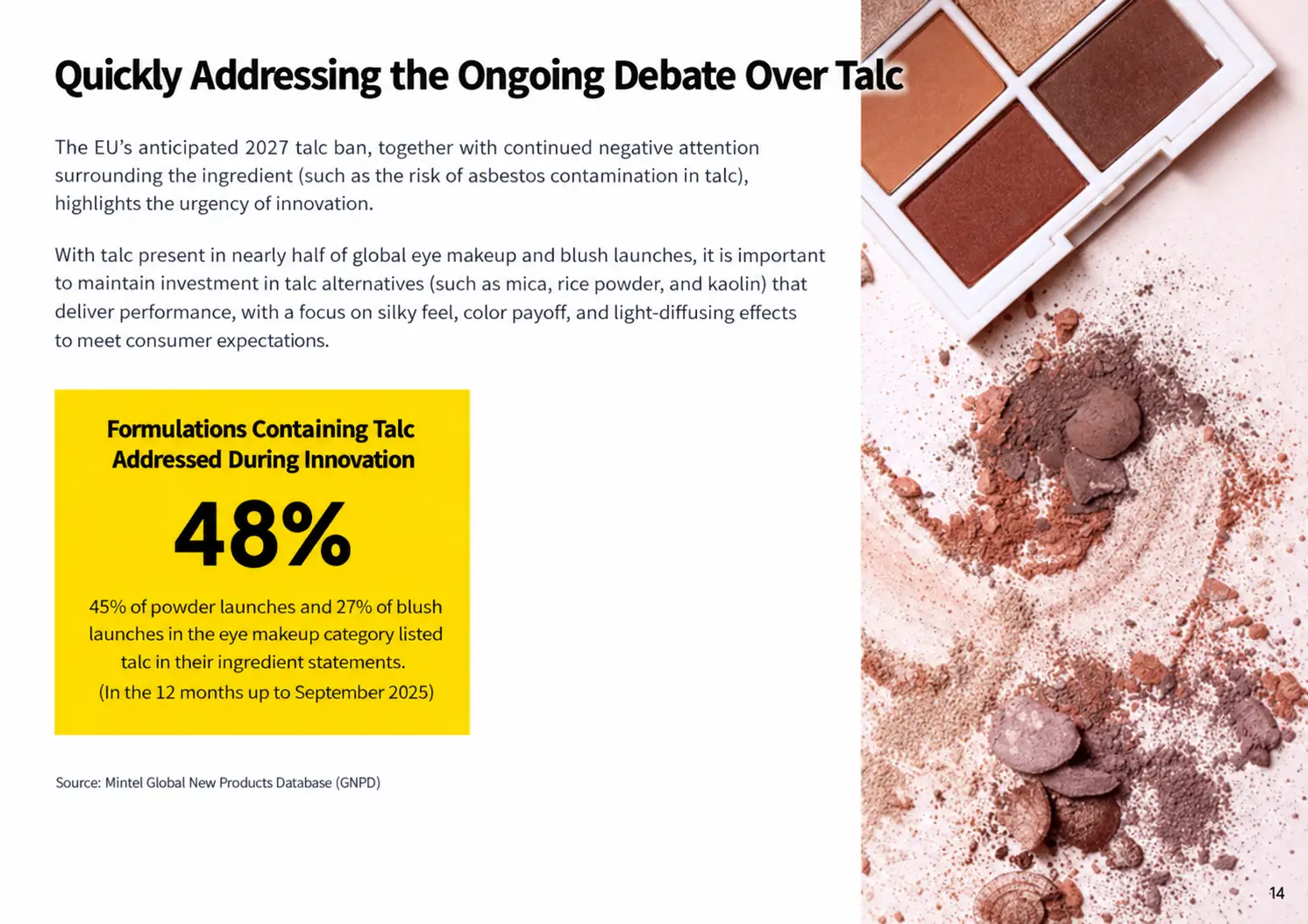
Regulatory pressure is now reinforcing the same direction. Mintel analysis points to the EU restriction on talc expected to take effect in 2027, combined with sustained negative attention on talc, including asbestos-contamination concerns, as a reformulation trigger the industry cannot postpone. Formulations that currently rely on talc will therefore need qualified alternatives, and plant-derived raw materials are moving forward as a leading substitution route. For botanical ingredient suppliers, this is one of the strongest demand signals heading into 2026 and 2027.
This is why botanical evaluation is gradually moving from:
"Is this ingredient natural?"
to:
"Is the botanical source, composition, quality, and functionality clearly defined?"
For brands and distributors, that makes standardization and quality documentation increasingly important. Instead of relying only on the word "natural," buyers should also ask:
What are the relevant active or marker compounds?
Is the botanical identity clearly defined?
How is batch consistency controlled?
What specifications are available?
Is there supporting efficacy or application data?
Natural origin remains a strong value proposition. It is increasingly the starting point rather than the complete value proposition.
2. From "Natural" to Evidence-Based Botanical Actives
If natural origin answers "where does the ingredient come from?", efficacy evidence answers "why should this ingredient be used?"
Historically, some botanical ingredients were marketed mainly through their plant origin, traditional use, or general consumer appeal. Modern cosmetic development requires a more structured evidence chain:
Ingredient identity → Active composition → Mechanism research → Efficacy testing → Quality and stability data → Formulation application
Each block answers a different technical question.
Ingredient and marker data. Establishes what an ingredient contains and supports consistency between batches.
Mechanism research. Explains how an ingredient may interact with a biological pathway relevant to the intended cosmetic application, the basis for any credible claim.
Efficacy testing. Provides evidence tied to a specific cosmetic benefit or development objective.
Stability data. Shows how an ingredient performs under relevant storage or formulation conditions.
Application data. Shows how the ingredient can actually be incorporated into a finished formulation.
More data does not necessarily mean better data. What matters is whether the available evidence answers the questions brands and formulators actually need to solve, and whether it is reproducible.
Consumer behavior shows how far this expectation has spread. According to Mintel, 35% of US consumers associate exclusive, well-characterized actives with premium positioning. What makes an active marketable is not the ingredient name but the mechanism behind it: a clear, testable explanation of how the ingredient supports collagen production, firmness, and elasticity. Brands that can share that mechanism, together with delivery and application data, turn scientific research into a visible premium story rather than a marketing claim.
Botanical ingredients are being held to the same standard. Natural-positioned products increasingly support their positioning with consumer or clinical test results rather than origin alone. Even a "natural" story is now expected to carry numbers.
3. Why Formulation Compatibility Decides Whether an Ingredient Ships
An ingredient can show promising biological activity and still be difficult to use in a finished product. This is one of the most common reasons a promising laboratory result never reaches a shelf.
Formulators need to resolve questions such as:
Is the ingredient soluble or dispersible in the target system, and does it need solubility enhancement?
Is it stable within the intended pH range?
How does it respond to processing temperature?
Can it affect product color or odor?
Does it influence the sensory profile of the formulation?
Is it suitable for the intended dosage form?
Is it compatible with other active ingredients?
Can the desired performance be maintained during storage?
This leads to an important distinction:
Efficacy addresses whether an ingredient can deliver a functional benefit. Formulation compatibility addresses whether that benefit survives contact with a real formula.
For that reason, cosmetic ingredients are increasingly judged not only by biological activity but by formulation readiness. In practice, the market is moving past unrefined botanicals toward formulation-ready actives that integrate seamlessly into finished products.
For a brand, this means a cosmetic ingredients supplier should ideally provide more than a specification sheet. Application guidance, stability information, sample support, and technical communication all reduce development uncertainty, particularly for skin firming active ingredients or anti aging ingredients, where performance expectations are high and reformulation is expensive.
4. Ingredient Technology Is Changing the Value of Botanical Extracts
Botanical extracts are not new. What is changing is the technology used to develop, standardize, and apply them.
Modern botanical ingredient development draws on several technical approaches, each aimed at a specific bottleneck:
Improving recovery of target active compounds
Increasing batch-to-batch consistency of botanical extracts
Improving solubility or dispersion in water-based and oil-based systems
Supporting ingredient stability across pH and temperature ranges
Optimizing the active delivery system for functional compounds
Developing clearer, testable mechanisms of action
Establishing more structured efficacy evaluation
Encapsulation technology, for instance, has successfully rescued sensitive compounds—such as oxygen-vulnerable retinol or labile plant polyphenols—from degradation in water-based systems. Similarly, supramolecular chemistry and co-crystallization are solving longstanding solubility barriers for hydrophobic botanicals like ferulic acid, and glabridin, enabling high-dosage delivery without risking crystallization or turbidity in finished formulas.
The same technology shift keeps opening new ingredient categories. What decides whether any of them gains traction is not the novelty of the name but whether the supplier can document dosage, mechanism, and formulation behavior.
The competitive question is no longer simply:
"Who has the better plant story?"
It is increasingly:
"Who can translate botanical resources into reliable, evidence-supported, formulation-ready cosmetic ingredients?"
This is where proprietary botanical extraction, delivery systems, and cosmetic ingredient synergy mechanisms become part of the product itself rather than a footnote in the technical dossier. Technology is the bridge between a botanical source and a practical cosmetic ingredient, and it is where cosmetic ingredient innovation is increasingly concentrated.
5. How to Decide Whether a Trending Ingredient Is Worth Developing
Not every trending cosmetic ingredient deserves immediate investment. For brands, formulators, and distributors, a more practical approach is to evaluate a new ingredient from three angles.
1. Consumer value: is there a clear product need?
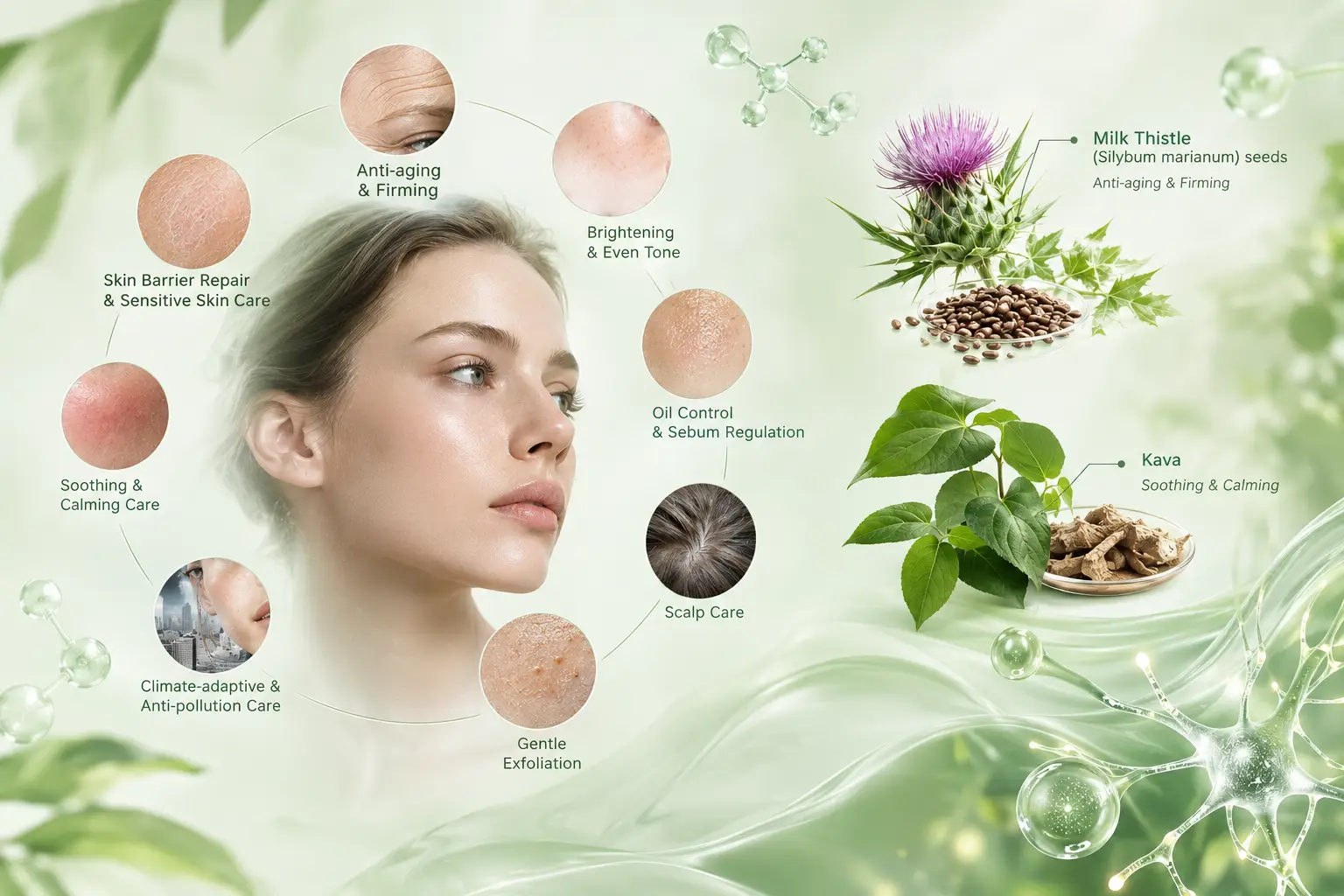
Start with the market need. Can the ingredient support a product concept consumers already understand? Recurring needs include:
Sensitive skin ingredients and barrier-friendly care → skin barrier repair ingredients
Skin soothing ingredients and calming care for reactive skin
Anti-aging and skin firming ingredients
Skin brightening ingredients and tone-evening
Ingredients for oil control and sebum regulation
Scalp care
Gentle exfoliation
Climate-adaptive and anti-pollution care for skin under environmental stress
A technically sophisticated ingredient may have strong laboratory potential, but if its value cannot be translated into a clear consumer benefit, commercialization becomes an uphill effort. Note that skin soothing ingredients and soothing skincare ingredients are not interchangeable with "anti-inflammatory" positioning. The claim language available to you depends on the target market.
Climate adaptability is the newest of these needs to matter commercially. According to Mintel, 21% of beauty and personal care buyers in Spain actively look for products proven to remain effective in extreme environmental conditions. For ingredient suppliers, that demand rests on technical evidence such as photostability, thermal stability, and performance data under stress.
2. R&D value: can formulators actually work with it?
Consumer demand is only the first step. Formulators also need to know:
· Is there a clear functional direction?
· Is there supporting efficacy evidence, ideally efficacy validated raw materials rather than marketing summaries?
· Is there sufficient formulation information?
· Is the ingredient stable under relevant conditions?
· Does the supplier provide practical application guidance?
An ingredient with a strong story but thin technical information (no clinical data, no stability profile, no application data) usually has less development value than an ingredient with a clear evidence package.
3. Commercial value: can it become a product opportunity?
For brands and distributors, the final question is whether the ingredient can support a commercially meaningful concept. An ingredient becomes considerably more attractive when it combines:
Clear botanical origin + defined functional positioning + supporting evidence + formulation information + reliable supplier support
That combination is what moves an ingredient concept into an actual development project. The same logic applies when sourcing from cosmetic raw material suppliers or a natural cosmetic ingredients supplier: the differentiating factor is rarely the price of the powder. It is the depth of the technical file behind it.
6. A Practical Checklist for Evaluating Cosmetic Ingredient Trends
When evaluating a new cosmetic ingredient, brands, formulators, and distributors can use this checklist as a first-stage screening tool.
Evaluation area | Questions to ask | Initial assessment |
Market demand | Is there a clear product or consumer need? | High / Medium / Low |
Botanical origin | Are the source, species, and plant part clearly defined? | Clear / Partial / Unclear |
Efficacy evidence | Is there data directly relevant to the intended cosmetic benefit? | Strong / Moderate / Limited |
Mechanism | Is there a reasonable, testable explanation for the functional activity? | Clear / Partial / Not available |
Formulation compatibility | Are solubility, ingredient stability, and application data available? | Strong / Moderate / Limited |
Quality and regulatory documentation | Can the supplier provide the documentation required for the target market? | Complete / Partial / Limited |
Technical support | Are samples, specifications, technical documents, and formulation support available? | Strong / Moderate / Limited |
The framework exists to prevent one of the most expensive mistakes in ingredient sourcing: choosing an ingredient simply because it is popular. Market attention is a signal worth reading. It is not an evaluation.
7. What Makes a High-Value Cosmetic Ingredient in 2026?
The answer can be summarized simply:
A high-value cosmetic ingredient in 2026 is not defined by natural origin alone. It increasingly needs to combine a clear source, functional value, supporting evidence, formulation usability, and reliable technical information.
That standard now applies across skin care ingredients, botanical actives, and functional peptides alike.
This does not mean natural ingredients are becoming less important. Quite the opposite. Botanical and naturally derived ingredients continue to offer real opportunities. The difference is that their value is now assessed across a complete chain:
Botanical source → Active compounds → Functional mechanism → Efficacy evidence → Formulation application → Product value
That shift affects every role in the supply chain:
For cosmetic brands, "Is this ingredient genuinely suitable for the product I want to develop?"
For formulators, "Can I formulate this ingredient reliably and hit the intended performance?"
For distributors, "Can I give customers the technical evidence and application information they need to evaluate this ingredient?"
This is why the role of the cosmetic ingredients supplier continues to expand beyond supply. A skincare ingredient distributor now competes on documentation, application data, and formulation support as much as on availability and price. A technology-driven botanical ingredient supplier bridges plant-based raw materials, scientific evidence, and practical formulation development.
FAQ: 2026 Cosmetic Ingredient Trends
1. Are natural botanical ingredients still a major trend in 2026?
Yes. Natural and botanical ingredients remain central to cosmetic product development, and botanical extracts show no sign of losing consumer relevance.
However, natural origin alone is increasingly insufficient to demonstrate ingredient value. Brands and formulators are also assessing ingredient identity, standardization, efficacy evidence, ingredient stability, formulation compatibility, and technical documentation.
Regulation is accelerating the shift. With the EU restriction on talc expected to take effect in 2027, formulators are already evaluating plant-derived alternatives, a reminder that demand now follows documented, formulation-ready natural actives rather than the word "natural" itself.
2. Are all plant-based ingredients considered active ingredients?
No.
"Plant-based" or "botanical" describes the source of an ingredient. It does not, by itself, establish a cosmetic function.
Whether an ingredient qualifies as a functional active, one of the active cosmetic ingredients in a formulation, depends on its composition, intended use, supporting evidence, and the requirements of the relevant market.
3. Does an ingredient need a large amount of scientific data to be valuable?
Not necessarily. Relevance and quality of data are often more important than quantity, which is usually what a brand means when it lists science backed skincare ingredients as a purchasing requirement.
Efficacy data supports functional positioning, mechanism research explains biological activity, ingredient stability data supports formulation decisions, and application data helps formulators use the ingredient effectively. A focused, reproducible evidence set usually outperforms a large volume of indirect material.
4. Should brands immediately develop products around a trending ingredient?
Not necessarily.
Market popularity indicates attention; it does not demonstrate product suitability. A new ingredient should be evaluated on market demand, efficacy evidence, formulation compatibility, stability, regulatory documentation, and supplier technical support before it enters a development pipeline.
5. What information should brands request from a cosmetic ingredients supplier?
Depending on the ingredient and target market, brands and formulators may request:
· Product specifications
· Ingredient composition or marker information
· Efficacy data
· Stability information
· Formulation or application guidance
· Quality and regulatory documentation
· Samples
· Technical support
The exact documentation required depends on the ingredient, target application, product format, and destination market.
Conclusion: Trends Identify Opportunities. Evidence and Formulation Validate Them.
The cosmetic ingredient industry will keep generating new trends and new ingredient concepts. For brands, formulators, and distributors, the goal should not be to chase every one of them.
The horizon for 2026-2027 is already visible. Regulatory milestones such as the EU restriction on talc expected in 2027, together with climate-driven formulation demands, will keep shifting procurement attention toward well-documented botanical and plant-derived alternatives. Ingredients that arrive with evidence, stability data, and formulation support will be ready for that shift. The rest will be reformulated around.
The more valuable approach is to identify ingredients that combine:
Market relevance + botanical or natural value + functional evidence + formulation usability + technical support
This is where botanical ingredient development is moving beyond the traditional "plant story." Competitive advantage increasingly lies in the ability to connect botanical resources, scientific research, ingredient technology, efficacy validation, and practical formulation support.
So when evaluating new botanical extracts or high-performance actives, brands and distributors shouldn't start by asking, “Is this trending?” Ask instead:
Does this ingredient have a clear value proposition, credible supporting evidence, and the technical foundation needed for real product development?
Ultimately, turning a trending plant concept into a successful market launch requires robust technical backing. At Plamed, we support brands and formulators by providing fully characterized botanical actives backed by complete analytical dossiers, clinical testing, and practical formulation guidance.
For ingredient sourcing or product development, technical specifications, samples, efficacy information, and application support can provide a more informed basis for evaluating the right ingredient for your formulation.
Trends identify opportunities. Evidence and formulation validate them.