

Introduction
More consumers than ever describe their skin as sensitive, yet the ingredients marketed as "soothing" are not created equal. Some arrive with a mechanism and a documented evidence package; others arrive with a descriptive word on a product flyer. This article explains how a brand, formulator, or technical buyer can tell the difference before a soothing ingredient reaches a formula.
The short answer: A soothing cosmetic ingredient stands out not because it carries a "soothing" claim, but because it simultaneously delivers a defined action direction, a traceable evidence type, documented mildness, confirmed formulation compatibility, and a complete target-market documentation package. The claim is the starting point, not the proof.
Sensitive Skin Demand: Why This Question Matters Now
Sensitive skin is a widespread concern across global skincare markets, rather than a niche category. The Guidelines for the Diagnosis and Treatment of Sensitive Skin in China (2024 Edition) report a sensitive-skin prevalence of 36.1% among Chinese women, with substantial regional variation. A 2025 review in Experimental Dermatology also cites Chinese studies reporting self-declared sensitive skin in approximately 40% of a national online survey and 49.7% of respondents in more recent regional studies. Together, these findings highlight the growing relevance of skin sensitivity and the need for skincare formulations designed to support skin comfort, soothing, and barrier function.
The practical consequence for ingredient selection is straightforward: when a growing share of the market self-identifies as sensitive, "soothing" becomes a purchase driver. That makes the gaps between soothing ingredients, mechanism, evidence, and formulation readiness, commercially important rather than academic.
Step 1: Define the Problem Before Choosing the Ingredient
The first mistake in ingredient selection is treating "sensitive skin" as a single problem. In practice, consumers describe a cluster of different experiences:
Consumer experience | What is often happening | What the ingredient must address |
Redness / flushing | Vascular response and visible capillary dilation | Appearance of redness, comfort |
Stinging, burning, tightness | Sensory nerve activation (neural signal transmission) | Sensory irritation response |
Itching | Itch signaling, often distinct from stinging | Signaling interception |
Barrier disruption | Elevated water loss, reduced tolerance | Barrier support and repair |
Reaction to other actives | Irritation from acids, retinoids, preservatives | Anti-irritation support within the formula |
Because these are different problems, a single soothing ingredient rarely covers all of them equally. Identifying which experience the product actually targets narrows the ingredient selection and prevents an "everything for sensitive skin" claim that no single data set can support.
Step 2: How to Evaluate a Soothing Ingredient
Once the problem is defined, evaluate candidate ingredients against five dimensions. A "soothing" label answers none of them on its own.
Dimension | What to check | Why it matters |
Action direction | Does the ingredient act on a defined target or pathway (e.g. receptor-level or signaling-level), or is the effect only described in general terms? | Defines what claim the data can actually support |
Evidence type | In vitro, cell-based, 3D epidermis, ex vivo, or human clinical? | Determines how far the result can be extrapolated |
Mildness / irritation data | In vitro irritation tests, human patch tests, use-level data | Sensitive-skin positioning requires direct mildness evidence |
Formulation fit | Solubility, pH operating window, compatibility with other actives and preservative systems | Decides whether the ingredient can enter the target system |
Documentation | INCI, specification, allergen statement, safety, stability, target-market regulatory files | Determines whether the finished product can be placed on the target market |
A useful rule: the claim must never exceed the evidence type. A cell-based result supports a mechanism statement; a human patch test supports a mildness statement; neither substitutes for the other.
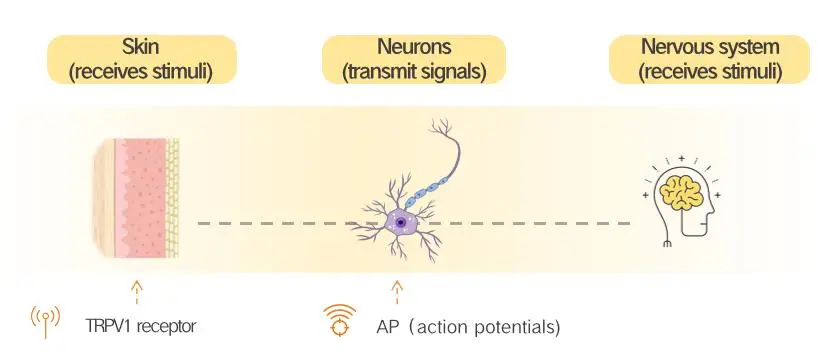
Schematic Diagram of Stimulus Signal Transmission
Step 3: From "Has Efficacy" to "Can Be Used"
An sensitive skin ingredient that performs well in a study or efficacy report can still fail in production. In cosmetic ingredient development, cosmetic ingredient innovation is not defined by a compelling concept, a patent, or an impressive data point alone. It must solve a real formulation problem and deliver reliable performance under practical manufacturing conditions.
Before selecting anti-irritation cosmetic ingredients, formulators should evaluate not only its efficacy, but also its formulation compatibility, processing requirements, stability, and suitability for scale-up. Five factors deserve particular attention:
1. Solubility. Is it water-soluble, oil-soluble, or does it require a solubilizer or dispersion system? Solubility determines how an active can be incorporated into aqueous systems, serums, essences, masks, and other product formats. Confirm whether additional processing is needed and whether the ingredient remains uniformly distributed in the finished formula.
2. pH operating window. Many soothing actives, especially botanical extracts, can change in stability, color, or performance outside a specific pH range. Confirm the target formula's pH against the ingredient's documented operating window, and assess whether the active remains compatible with the other ingredients throughout the intended shelf life.
3. Add-back point. Can the skin barrier repair ingredients tolerate the process temperature and order of addition? Some actives can withstand conventional heating, while others need to be added after neutralization or during cool-down. Understanding the appropriate addition point helps reduce processing risks and supports more consistent manufacturing results.
4. Compatibility with co-actives. When irritation is associated with other actives, such as acids, retinoids, or brightening ingredients, or with the preservative system, the soothing ingredient should be evaluated in the complete formulation rather than only in an aqueous dilution. Compatibility testing helps identify potential interactions that may affect stability, appearance, or overall product performance.
5. Viscosity and clarity impact. In thickening systems such as carbomer or natural polymer gels, confirm that the ingredient does not reduce viscosity, cause precipitation, or create haziness, particularly in clear or light-colored formulas. These effects can influence both manufacturing consistency and the finished product's sensory and visual quality.
The key question is not simply whether an ingredient demonstrates efficacy, but whether its performance can be translated into a stable, reproducible, and commercially viable formulation. This is what connects ingredient innovation with practical value for formulators, product developers, and cosmetic brands.
Worked Example: Evaluating Formulation Fit with PMSoothe® Kava97
Understanding an ingredient's efficacy is only part of the formulation process. Formulators also need practical information on solubility, processing conditions, thickener compatibility, and pH-related stability to determine whether an active is suitable for a specific product system.
PMSoothe® Kava97 provides an example of how product-specific technical documentation can support these decisions. The following data points, drawn from Plamed's internal technical documentation, illustrate the types of formulation questions that can be addressed during ingredient evaluation.
Formulation Consideration | PMSoothe® Kava97: Documented Findings | Relevance to Formulation Development |
Water solubility | Documented as a water-soluble powder | Helps formulators assess its suitability for aqueous and water-based formulations |
Process tolerance | No degradation reported after exposure to 80–90°C for 30 minutes in an internal stability test | Provides a reference for evaluating compatibility with heating processes under the tested conditions |
Thickener compatibility | No viscosity change reported in a neutralized carbomer system when added after neutralization | Helps guide the order of addition when developing carbomer-based formulations |
pH-related stability | Increased yellowing risk reported at pH ≥ 7 when combined with certain brightening actives; a pH near 6 is recommended in the documented formulation guidance | Highlights the importance of evaluating pH and co-active compatibility together |
These findings are specific to PMSoothe® Kava97 and the conditions documented in Plamed's internal tests. They should not be interpreted as universal performance guarantees or assumed to apply to every formulation.
For formulators, the practical takeaway is clear: an ingredient's formulation suitability should be assessed through documented properties, defined processing conditions, and compatibility testing in the intended formula. Reviewing this information early can help identify potential formulation constraints before pilot production and scale-up.
Step 4: The Documents a Brand Should Request
A efficacy validated raw material's documentation package is the difference between a promising sample and an ingredient. Before confirming supply, request and check:
Identity and quality: Technical Data Sheet (TDS), technical specification, Certificate of Analysis (COA), analytical method (e.g. HPLC method for the marker actives), compositional breakdown statement
Safety: Safety Data Sheet (SDS), safety and toxicological information, allergen statement
Stability: Stability report, including temperature and pH conditions tested
Formulation support: Application formulations, recommended use levels, formulation guidance
Regulatory and market: ISO 16128-1 natural-origin information (if a natural claim is intended), preservative-free statement (if applicable), vegan and non-animal statement
Supply: Origin of raw material, manufacturing site, minimum order quantity, packaging
The availability of technical documentation may vary by ingredient and application requirements. As a cosmetic ingredients supplier, Plamed provide product-specific technical support for cosmetic ingredient distributor to help formulators and brands assess ingredient quality, stability, safety, and formulation suitability. Learn more about our ingredient portfolio and the documentation available to support product evaluation.
Frequently Asked Questions
Is a botanical extract automatically gentle because it is natural?
No. Botanical origin describes the source of the material, not its irritation profile. A botanical extract still requires its own irritation and mildness data — for example an in vitro irritation test or a human patch test at the intended use level — before it can be positioned for sensitive skin.
Does anti-inflammatory data mean an ingredient is suitable for sensitive skin?
Not by itself. Anti-inflammatory data addresses an inflammation or redness pathway; sensitive skin also involves sensory irritation (stinging, burning, tightness) and barrier function. An ingredient with only anti-inflammatory data may not address the sensory irritation that many sensitive-skin consumers report. Check which dimension the data actually covers.
Can supplier documentation replace a formulation test?
No. Supplier documents describe the raw material. The finished formula has its own pH, co-actives, preservative system, and process conditions, and interactions occur in the base, not in the raw material. Supplier documentation reduces risk; a compatibility and stability test in the target formula confirms it.
Is a higher extract ratio or a higher marker content always better?
Not necessarily. What matters is whether the marker content is standardized and verified (for example by HPLC), whether the marker is the component responsible for the claimed effect, and whether the ingredient remains stable and soluble at the recommended use level. A high number without a defined marker and method is difficult to evaluate.
Does one soothing ingredient cover every sensitive-skin need?
Usually not. Redness, sensory irritation, itching, and barrier disruption are different problems. A single active may cover one or two; a complete sensitive-skin formula often combines a soothing active with barrier-support ingredients. Match the ingredient to the specific problem the product will claim.
What can be said on the pack?
Product claims must be tied to the evidence type and to the target market's rules. Mechanism and in vitro data generally support technical communication rather than consumer efficacy claims; cosmetic claims must avoid therapeutic language and stay within the regulatory framework of the destination market. Confirm claim wording with the regulatory team before finalizing copy.
Conclusion
Sensitive skin demand is growing, and "soothing" is becoming one of the most crowded claims in skin care. The ingredients that stand out are not the ones with the loudest label — they are the ones that can show a defined action direction, evidence matched to the claim, documented mildness, confirmed formulation compatibility, and a complete target-market documentation package.
In short: the trend creates the opportunity; the data and the formula decide whether it becomes a product.
To evaluate a soothing ingredient for your target dosage form and market, send Plamed your target application, market, and documentation requirements. We can provide sample quantities, cosmetic ingredients with clinical data and application guidance for review.