
Why "fewer wrinkles" is no longer a complete anti-aging brief
For a long time, an anti-aging brief could be written in one line: reduce the appearance of wrinkles. That line is no longer enough. A single anti-aging launch is now expected to speak to firmness, elasticity, skin "density", radiance, evenness, comfort and resilience at the same time, and each of those words points at a different biological process, a different consumer test method and a different evidence requirement.
Skin aging is also driven by two distinct but overlapping processes: intrinsic aging and extrinsic aging, particularly UV-induced photoaging. A 2026 study published in Clinical Epigenetics developed two independent DNA methylation clocks to distinguish these processes. The exogenous skin clock was associated with sun-seeking behavior, facial photodamage and changes in skin gene expression, highlighting the importance of evaluating different aging pathways separately. For anti-wrinkle ingredients development, this reinforces a key principle: the mechanism being targeted should determine the evidence used to demonstrate efficacy.
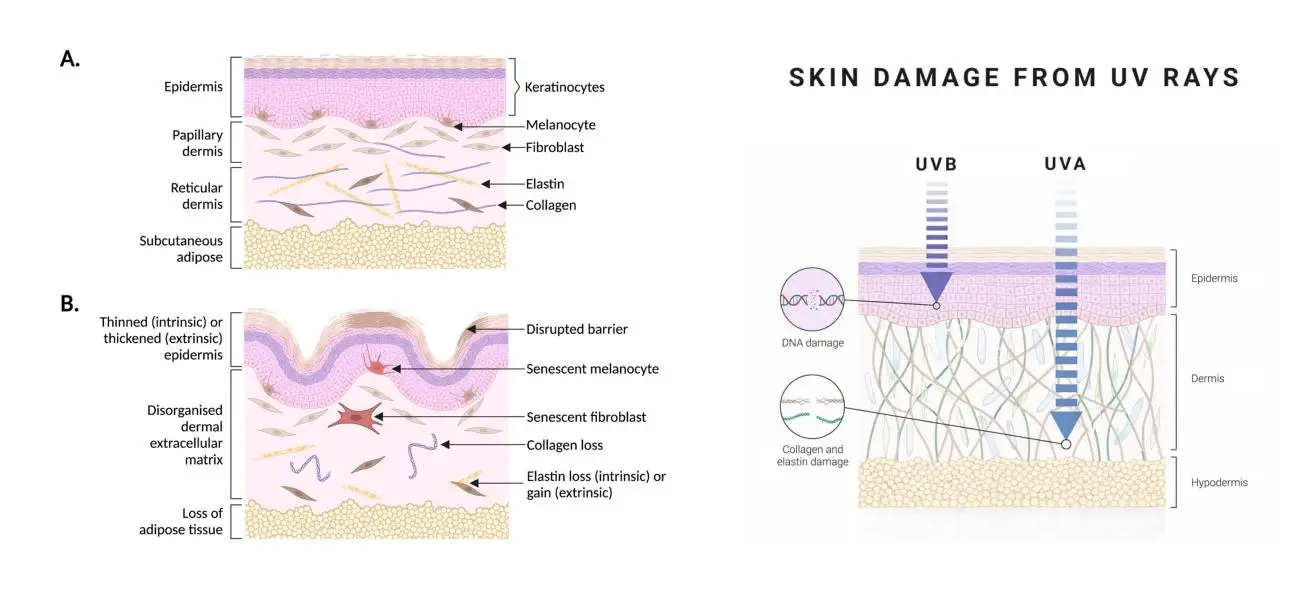
Endogenous Skin Clock(Left) VS. Exogenous Skin Clock(Right)
In short — the sentence to keep in mind when a personal care raw material suppliers presents "anti-aging data":
Anti-aging is not one target. Modern anti-aging ingredients are assessed across at least five separate axes, dynamic (expression) wrinkles, firmness and the extracellular matrix (ECM), glycation, oxidative stress, and barrier support, and each axis needs its own model, its own endpoint and its own documentation. Strong data on one axis does not automatically carry data on another.
Four different questions hide inside every "anti-aging ingredient" discussion
Anti-aging conversations blur together four kinds of questions. Separating them early saves both development time and claim risk:
1. Regulatory — in the target market, is the intended benefit a cosmetic function or a drug claim, and which wording is permitted?
2. Supply — can the material be sourced at a consistent specification, with stable marker content and complete documentation?
3. Formulation — will it survive pH, temperature, emulsifier systems, packaging and shelf life?
4. Evidence — what exactly was measured, in which model, and how far can that result be extrapolated?
In practice, most "the ingredient doesn't work" conversations are really formulation conversations. Most "the claim was rejected" conversations are regulatory conversations. And most "the data looked impressive but we couldn't use it" conversations are evidence conversations.
Direction 1: Dynamic wrinkles — an expression-line question, not a collagen question
Dynamic wrinkles develop through repeated facial movements, making the neuromuscular pathway a relevant focus for expression-line care. Unlike firmness or elasticity, which are closely linked to the dermal structure and extracellular matrix (ECM), dynamic wrinkles require evidence that addresses the processes associated with muscle contraction. Collagen data alone cannot establish an anti-aging skincare ingredient’s effect on expression lines.
This distinction also shapes how ingredients should be evaluated. Beyond measuring visible wrinkles, researchers can investigate mechanisms associated with neuromuscular signalling, including intracellular calcium (Ca²⁺), VAMP2-mediated vesicle fusion and muscle contraction-related pathways. Plamed’s research on PMSoothe® Kava97 explores these mechanisms, alongside clinical assessments of crow’s feet. The reported findings include changes in several mechanistic markers and reductions in crow’s feet measurements after 7 and 14 days of use.
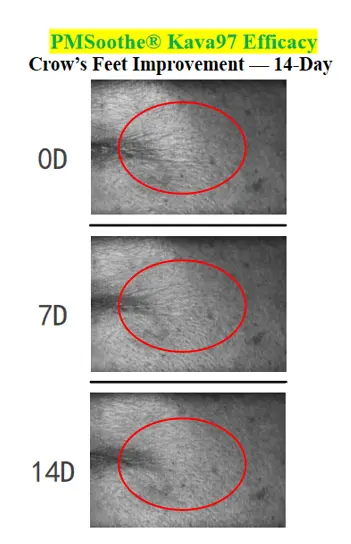
Reductions in crow’s feet measurements after 7 and 14 days of use
These findings illustrate the value of combining mechanistic investigation with clinical assessment: the former helps explore how an ingredient may work, while the latter examines whether measurable changes in expression lines occur under the tested conditions. Neither should be used as a substitute for the other.
What this direction requires:
In-vitro models assessing neuronal signalling and contraction-related pathways.
Ex-vivo contraction or tension models, where appropriate.
Clinical assessment of expression lines under standardised conditions, ideally supported by instrumental image analysis rather than visual scoring alone.
For brands and formulators, the key question to evaluate anti aging skin ingredients is not simply whether an ingredient has anti-aging activity, but whether the evidence directly supports the specific expression-line claim being made.
Direction 2: Firmness and the ECM — collagen, elastin and dermal density
Firmness claims usually point at the extracellular matrix: collagen synthesis, elastin, and overall dermal density. Because consumers read firmness as a visible result, brands need a chain of evidence that runs from mechanism to a measurable endpoint.
What this direction requires:
Fibroblast-level endpoints (for example pro-collagen I, elastin or ECM-related gene/protein expression)
A dermal-level or clinical endpoint (for example skin firmness or elasticity measurement, or dermal density imaging)
A clear statement of which endpoints were measured on the ingredient itself and which come from the finished formula
Biotechnology-derived materials such as Recombinant Collagen and well-defined peptides are increasingly common here, partly because their identity and specification are easier to document than those of an unstandardised botanical.
Direction 3: Glycation and AGEs — a distinct axis with its own assays
Glycation is the non-enzymatic reaction between reducing sugars and proteins, leading to the formation of advanced glycation end-products (AGEs). These compounds can affect protein structure and contribute to changes in the skin’s extracellular matrix (ECM), making glycation an important consideration in skin-aging research.
Although glycation is often discussed alongside wrinkles and loss of firmness, it represents a distinct biological pathway. Evaluating anti-glycation activity therefore requires specific assays, alongside separate assessments of changes in skin structure and visible signs of aging.
What this direction requires:
In-vitro AGE-formation inhibition assays using defined protein–sugar systems.
Protein-glycation models measuring specific markers of glycation.
Where available, skin-level assessments of AGE-related markers, such as carboxymethyl lysine (CML), or validated autofluorescence measurements.
Plamed connection: PMAnti-AGEs® Silibinin focuses on the glycation-related pathway in skin aging. Plamed’s research on silymarin ingredients has investigated AGE formation and ECM-related markers in human skin explant models under glycation and UV stress. In one such model, the proven anti-aging ingredient PMAnti-AGEs® Silibinin, tested at 0.05% and 0.2%, showed reported reductions in AGEs (CML) of 73.89% and 82.60%, respectively. The broader research direction connects glycation control with the maintenance of skin structure, providing a scientific basis for exploring complementary approaches to skin firmness and wrinkle management.
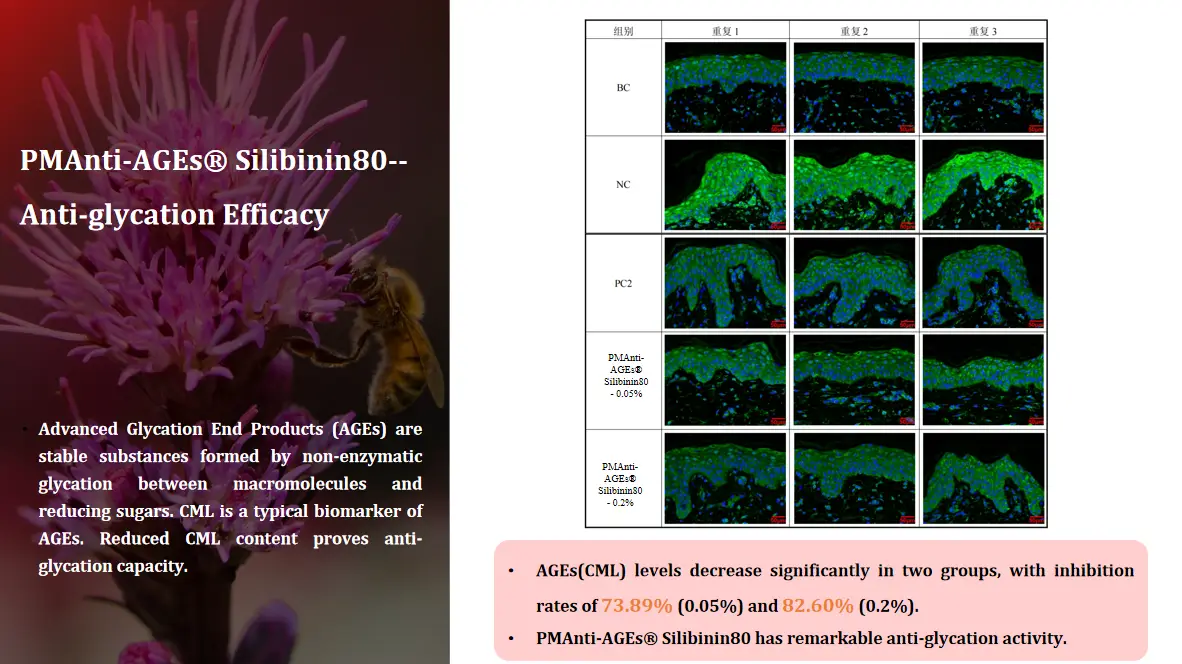
PMAnti-AGEs® Silibinin80 has remarkable anti-glycation activity
Anti-glycation and wrinkle reduction remain distinct endpoints, but they can contribute to a more comprehensive understanding of skin aging when evaluated through appropriate, complementary evidence.
Direction 4: Oxidative stress and photo-aging — measured in the right context
Antioxidant claims are the easiest to over-extend, because radical-scavenging activity in a tube says little about what happens in a finished emulsion on skin. The relevant question is whether the antioxidant survives the formula and reaches the site of action.
What this direction requires:
Antioxidant capacity or radical-scavenging assays (necessary but not sufficient)
UV- or ROS-challenged cell models
Formulation-context data, including whether the active remains available after emulsification, pH adjustment and storage
Direction 5: Barrier support and sensitivity — where anti-aging meets tolerance
An anti-aging routine that irritates the skin is a losing proposition, particularly for consumers who already describe their skin as reactive. Barrier and tolerance data are therefore increasingly part of the anti-aging package rather than a separate "sensitive skin" topic.
What this direction requires:
l Barrier-function endpoints (for example transepidermal water loss and barrier recovery)
l Tolerance and irritation testing appropriate to the claims being made
l Panel data on a sensitive-skin population when a sensitivity-related benefit is implied
This is also where the vocabulary of soothing and skin barrier repair ingredients overlaps with anti-aging: water-soluble soothing ingredients and anti-irritation cosmetic ingredients can raise the tolerance ceiling of a multi-active anti-aging formula, even though they are not themselves anti-wrinkle actives.
How to build an anti-aging ingredient portfolio without over-claiming
A practical sequence that works for brands, distributors and formulators alike:
1. Start from product positioning, not from an ingredient. Write the single most important consumer-facing benefit first, then decide which of the five directions it belongs to. That becomes the primary claim.
2. Choose one primary direction and one to two supporting directions. Multi-direction products are legitimate, but each direction needs its own evidence and its own claim wording.
3. Verify each ingredient separately. Two ingredients from the same supplier, or even from the same plant, are two separate evidence sets. Product-level data must never be transferred between SKUs.
4. Check formulation reality before adding a fifth active. Ingredient stability, solubility and delivery all decide whether the evidence you collected will still be valid inside the finished product. When an active is poorly water-soluble, a solubility enhancement or an active delivery system may be required — and that changes what the formulation can claim.
5. Assemble the documentation in one place. Specification, safety/regulatory documents, efficacy reports, stability data and application guidance should travel together, so the evidence can be matched to the claim at review time.
For brands comparing suppliers, the practical checklist is the same in both directions: does the supplier give you efficacy validated raw materials with the underlying reports, or only a summary? Can they show cosmetic ingredients with clinical data where a clinical endpoint is being claimed, and are they explicit about the limits of their in-vitro results?
The tool: anti-aging need → ingredient direction → evidence type
Consumer-facing need | Underlying direction | Typical ingredient direction | Evidence that actually supports it | What it does NOT prove |
Fewer expression lines | Dynamic wrinkles / contraction signalling | Neuro-mediator–modulating botanical actives, peptides | Neuron–muscle co-culture or reporter assays; ex-vivo contraction models; standardised clinical expression-line scoring | Anything about dermal collagen, firmness or glycation |
Firmer, denser feel | ECM support / collagen and elastin | Recombinant collagen, peptides, botanical ECM-supporting actives | Fibroblast endpoints (pro-collagen I, elastin, ECM expression); clinical firmness/elasticity or dermal density imaging | Elastase- or collagenase-inhibition IC50 alone; in-vitro fold-increase ≠ clinical firmness |
Dullness, stiffness, "sugar" look | Glycation / AGEs | Anti-glycation botanical actives | In-vitro AGE-formation inhibition on a defined system; protein-glycation models; skin-level markers where available | Wrinkle reduction; applicability to a different ingredient |
Uneven tone, photo-aged appearance | Oxidative stress / photo-aging | Antioxidant botanicals, delivery-stabilised actives | Antioxidant capacity assays plus UV/ROS-challenged cell models; clinical photo-aging endpoints | That the antioxidant survives the finished formula and reaches the target site |
Tightness, reactivity, discomfort | Barrier support and tolerance | Barrier-supporting and soothing actives | TEWL and barrier recovery; tolerance patches; sensitive-panel studies | Firmness, wrinkle or anti-glycation claims |
FAQs
Is anti-glycation the same as anti-wrinkle?
No. Glycation and wrinkle formation are different processes measured by different assays. An anti-glycation result supports a glycation-related statement; it does not, by itself, support a wrinkle-reduction claim. Keep the two claim pathways separate, and only combine them if you hold evidence for both.
Can collagen data be used to support a firmness claim?
Not automatically. Collagen-related data usually comes from cell models; a firmness claim is a consumer-perceptible endpoint and normally requires dermal or clinical measurement. Cell-level collagen synthesis is an important part of the chain, but it is the middle of the chain, not the end.
Can several benefits be written into a single claim?
Only if each benefit has its own supporting evidence and the wording is permissible in the target market. Stacking benefits into one sentence because they share an ingredient is one of the most common sources of claim risk — the evidence has to be per benefit, not per ingredient.
Does a botanical source imply a gentler ingredient?
No. Botanical origin says something about the supply chain, not about tolerance. Tolerance is established by testing the material, at the use level and in the relevant formulation.
What should we ask a cosmetic raw material suppliers for, first?
Ask for the evidence that matches the claim you intend to make — not for "all the data". A specification and quality documentation, efficacy reports with model and endpoint stated, stability and application data, and regulatory documents for the target market.