
The botanical extract shelf is crowded. Very little of it is actually active.
Open any cosmetic ingredient catalogue and you will find hundreds of botanical extracts. They arrive with similar-looking documentation, similar-sounding stories, and one reassuring word on the label: natural. That word is not a specification. It does not tell you which plant part was used, what was extracted, how the extract was standardised, what was measured against the skin, or whether any of it survived the formula it was poured into.
In short — the definition worth keeping:
A botanical extract becomes a proven active only when five things can be documented: a controlled plant source and proprietary botanical extraction process, defined marker compounds, efficacy evidence against a stated model, ingredient stability, and application data for the intended dosage form. Without those five, a botanical extract is a natural-origin raw material with a plant name on the label — not an active cosmetic ingredient. The difference between the two is where most botanical products succeed or fail.
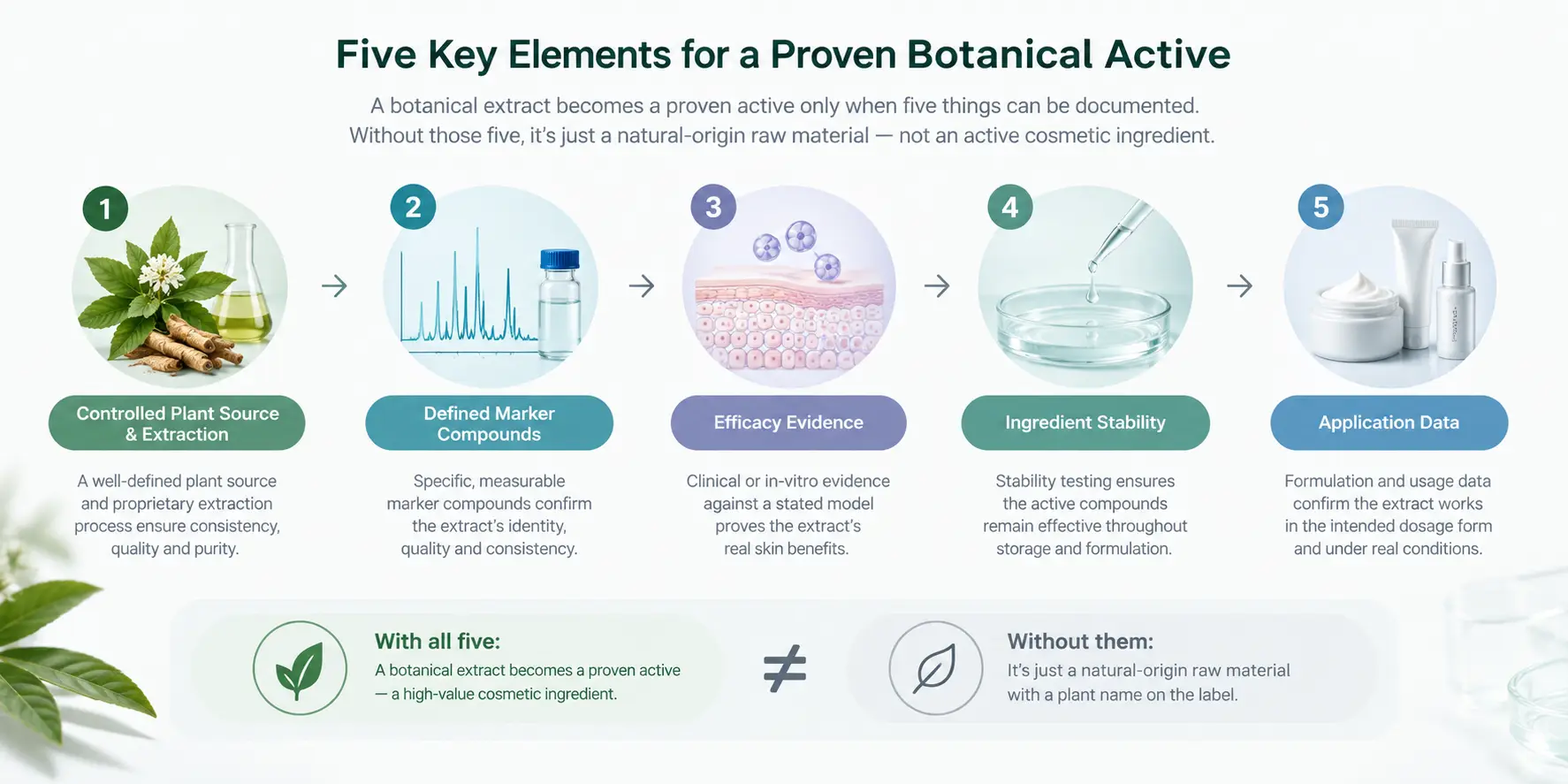
Five Key Elements for a Proven Botanical Active
Four different questions hide inside "is this botanical extract any good?"
Botanical extracts are usually discussed as one category. They are not — and lumping them together is why plant-derived projects stall. Separating four question types early makes comparison far faster:
1. Regulatory — in the target market, may this botanical be named and positioned this way, and which of its benefits may be expressed as a cosmetic function?
2. Supply — can the same species and plant part be delivered batch after batch, with a stable marker specification and traceable origin?
3. Formulation — does it dissolve, disperse or stay suspended in the intended base, and does it survive pH, temperature, packaging and shelf life?
4. Evidence — what was measured, on the extract itself or on a finished formula, in which model, and how far can that result be extended?
Most "this botanical doesn't perform" experiences are formulation answers (question 3). Most "we couldn't use the supplier's botanical data" experiences are evidence answers (question 4). And a surprising number of stalled projects are actually question 2 — the supplier could never reproduce the sample that impressed the brand in the first place.
What a plant name can tell you — and what it cannot
Source information about a botanical is genuinely valuable. It is simply not efficacy information. Here is what a well-documented natural cosmetic ingredients supplier should be able to state about the extract, and what each item does and does not settle.
What the supplier states about the botanical | What it establishes | What it does not establish |
Species and plant part (root, bark, leaf, flower, seed) | Identity of the raw material | Any effect on skin |
Origin and traceability | Supply reliability and a basis for consistency | Potency, or a usable dose |
Extraction route (solvent, temperature, concentration step) | Whether the process concentrates the compounds of interest | That the extract behaves the same in your base |
Extract ratio (e.g. "10:1") | How much raw plant material went in | How much of the interesting compound came out |
Standardisation to a defined marker | That the material can be specified, compared and reproduced | That the marker is bioavailable, or that it reaches the target |
Traditional or folkloric use of the plant | Cultural context and consumer familiarity | A cosmetic function claim |
Two consequences follow directly, and both are commonly violated in botanical marketing:
l A familiar plant is not automatically a functional extract. Traditional use of a plant is not evidence for a cosmetic claim. A well-known botanical extracted badly — wrong plant part, harsh process, no standardisation — is a different material from the same botanical extracted and controlled properly.
l An unfamiliar species is not automatically weaker. What separates a natural-origin filler from a proven active is the documentation, not the prominence of the plant's name.
For plant-derived materials the identity question is unusually strict, because the same plant does not yield the same extract from different organs. Composition — and therefore both efficacy and safety profile — can differ by plant part. This is also why regulatory frameworks for plant-derived cosmetic ingredients require the specific plant part to be declared rather than leaving it as "plant extract".
What actually turns a botanical extract into a proven active
Three things separate a natural-origin botanical ingredient from an active cosmetic ingredient. None of them is about the plant's reputation.
1. A defined marker compound. An active botanical has a compound — or a defined compound class — that the specification, the analysis and the claim all point at. This is what makes one batch comparable to the next, and one supplier comparable to another. Marker compounds behind well-known botanical anti-aging actives include, for example, glabridin from licorice root, baicalin from Scutellaria baicalensis, escin from Aesculus chinensis, madecassoside and asiaticoside B from Centella asiatica, salicin from willow bark, kavain and yangonin from kava root, and pueraria flavones from Pueraria lobata. Extract ratio does not do this job: two extracts with the same ratio can differ substantially in marker content. The marker is what turns "a plant extract" into a thing you can specify, buy and claim.
2. A mechanism. Knowing the plant is not knowing the target. A useful botanical active dossier states which process the extract is expected to influence and why that mechanism is relevant to the intended benefit — rather than leaving "it's a plant, plants are good for skin" as the explanation.
3. An efficacy model. The output of a mechanism is a model: cell-free and enzymatic assays first, then cell and 3D/ex-vivo systems, and where the claim requires it, human studies. Each step carries a different evidential weight and a different limit.
Identity | Plant name | Plant + specific plant part + marker compound |
Specification | Appearance, extract ratio | Defined marker content, verified by a stated method |
Batch consistency | Described | Monitored against the marker across batches |
Mechanism | Not addressed | Stated target or pathway |
Evidence | Traditional use, general literature | Extract-specific efficacy data with models named |
Formulation data | Usually absent | Solubility, stability and application guidance |
Regulatory naming | Often incomplete | Plant part and name consistent with the filing |
What it supports | A "natural origin" statement | A specific cosmetic function claim |
Plamed's botanical range is built on this second column — standardised botanical anti-aging actives specified on defined markers rather than extract ratios.
Why the plant's real weak point is usually formulation, not biology
A botanical active can be perfectly characterised and still fail at the bench. This is the part of the botanical story that gets the least airtime — and it accounts for a large share of why botanical products underperform a claim.
Solubility(H3)
Many interesting plant compounds are lipophilic or poorly water-soluble. If the extract cannot be dissolved or evenly dispersed at the use level, the efficacy measured in a laboratory system never reaches the skin, and the dosage form has to be redesigned around it. This is where solubility enhancement stops being a technical footnote and becomes a product decision.
Stability(H3)
A plant extract is not a stable object by default. Marker content can decline during storage; colour can drift; odour can develop; emulsions can separate. Where a botanical is stored or formulated in unfavourable conditions, loss of the active fraction over a short period is a realistic outcome — which means a product can be formulated correctly and still reach the consumer carrying far less activity than was intended. Ingredient stability data — at the relevant pH, temperature and packaging, and ideally in the intended base — belongs in the evaluation, not in the afterthought column.
Delivery(H3)
When a botanical compound is unstable or poorly water-soluble, an active delivery system may be required. Plamed’s encapsulation technology using cyclodextrins is one established route: forming a supramolecular encapsulation inclusion complex can change how the botanical behaves in water, how it is handled in production, and how it is released. The important qualification is that inclusion-complex formation has to be characterised, not assumed — "supramolecular" describes a verified structure, not a marketing adjective, and a claim built on it needs the characterisation data behind it.
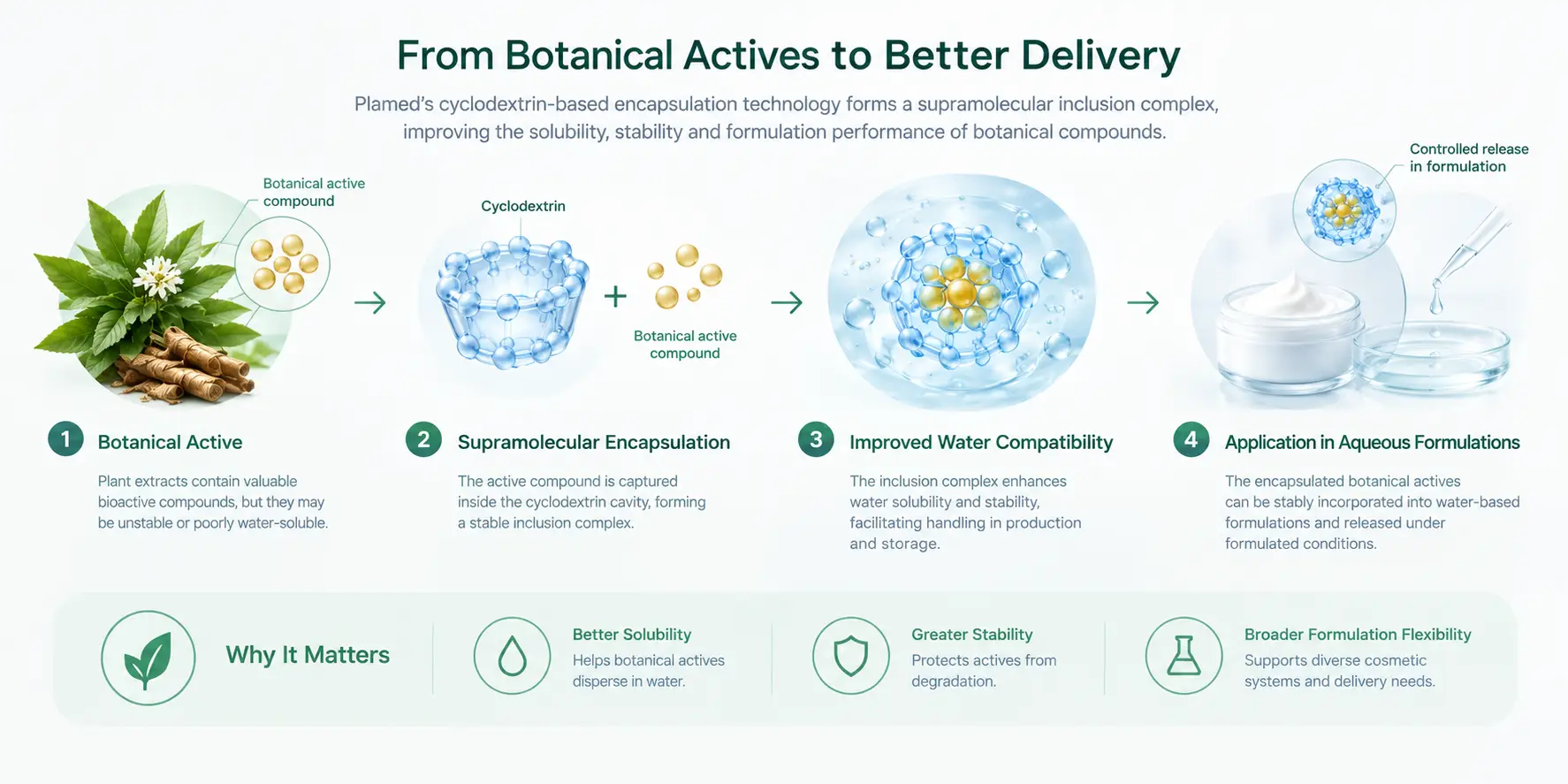
From Botanical Actives to Better Delivery
Application fit(H3)
Dosage form, pH window, processing temperature, addition order, and compatibility with the rest of the formula are the last gate before scale-up. Even a well-specified botanical performs differently in a toner, an emulsion and an anhydrous system.
A concrete illustration(H3)
Plamed’s PMRefresh® Willow from willow bark is used as a botanical route to endogenous skin renewal, where the skin's own enzymes convert the glycoside into the active form. That mechanism is what allows cosmetic exfoliants based on salicin to work differently from acid-based exfoliation — which is why acid-free exfoliation raw materials are evaluated on tolerance and formulation behaviour, not only on the strength of the exfoliating effect.
The six steps from a plant to a formulation-ready botanical active
This is the path the word "active" actually describes — and each step is a place where botanical projects stall:
1. Source — a defined species and a specific plant part, with traceable origin
2. Extraction and purification — a controlled process that concentrates what you intend to keep
3. Standardisation — the extract is adjusted and verified against a defined marker compound
4. Mechanism and efficacy evidence — a stated target, tested in a named model, on the extract itself
5. Stability and application testing — behaviour in real dosage forms, at real use levels
6. Documentation — specification, quality, safety/regulatory and application files that travel with the extract
Skipping step 3 is what makes a botanical impossible to specify. Skipping step 5 is what makes a botanical "active" impossible to formulate. Both are common, and both are invisible in a marketing sheet.
The tool: a botanical active evaluation table
Score each candidate extract against these eight columns. A material that cannot be scored in a column should not be assumed to have passed it.
Column | What to look for | |
1 | Source | Species, specific plant part, origin, traceability |
2 | Process | Extraction route, purification, batch consistency |
3 | Marker | Which compound or class, at what specification, verified by which method |
4 | Evidence | Which model, which endpoint, on the extract itself or on a formula |
5 | Stability | Data at relevant pH, temperature, packaging and shelf life |
6 | Formulation | Solubility, dosage-form fit, addition conditions, compatibility |
7 | Quality / regulatory | Specification, quality documentation, plant part and naming for the target market |
8 | Supplier support | Samples, application guidance, technical and cosmetic ingredient distributor technical support |
A reading rule: columns 1–3 are identity, column 4 is the claim, columns 5–6 are feasibility, columns 7–8 are the ability to actually buy and defend the extract. A botanical extract that scores well in 1–3 and 7–8 but has nothing in 4–6 is a supply-chain material with an active-sized price tag — the most expensive kind of botanical buy.
Where the botanical claim boundary sits
Botanical origin is a supply-chain fact; it is not a licence to imply efficacy or safety. Three reminders specific to plant-derived ingredients:
l "Natural" is not a permitted claim by itself in every market, and the wording acceptable for origin, sustainability or tolerance differs by region.
l Literature on a plant is not evidence for your extract. A published study on a related species, a different plant part, or a differently standardised extract does not validate the material in front of you.
l The name you use in the formula must match the material supplied. For plant-derived ingredients this extends to the declared plant part — a mismatch surfaces at filing, not at sampling.
FAQ
Does a natural source mean a natural benefit?
No. Origin describes where the botanical came from. Whether it has any effect on skin depends on what is in the extract, at what concentration, and whether it survives the formula. Those are separate questions with separate evidence.
Is a higher extract ratio always better?
Not necessarily, and the ratio is often the least informative number in a botanical specification. Extract ratio describes how much raw plant material went in — not how much of the interesting compound came out. Two extracts with the same ratio can differ substantially in marker content. A standardised marker, verified by a stated method, is the number to rely on.
Does the plant part really matter?
Yes, and it is one of the most commonly skipped details. Different organs of the same plant can differ in composition, which means they can differ in efficacy and safety profile — and regulatory frameworks for plant-derived ingredients require the specific part to be declared for exactly this reason.
If there is published literature on the plant, is our extract already validated?
No. Literature on the plant describes the plant. Extract-specific validation requires testing on the extract in question, with the model and endpoint stated. This is precisely the difference between a science backed skincare ingredient and an extract that merely references science.
Can two extracts from the same plant share one evidence package?
No. A different plant part, a different extraction route or a different marker specification means a different material. Evidence must be matched to the specific extract — the same discipline required for cosmetic ingredients with clinical data, where the clinical result belongs to the extract that was tested.
Is botanical the only route to a modern active?
No. Biotechnology-derived materials — including fermentation products and recombinant proteins such as recombinant collagen — are a parallel route, and synthetic biology cosmetics has become its own category. The evaluation logic is identical: identity, marker or specification, mechanism, model, stability, application. Botanical or biotech, the documentation is what makes the material usable.