

ECM skincare rests on real science, but the word "ECM" has been attached to ingredients whose evidence ranges from published human trials to a single cell-culture well. The extracellular matrix is a specific biological structure, and the claims made about it are not equally specific. Six checks separate the two: standardised identity, claim-route evidence, solubility and compatibility data, impurity limits, documentation depth, and market access.
The science arrived first. A 2025 review in Cell by Kroemer, López-Otín and colleagues added extracellular matrix changes to the list of ageing hallmarks — a framing that gave the industry a legitimate biological story to tell. Marketing followed, and with it a problem that every formulator now inherits: the strength of the underlying science says nothing about the strength of any particular ingredient’s file. This article uses one ingredient as the worked example throughout: silymarin, the milk thistle extract standardised to silibinin. If you arrived from a search about milk thistle benefits for skin, the short version is that almost every such claim traces back to one number — how much silibinin the extract actually carries.
This article gives you a way to tell them apart. The six checks below run in the order you actually meet them: the first four cost an email and a sample, the last two decide whether the project is worth starting. Where the checks map onto Plamed’s own 7-gate screen for formulation-ready ingredients, the overlap is noted.
Short answer: what should you check beyond efficacy data?
# | Check | What a verifiable answer looks like |
1 | Standardised identity | A named marker, a stated content, an analytical method, and a batch-to-batch record |
2 | Claim-route match | Evidence at the level the claim needs — mechanism, cell, skin model, or human |
3 | Solubility and compatibility | Numbers with conditions: solvent, temperature, concentration, pH, and what it does in a real base |
4 | Impurity and micro limits | Explicit Pb/As/Hg/Cd and microbiological limits, not "meets specification" |
5 | Documentation depth | Four tiers of documents, each answering a different question |
6 | Market access | A confirmed route in each target market, not a history of having been sold there |
Six checks earn their place because the alternative is expensive. A botanical active that fails check 3 costs a reformulation cycle, not a sample; a claim that fails check 2 costs a retraction of marketing copy after the launch.
What is the extracellular matrix, and why did it enter skincare now?
The extracellular matrix (ECM) is the non-cellular macromolecular network between cells: collagens, non-collagenous glycoproteins, elastin, glycosaminoglycans and proteoglycans. It sets the mechanical properties of skin — firmness, elasticity, and how well a wound closes — which is why it became a credible target for anti-ageing claims rather than another metaphor.
The Cell review placed ECM changes among the hallmarks of ageing, alongside better-known entries such as genomic instability and cellular senescence. That placement matters commercially: it let brands describe matrix degradation as an ageing mechanism rather than a cosmetic observation, and it gave ingredient suppliers a shared vocabulary across markets and languages.
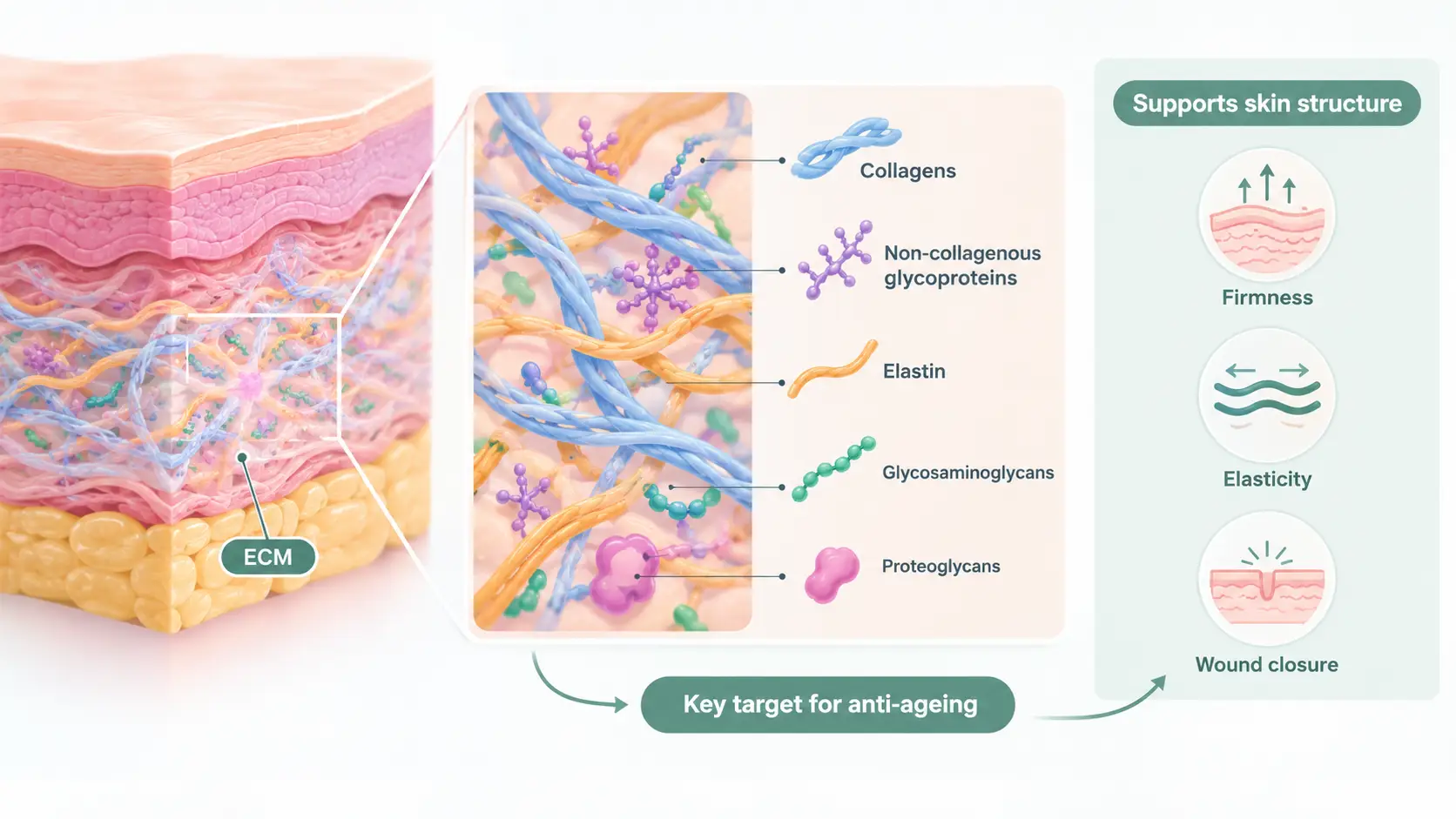
The skin extracellular matrix (ECM) and its role in maintaining skin integrity.
The corroborating evidence is older and stronger than the review. Naked mole rats carry roughly ten times the high-molecular-weight hyaluronic acid of mice and humans, and show unusual resistance to age-related disease. When the gene behind that — Has2 — was transferred to mice, healthspan extended, in a 2023 Nature study (Zhang et al., Nature 621:196–205). That is a causal link between one matrix component and ageing biology. It is also the class of evidence to hold in mind when a supplier claims a matrix benefit: the pathway is real, so the question is not whether ECM matters, but whether the specific ingredient touches it in a measurable way.
Which ECM claim route does your ingredient actually sit on?
Route | How the claim works | Typical actives | Evidence to demand |
① Replenish components | Supply collagen, hyaluronic acid, proteoglycans exogenously | Collagen, hyaluronic acid, proteoglycans | Molecular weight and localisation data; penetration evidence, given the size question |
② Stimulate synthesis | Activate fibroblasts and matrix gene expression | Retinoids, signal peptides, silibinin | Model and conditions, dose–response, and whether human skin models confirm it |
③ Protect from degradation | Inhibit MMP secretion, resist glycation and oxidation | Antioxidants, anti-glycation actives (silibinin in the AGEs/CML direction) | The specific inhibited pathway, with markers and controls |
④ Delivery and biomimicry | Carry actives or mimic matrix architecture | Microspheres, assemblies, recombinant biomimetic materials | Carrier stability and scale-up feasibility |
"ECM skincare" is not an ingredient category. It is four different claim routes — replenish matrix components, stimulate matrix synthesis, protect the matrix from degradation, or deliver matrix-like materials — and each route needs a different class of evidence. The first question to a supplier is which route they are taking.
The route you choose also sets the words you may use. A route ③ ingredient with a clean glycation assay supports a sentence about glycation inhibition; it does not support a sentence about lifting. Keeping the claim inside the route is the cheapest compliance work available.
Is ECM skincare overhyped? A buyer’s test
ECM skincare is not hype by nature — the underlying biology is published and the actives are real. It becomes hype when the seller substitutes a journal citation for ingredient evidence. Four signals tell you which situation you are in.
High-risk signals. The copy mentions ECM content but says nothing about molecular weight, penetration or localisation. Efficacy rests on a single positive cell-culture result with no dose–response and no repeat run. A Cell citation appears where an ingredient study should be — the review supports a link between ECM and ageing, not a claim about any product. No standardised specification exists, so batches cannot be compared even in principle.
Assessable signals. The claim route is stated explicitly; the evidence sits at the level that route requires; a standardised specification exists with a named marker and method; and application data describes what happens in a real base, not only in solvent.
On that reading, whether ECM skincare is overhyped depends on what the seller can prove it is not — and that is a documentation question, not a scepticism question.
What are the six checks beyond efficacy data?
Run them in order and the file builds itself. Each check below asks one question, names the document that answers it, and shows what a weak answer looks like against a strong one — Plamed’s PMAnti-AGEs® Silibinin is used as the worked example throughout.
Silibinin is a useful test case because its name is where the trouble starts. The plant name, the extract name and the marker name are not interchangeable. Products sold as milk thistle for skin rarely state a marker compound. A label that says milk thistle extract silymarin without a percentage tells you the source but not the strength, and a silibinin milk thistle extract sheet that stops at the plant name tells you even less. Silybum marianum is the botanical name, and the specification line usually reads Silybum marianum milk thistle extract. The fruit supplies silymarin, and silibinin is the fraction that gets measured. Only the marker is what an HPLC assay quantifies, so it is the only quantity a formulator can hold a supplier to.

Milk thistle (Silybum marianum) plants
What does silymarin do for the skin?
The honest answer is narrower than the marketing. Silymarin is a standardised extract, and the skin benefits of milk thistle sit in three directions. The first is antioxidant protection. The second is anti-glycation chemistry against advanced glycation end-products such as CML. The third is matrix-related structural protein work on ex vivo skin models. Those three cover most of what Silybum marianum extract skin benefits refers to in practice, and none of them is a hydration claim, a barrier claim, or a lifting claim.
What separates a defensible silymarin skin care product from an indefensible one is the strength of the evidence behind it. Silibinin content determines the actual active load, making standardisation essential. PMAnti-AGEs® Silibinin offers two grades, ≥80% and ≥98% silibinin A+B by HPLC, delivering different active loads at the same inclusion rate. This is why a clear assay specification matters more than a generic ingredient name.
There is also a solubility boundary that rules out whole product categories before efficacy is even discussed. The extract is insoluble in water and effectively insoluble in oil, so silymarin extract powder has to enter a formula through a diol pregredient phase. A water-based toner cannot carry it directly. A pure oil serum cannot carry it at all. That is why a milk thistle oil for skin product and a silymarin skincare product are not substitutes, even when the front of the pack says the same plant name.
For an anti-glycation skin care ingredient, this is the narrowest part of the claim to defend. A supplier has to show a measured reduction in an AGE marker, not merely an antioxidant capacity, and has to say which model produced it. Most anti glycation skin care ingredients on the market document the second and not the first, which is why the direction is worth asking about by report number rather than by marketing phrase.
1 · Standardised identity
A botanical active is only comparable batch to batch if a named marker is measured by a named method against a stated content. "Standardised extract" without those three is a description, not a specification.
For PMAnti-AGEs® Silibinin, the declaration is silibinin A+B 80% by HPLC, and the chromatogram separates A from B so the total is auditable rather than asserted. The isomer split matters. Silibinin A and B differ in one stereocentre and are separated by HPLC. A supplier who reports “silibinin” without saying whether the number is A+B, A alone, or a UV absorbance against a mixed standard has reported a number that cannot be compared with anyone else’s. At the 80% grade the measured split is A 32.6% / B 50.7%; at the 98% grade it is A 45.3% / B 54.3%. The two grades report the split; only the A+B total is held as a specification limit.
Ask for the chromatogram of the batch you are sampling, not of a reference batch, and ask what the acceptance window is. A ≥80% specification with a 79.4% batch and a 96% batch both passing tells you the window is wide; a supplier who can quote the actual distribution across the last twenty batches is telling you something about process control. Named lots make the question concrete: lot PMKZ3101-260330 measured A+B 83.3% against a ≥80% specification, and lot PMKZ3102-260328 measured 99.6% against a ≥98% specification. Where the number comes from matters too. Silymarin extraction is a solvent process followed by purification, so the spread between silymarin manufacturers — and between silymarin powder manufacturers selling the same nominal grade — shows up as a range of measured content rather than as a different plant.
2 · Claim-route match
Evidence exists on a ladder — biochemical assay, cell culture, 3D skin model, human study — and each rung supports a different sentence. A claim must name the rung it stands on.
A biochemical assay supports a mechanism sentence and stops there. Cell culture adds a cellular response but not a tissue response. A 3D or ex vivo skin model begins to support statements about skin. A human study supports a claim about that endpoint, in that population, in that formula. Skipping a rung is common; declaring which rung you are on is rare, and it is the difference between a technical claim and a marketing one. Ingredients with a well-described silibinin mechanism of action are the clearest case. A supplier can explain how silymarin works in a cell through a silibinin extract, and still have nothing to say about facial skin.
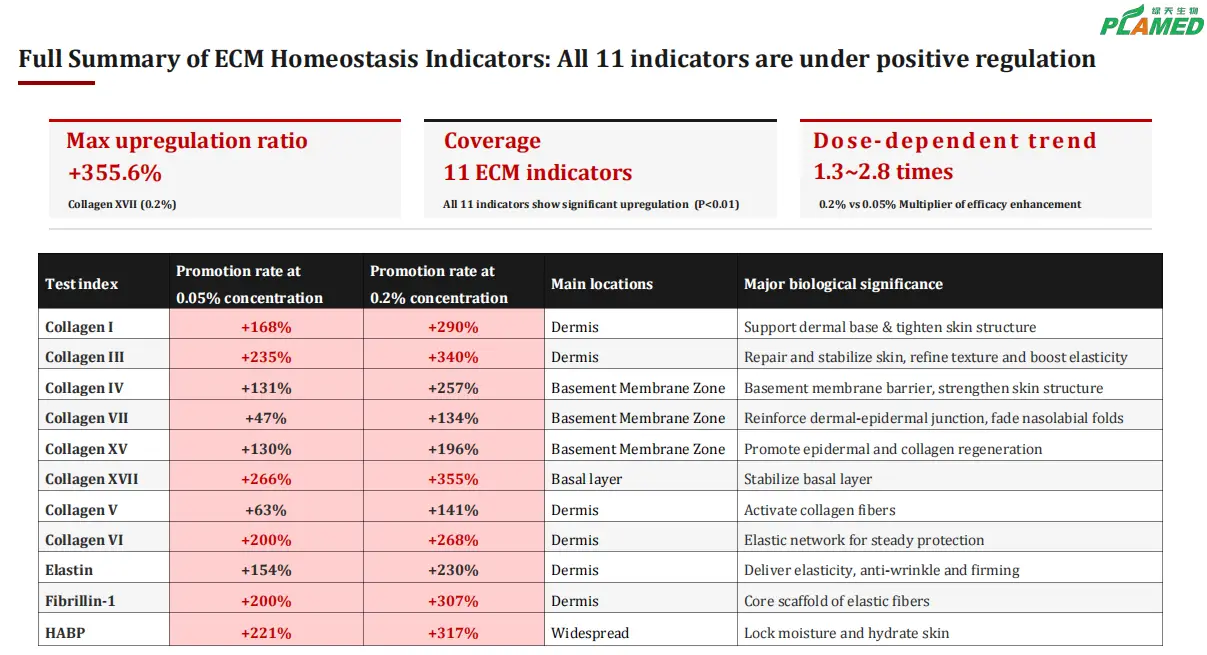
For silibinin, the relevant directions are matrix-related structural protein work on one side and glycation chemistry — advanced glycation end-products and CML — on the other. Both are legitimate paths; neither licenses a lifting claim. Where a supplier reports these studies, ask for the model, the dose range, the controls and the report number, and read the report title before the abstract. Plamed’s own ECM work is filed that way. Report GT-0004814 covers tightness, wrinkle and anti-glycation endpoints on an ex vivo skin model, with eleven of eleven endpoints reaching P < 0.01 and collagen XVII up 355.56% at 0.2%. The 98% grade also has a separate cell-model report at 0.0125%, where collagen III rose 35%, collagen IV 47% and collagen XVII 32%.
3 · Solubility and formulation fit
Solubility is not one number. It is a number with conditions attached: which solvent, at what concentration, at what temperature, at what pH, and with which co-solvent. A supplier who answers "freely soluble" has answered nothing.
The failure mode is predictable. An active dissolves in a diol, the formulator dilutes it into a water-rich serum, the apparent solubility collapses, and the batch hazes over at 4 °C three weeks after filling. The fix is to ask for a matrix of solvents at a stated temperature and method, and to pick the pregredient phase from that matrix rather than from habit.
Where silibinin actually dissolves
The grades differ by roughly a third on the same solvent, which is the first thing the matrix reveals. Both begin as a Silybum marianum fruit extract, milled and sieved into a Silybum marianum powder that is pale yellow to light brown and flows badly once moisture climbs. Cosmetic and internal-use grades share that origin; they differ in specification, not in source, so the Silybum marianum fruit extract for skin behaves as this table describes. Silibinin 80, a silibinin powder at ≥80% A+B, dissolves to 1.0–1.1 g per 100 g in 1,3-propanediol at room temperature with ultrasonic assistance. Silibinin 98 reaches ≤0.6875 g per 100 g in the same solvent. The gap repeats across the panel: 1.0–1.1 versus ≤0.61 g per 100 g in 1,3-butanediol, 0.3–0.4 versus 0.2–0.3 in 1,2-pentanediol, and 0.1–0.2 versus 0.05–0.1 in 1,2-hexanediol. Both are insoluble in water and effectively insoluble in GTCC at below 0.01 g per 100 g.
Solvent system | Silibinin 80 (g/100 g) | Silibinin 98 (g/100 g) | Formulation consequence |
1,3-Propanediol | 1.0 ≤ X < 1.1 | ≤ 0.6875 | Preferred pre-dispersion medium |
1,3-Butanediol | 1.0 ≤ X < 1.1 | ≤ 0.61 | Acceptable alternative |
1,2-Pentanediol | 0.3 ≤ X < 0.4 | 0.2 ≤ X < 0.3 | Slightly soluble; pre-dispersion required |
1,2-Hexanediol | 0.1 ≤ X < 0.2 | 0.05 ≤ X < 0.1 | Slightly soluble; pre-dispersion required |
Water | Insoluble | Insoluble | Cannot be added directly to the aqueous phase |
GTCC | <0.01 (effectively insoluble) | <0.01 (effectively insoluble) | Not suitable for a pure-oil system |
Read the table as a set of exclusions before it becomes a set of options. The GTCC line rules out an anhydrous oil serum; the water line rules out a direct aqueous addition; and the two diol lines mean the material enters the formula through a pregredient phase, not through the water phase. At a 0.5% use level in 1,3-propanediol, Silibinin 98 disperses uniformly at 1:20. Silibinin 80 still shows sediment at the same ratio and needs a leaner pregredient dilution — the practical reason the solvent matrix has to be read per grade.
There is a second question the solubility table cannot answer: what happens when the pregredient meets the emulsifier, the electrolyte and the preservative. A diol solution diluted into a high-electrolyte gel can still cloud, because apparent solubility depends on the surrounding medium, not on the solvent you started in.
Why pure-solvent solubility is only half the answer
A solubility figure measured in a neat solvent and a stability result measured in a water-containing base are two different measurements, and a supplier should be able to show both. PMAnti-AGEs® Silibinin dissolves at roughly 1 g per 100 g in 1,3-propanediol as a neat solvent. Yet in an aqueous base containing 10% 1,3-propanediol at a 0.1% use level, the same material clouds or sediments across pH 3–9 and does not clear above pH 9. After one month at 50 °C it precipitates heavily.
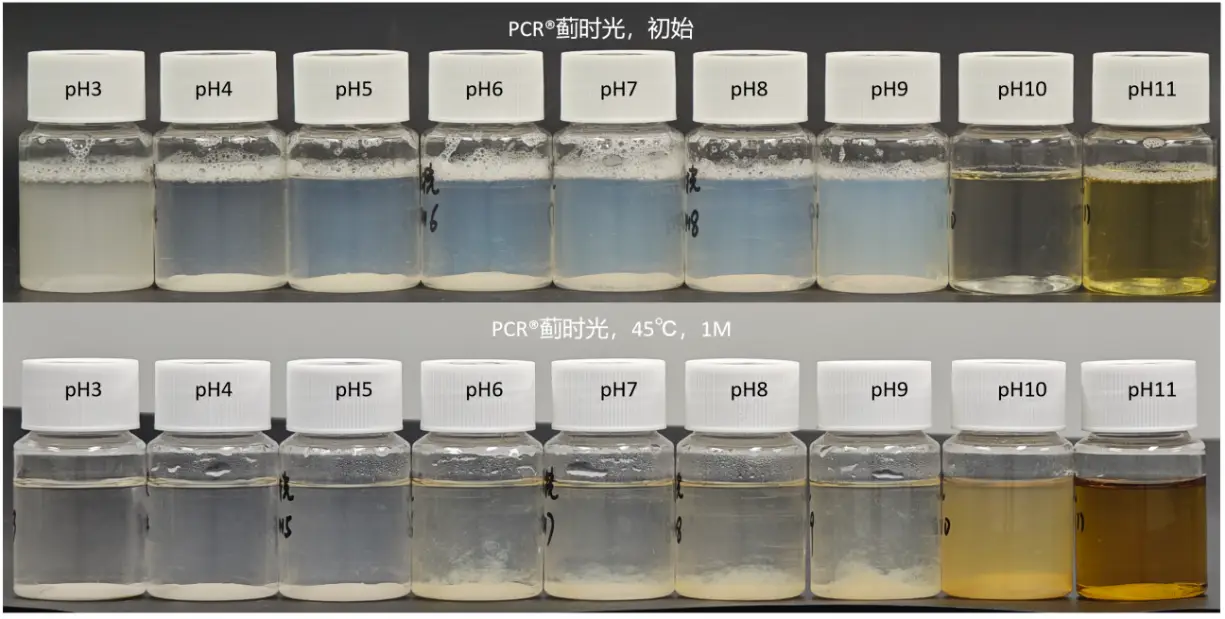
Plamed's application validation reports measure the second of those — the behaviour in an aqueous base — and the results are specific enough to design around:
What was tested | Result | What it tells a formulator |
pH 3–11 ladder, 0.1% active in a base containing 10% 1,3-propanediol, read initially and after 50 °C / 1 month | Both grades cloudy or sedimented across pH 3–9; no clearing at pH 10 or pH 11; heavy precipitation after accelerated storage | An aqueous serum at any normal pH is not the right home for either grade; raising pH does not rescue solubility |
pH where colour shifts | Silibinin 80: colour holds pH 3–8, deepens at pH ≥9. Silibinin 98: colour holds pH 3–9, deepens at pH ≥10 | Avoid strongly alkaline systems; the grades differ by one pH unit, and above the threshold the shift is a colour deepening rather than a haze |
Dispersion-ratio gradient in 1,3-propanediol, butylene glycol, 1,2-pentanediol | Silibinin 98 reaches a uniform dispersion at 1:20; Silibinin 80 still shows sediment at the same ratio. Exact ratio per grade not established in the available report. | Pre-disperse per grade and confirm the working ratio in your own base; do not read the 98-grade ratio across to the 80 grade |
The two grades do not behave identically, and that is the practical point. Judge them on two separate axes, because mixing the two is how a formulation brief goes wrong. On colour, Silibinin 80 holds across pH 3–8 and Silibinin 98 across pH 3–9; above those points both deepen in colour rather than merely clouding. On dispersion, Silibinin 98 reaches a uniform pregredient at 1:20, while Silibinin 80 still leaves sediment at that same ratio and needs a leaner dilution. Choosing between them is a formulation decision about pH window and diol budget, not a claim about which is better.
Read together, the neat-solvent table and the aqueous-base table say one thing: solubility quoted without its medium is not a property of the material, it is a property of the test. A supplier who reports only the first table has described a possibility; a supplier who reports both has described a process. So does a supplier who reports each grade against its own lot number, because a shared matrix conceals exactly the grade difference a formulator needs.
One warning line belongs on top of the table. Everything in it describes 0.1% active in a leave-on base built on 10% 1,3-propanediol — a deliberately favourable system, chosen so that the pH ladder isolates pH rather than confounding it with a solvent change. Move to 0.5% or to a different diol and the thresholds shift. Note also that the solvent panel was run at room temperature with ultrasonic assistance. Without ultrasound the same solvents need more than eight hours of stirring to reach a clear solution, which is a process constraint the table itself does not show. The numbers are a starting point for your own trial, not a specification.
Compatibility testing is a method, not a claim
Compatibility work is only comparable across suppliers if the method is disclosed. Plamed’s application validation reports follow one template, and the template is the transferable part. It fixes the batch number and the test concentration. It states the co-solvent load, so that a solubility difference cannot be mistaken for a pH difference. It reads a pH ladder from 3 to 11 twice, initially and after accelerated storage at 50 °C for one month. It adds a separate oil-solubility screen across synthetic esters, natural oils and silicone, and a dispersion-ratio gradient to find the minimum workable dilution.
Two of those design choices are worth borrowing. Fixing the co-solvent load — Plamed's reports use 10% 1,3-propanediol throughout the pH ladder — separates "insoluble" from "insoluble without help", which is the difference between a material that cannot be used and one that needs a pregredient phase. Reading the pH ladder twice, before and after accelerated storage, separates a pH-dependent solubility problem from a degradation problem, and those two have different fixes.
The method also sets what the report is allowed to conclude. Both reports end with an application instruction rather than an efficacy statement: use in an emulsion system, pre-disperse at 1:20 or leaner in a diol, add after emulsification, keep the pH inside the range where the colour holds. That is the correct scope for an application validation report, and it is the scope a formulator can act on without asking a second question.
4 · Impurity and microbiological limits
Limits belong in the specification as numbers with methods. "Heavy metals: meets specification" is not a limit; it is a promise that a limit exists somewhere you cannot see.
Parameter | Limit (specification applies to both Silibinin 80 and Silibinin 98; confirm against the current SPEC document) |
Lead (Pb) | ≤10 ppm |
Arsenic (As) | ≤2 ppm |
Mercury (Hg) | ≤1 ppm |
Cadmium (Cd) | ≤5 ppm |
Total plate count | ≤1000 CFU/g |
Yeast & mould | ≤100 CFU/g |
Pseudomonas aeruginosa, Staphylococcus aureus, heat-resistant E. coli | Not detected |
Moisture / ash | ≤10% / ≤7% |
The moisture and ash lines are the ones formulators skip and later regret. Moisture drives caking and hydrolysis in storage. Ash reflects the inorganic load a plant extract carries in from soil and process water — it will not show up in an assay, but it will show up in colour and in solubility drift over a shelf life.
5 · Documentation depth
Documents come in four tiers, each answering a question the others cannot. A supplier who sends only the first tier has shipped a material; a supplier who can send the second has qualified a process.
Tier | Documents | Question it answers |
1 | SDS, TDS, batch-specific CoA | Is it safe, what is it, and did this batch pass? |
2 | Composition, process description, analytical methods, application validation reports | How was it made, and how does it behave in a base? |
3 | Allergen, GMO/vegan, animal-testing and origin statements | Can I make the claims my marketing plan needs? |
4 | Specification change notification, retention-sample policy, deviation record | What happens when a batch or a process changes? |
A 12-item list that covers most sourcing reviews — TDS, COA, SDS, specification sheet, composition breakdown, source statement, vegan statement, process flow, solubility support, application validation, human-efficacy documentation, technical efficacy documentation — maps onto those tiers unevenly. Solubility support and application validation land in tier 2, and they are the two that decide whether a formulation project starts.
6 · Market access
Market access is a route, not a sales history. An ingredient that has been sold in a market for years can still sit outside the permitted use conditions for your product type or application site.
For China, the first check is whether the ingredient appears in IECIC and what the published in-market use information says about application site; for the EU and US, the check is ingredient identity and any restriction attached to it. The failure pattern is consistent: a brand validates a formula, then discovers the use level or the application site sits outside what the entry supports. Ask for the entry as a document rather than as a statement, because the use conditions attached to an entry are the part most often summarised away. Ingredient identity is the other half. An anti-glycation skin care ingredient filing that names silymarin will not automatically cover a supplier selling the same extract under a different name. A silymarin skincare launch that lists the botanical source but not the INCI is the kind of file that stalls at registration.
What do the six checks look like run on one real ingredient?
Run against PMAnti-AGEs® Silibinin, in its two grades, the six checks produce a file rather than an impression. That file holds a named marker with a method, a claim route declared, a solubility matrix with exclusions, explicit impurity limits, a document set that reaches tier 2, and a market-access question still to be answered per target market. It is not complete, and saying so is the point. The sixth box stays open until a target market is named.
Field | Silibinin 80 | Silibinin 98 |
Product name | PMAnti-AGEs® Silibinin 80 | PMAnti-AGEs® Silibinin 98 |
INCI | Silymarin | Silymarin |
CAS | 22888-70-6 | 22888-70-6 |
Botanical source | Silybum marianum seed | Silybum marianum seed |
Active marker | Silibinin A+B | Silibinin A+B |
Marker specification | ≥80% | ≥98% |
Appearance | Pale yellow to light brown powder | Pale yellow to light brown powder |
Recommended use level | 0.1%–0.5% (reference range) | 0.1%–0.5% (reference range) |
Solubility | 1.0–1.1 g/100 g in 1,3-propanediol; insoluble in water; effectively insoluble in GTCC | ≤0.6875 g/100 g in 1,3-propanediol (about 62% of the 80 grade); insoluble in water; effectively insoluble in GTCC |
Shelf life / storage | 36 months / sealed at room temperature | 36 months / sealed at room temperature |
Measured A+B (named lot) | 83.3% (lot PMKZ3101-260330, report AJD260407311) | 99.6% (lot PMKZ3102-260328, report AJD260407310) |
The two grades share a botanical source and an INCI name, but they differ on two axes rather than one: marker load and the A/B isomer ratio. The second axis is easy to miss and it is the one that changes behaviour. Raising the marker load from 83.3% to 99.6% means the same active mass arrives in roughly 84% of the powder mass. That is why the diol budget is not transferable between grades, and one more reason the dispersion ratio has to be tested per grade rather than read across.
Two limits on this table. The use level is a reference range, not a regulatory ceiling, and the market-access position has to be confirmed per market before a claim plan is written. Where a supplier's efficacy data for the matrix and glycation directions exists as a report rather than a summary, ask for it by report number — and treat "available upon request" as an answer you should actually request before briefing a formula. Plamed publishes those numbers the same way: lot PMKZ3102-260328 carries 36-month shelf life confirmed to 27 March 2029, and lot PMKZ3101-260330 to 29 March 2029.
Frequently asked questions
Does adding collagen or hyaluronic acid count as ECM skincare?
It can, under route ①, but only with penetration or localisation evidence. Intact collagen is a large molecule, and a replenishment claim without data on where it ends up is a claim about the ingredient's presence in the formula rather than its effect on the matrix.
What does "standardised" actually mean for a botanical active?
It means a named marker, a stated content, a named analytical method, and a defined acceptance window — silibinin A+B ≥80% for Silibinin 80 and ≥98% for Silibinin 98, both by HPLC, for example. Without those four, two batches cannot be compared and the word carries no information. Note what is inside the window and what is not: in this case the A+B total is a specification limit, while the A/B split is reported per batch rather than controlled as a limit.
Why is solubility data a red-flag detector in ingredient sourcing?
Because solubility figures are cheap to state and expensive to get right. A supplier who publishes a solvent matrix with temperature, method and concentration has done the work; a supplier who says "soluble in glycols" has avoided the question.
How does glycation connect to extracellular matrix ageing?
Glycation attaches sugar residues to long-lived matrix proteins, producing advanced glycation end-products such as CML that stiffen collagen and resist turnover. That is why anti-glycation actives sit under route ③, protection, rather than route ②, synthesis.
What documents should an ECM active supplier be able to provide?
Four tiers: SDS, TDS and a batch-specific CoA; composition, process description and analytical methods; statements for allergen, GMO, vegan and animal testing; and a change-control and retention-sample policy. Solubility support and application validation sit in the second tier and matter most at the sampling stage.
Is ECM the next PDRN? How do the two trends differ?
PDRN is a single defined material with a repair narrative built on one ingredient class. ECM is a biological system with four claim routes and no single molecule, so the ECM conversation is about which route and which evidence, while the PDRN conversation is about which grade and which source. Both conversations end in the same place: the seven checks a formulation-ready ingredient has to clear.
What are the benefits of milk thistle for skin?
In cosmetic use, milk thistle skin benefits, silymarin skin benefits and silymarin benefits for skin all describe the same set of effects, and the reported directions are antioxidant, anti-glycation and matrix-related structural protein work rather than hydration or barrier repair. That is a route ③ claim, so it is bounded by the same limit as any other protection ingredient: a supplier who can show glycation inhibition has shown glycation inhibition, not lifting.
Is silymarin the same as silibinin?
No. Silymarin is the extract fraction and silibinin is its principal component, so a silymarin active ingredient description usually means silibinin content — but not always, and the difference is legal as well as technical. A specification that says silymarin extract powder with no assay method cannot be compared with one that says silibinin A+B by HPLC, which is why the measurement has to come before the word.
Is silymarin the same as milk thistle oil?
No, and the difference decides whether the ingredient is usable at all. Milk thistle oil is a fatty carrier with little standardised silymarin in it; silymarin extract is a powder that dissolves in diols and is effectively insoluble in oil. A formula that needs an anhydrous serum cannot use the extract, and a formula that wants a standardised actives claim cannot rely on the oil.