
A botanical cosmetic ingredient is not judged by its claims. It is judged by whether the material can actually be used in your formula, batch after batch. Ten checks decide that: identity, standardisation, contamination, manufacturing control, technology claims, compatibility, stability, regulatory status, supply consistency, and the paperwork behind each batch.
Skin soothing ingredients make the point sharply — and so do the calming ingredients sold alongside them. A kava root extract for cosmetics can look perfect on a specification sheet and still fail in a serum. The wrong plant part. A marker that drifts between batches. A solubility figure that only held in water. A supramolecular claim with no data behind it. None of those problems started in your lab. All of them were decided earlier, at a step the buyer never sees.
This guide follows the five steps every botanical active goes through, and names what is controlled at each one, what document it leaves behind, and what a buyer should ask. PMSoothe® Kava97, a water-soluble soothing skincare ingredient for sensitive skin, runs through the whole article as the worked example: every number on its specification can be traced back to a named test.
What should you check beyond efficacy when choosing cosmetic raw materials?
Ten areas decide whether a botanical active is usable. Each one maps to a document you can request and read — not to a claim you have to take on trust. Together they are the quality control checklist for any cosmetic ingredient supplier.
Check | What to verify | What to ask for |
1 Ingredient identity | Species, plant part and harvest window — not just the trade name | Identity specification, botanical source statement |
2 Standardisation | Which marker, at what content, by which method | Specification sheet plus a batch-specific CoA |
3 Contaminant control | Pesticides, heavy metals, residual solvent, microbiology | Analytical reports with limits and methods |
4 Manufacturing controls | The process settings that protect the marker | Process description, manufacturing flow chart |
5 Technology claims | Whether a claimed modification was measured or just asserted | Characterisation data with sample groups and methods |
6 Formulation compatibility | Solubility and thickening behaviour in your base | Application data, compatibility report |
7 Stability | Behaviour at set temperature, pH and time | Stability protocol and the data already generated |
8 Regulatory documentation | Status in your market, permitted use levels | IECIC or equivalent entry, safety assessment |
9 Supply consistency | Batch traceability and change notification | Retention-sample policy, change-control agreement |
10 Documentation trail | Which of the four document tiers the supplier can really provide | See the four-tier table below |
Row 10 is the one buyers skip. A supplier that answers rows 1 to 9 but cannot show a change-control policy has answered every question except the one that bites two years later.
How are botanical cosmetic ingredients made?
Every botanical active goes through five stages: accepting the raw herb, extracting the active, standardising the content, converting it into a water-compatible form, and drying plus release testing. The first three decide which molecules you get. The last two decide how those molecules behave once they are in a formula.
Stage | What it does | What is controlled | What it leaves behind |
1 Incoming acceptance | Confirms species, part, harvest and cleanliness | Identity, marker profile, pesticides, heavy metals, moisture | Incoming inspection report, supplier CoA |
2 Extraction | Pulls the target molecules out of the plant | Solvent, ratio, temperature, time, pH | Batch manufacturing record |
3 Standardisation | Fixes a measurable active content and narrows batch variation | Purification route, marker assay, mass balance | In-process assay, adjustment log |
4 Supramolecular conversion | Makes the standardised active mix with water | Host–guest ratio, reaction conditions, endpoint | Complexation record, characterisation data |
5 Drying, testing and release | Turns the complex into a powder that meets a specification | Filtration cut-off, drying temperature, residual solvent, particle size, release tests | Batch-specific CoA, stability report, retention sample |
A supplier that can describe stages 1, 2 and 5 has described a trading relationship. The real technical content sits in stages 3 and 4 — and that is why two kava extract powders at the same stated strength behave completely differently.
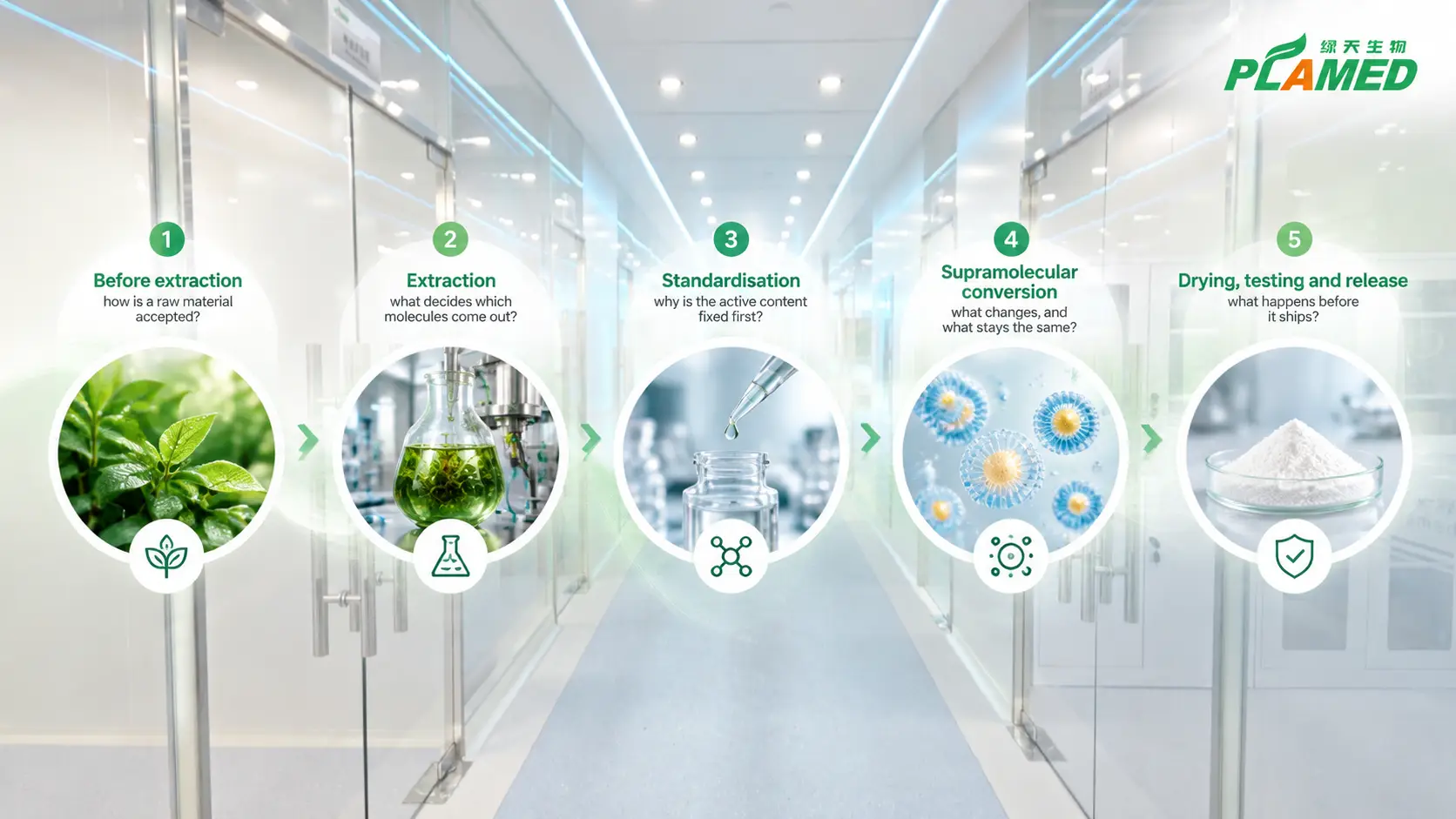
Stage 1 — Before extraction: how is a raw material accepted?
Incoming acceptance settles three things before anything is processed: the correct species and plant part, a marker profile that matches a retained reference, and a contaminant screen that reflects where the plant grew. Mistakes here spread silently, because every later stage keeps processing the wrong material, consistently.
Kava shows the problem clearly, because the plant part is where the market splits. The soothing kavalactones sit in the root and rhizome. A "root, stem and leaf extract" waters down the active content with leaf mass, and brings in leaf alkaloids that carry a liver-safety concern. So kava root powder and a whole-plant extract are not two grades of one ingredient — they are two different risk profiles. T/CAFFCI 108—2026 closes that gap by fixing the botanical source, the plant part and the processing requirements inside the standard itself.
The incoming tests are the ones no later step can fix. Pesticide residues are screened against a 55-substance panel under GB/T 39665—2020 , because residues concentrate in the extract instead of being washed out by purification. Heavy metals are capped at Pb ≤10, Hg ≤1, As ≤2, Cd ≤5 mg/kg — limits that come from soil uptake and cannot be corrected downstream. Moisture is held at ≤10.0%, because water activity drives both hydrolysis and microbial growth in storage. The Agriculture Ministry's Announcement No. 250 and No. 2032 are treated as the current banned and restricted pesticide lists.
Two documents come out of this stage: the supplier's CoA for the raw herb, and the manufacturer's own incoming inspection report. The second one is what makes the identity claim the manufacturer's own, and it is the one worth asking for. A CoA from a trading intermediary reports what was bought, not what was checked.
Stage 2 — Extraction: what decides which molecules come out?
The extraction method sets yield and impurity profile before any technology claim is made. Supercritical CO₂ extraction at roughly 55 °C replaces both the solvent and the temperature of a conventional process. For a heat-sensitive kavalactone, that difference is the active content you actually receive.
The trade-off is real, not theoretical. A conventional solvent process runs at 80–90 °C , where extraction efficiency rises — and heat degradation rises with it. Supercritical CO₂ runs near 55 °C , dissolves the fat-soluble kavalactones selectively, and leaves the polar chlorophyll, sugars and leaf alkaloids behind. The purification load downstream is smaller, and the marker reaches standardisation intact. The CO₂ is recovered and reused, and residual CO₂ in the finished material measures below the CO₂ content of ordinary air.
This is the stage most suppliers never document, because the record is a batch manufacturing record rather than a certificate. It is also where much of the difference between two nominally identical extracts begins.
Here is a testable version of that claim. Ask for three numbers: the extraction temperature, the fluid or solvent used, and the residual level of that fluid in the finished material. A supplier running a low-temperature, solvent-free process will have all three to hand. A supplier running a conventional solvent process will describe the outcome instead.
Stage 3 — Standardisation: why is the active content fixed first?
Standardisation fixes a named marker at a stated concentration and narrows batch-to-batch variation, so everything downstream gets a consistent feed. For PMSoothe® Kava97 that means kavain ≥4,000 ppm and yangonin ≥500 ppm , both by HPLC against external standards. This is the step that separates a kavalactone powder with a reliable number from one with a reliable-looking label.
The choice of marker is the real quality decision inside that sentence. Many kava extracts are sold by ratio — a kavalactone percentage that describes the method rather than the content delivered. A named marker at a stated concentration can be checked batch by batch. A ratio cannot. The cost is genuine: controlling one defined kavalactone limits raw-material sourcing and raises cost per batch, which is exactly why ratio specifications stay common in the market.
Kava97 goes beyond two external numbers. Six kavalactones are held to internal limits: kavain 4,000–5,000 ppm and yangonin 1,000–2,000 ppm as internal ranges, plus A38, A39, A40 and A41 kept inside bands derived from the same reference standard. The external specification is what a buyer can verify. The internal ranges are what a manufacturer uses to catch drift before a batch fails. A spec with only external limits tells you the floor. A spec with internal ranges tells you the process is in control.
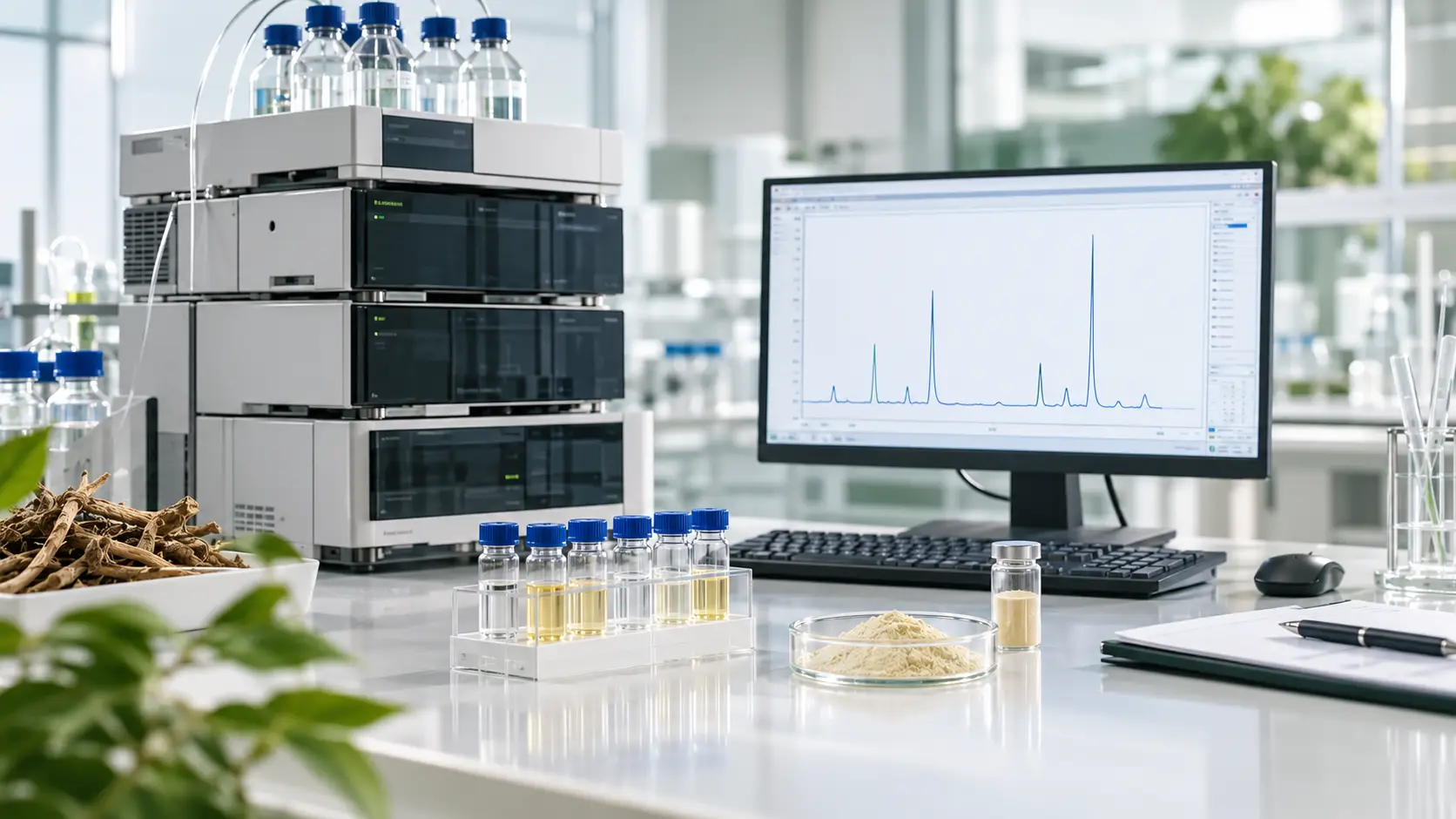
The method matters as much as the number. The assay is an external-standard HPLC method on a C18 column (25 cm × 4.6 mm, 5 µm), read at 246 nm with a water : methanol : acetonitrile mobile phase of 38 : 21 : 26. Kavain elutes at about 11.7 minutes and yangonin at about 16.2 minutes. Two suppliers both reporting "kavain ≥4,000 ppm" against different columns, wavelengths and standards are not reporting the same number — which is why the method belongs in the comparability conversation.
Stage 4 — Supramolecular conversion: what changes, and what stays the same?
Supramolecular encapsulation puts a guest molecule inside a cyclodextrin cavity through a non-covalent interaction, without changing its chemical structure. What changes is the physical state. Solid crystals or clumps become a molecularly dispersed host–guest complex, which lifts apparent water solubility and shields the guest from light, oxygen and heat.
Kava is a case where that change decides everything. Kavalactones are fat-soluble and poorly soluble in water, which caps how much can go into an aqueous serum. PMSoothe® Kava97 is built as 15% kava root extract carried on 85% hydroxypropyl cyclodextrin . The resulting powder is fully water-soluble: a 5% aqueous solution reads 95%–100% transmittance at 686 nm , with a colour difference of ΔE ≤3.0 .
Three parameters decide whether the complex forms: the host–guest ratio, the concentration of the water phase, and the temperature and mixing time together. The reaction endpoint decides when complexation stops. These are process parameters, not marketing choices — and they explain why two suppliers using the same cyclodextrin can release complexes with very different free-active fractions.
Encapsulation is a wider word than inclusion. Coating and matrix dispersion both count as encapsulation. Inclusion is a defined structural state inside the cavity. Only inclusion produces a complex whose formation can be shown by a method rather than guessed from a solubility improvement. To tell them apart, ask which characterisation methods were run and against which sample groups. A physical mixture, the pure carrier and the pure active are the controls that separate a real complex from a good blend. Where a supplier sells a supramolecular extract powder, that four-group comparison is the evidence to request. A worked TEM and XRD comparison on a supramolecular escin shows what it looks like.
Stage 5 — Drying, testing and release: what happens before it ships?
Drying fixes the physical form your process receives — particle size, bulk density, flowability, how much water it picks up, and how fast it dissolves again. Release testing then proves the batch against a written specification. Two batches can pass the same assay and still behave differently on the factory floor.
For a spray-dried cyclodextrin complex, the drying route also sets the heat history. Hydroxypropyl cyclodextrin is spray-dried above 100 °C , and the kava extract itself passes an 8-hour drying stage at 75 °C during manufacture. Both are gentler than an extended high-temperature solvent strip, and both belong in the batch record alongside inlet and outlet temperatures, particle-size distribution and moisture.
Release testing covers five families, and every line on the certificate carries a method and an acceptance limit:
Test family | Specification (PMSoothe® Kava97) | Why it is on the sheet |
Identity and assay | Kavain ≥4,000 ppm; yangonin ≥500 ppm; HPLC external standard | Defines the active you are buying |
Appearance | Off-white to light yellow powder; characteristic odour; ΔE ≤3.0 | Fast visual check for batch consistency |
Physicochemical | Moisture ≤10.0%; ash ≤7.0%; pH 4.0–7.0 (1% aqueous); methanol ≤2,000 mg/kg | Caking, hydrolysis, mineral load, residual solvent |
Heavy metals | Pb ≤10; Hg ≤1; As ≤2; Cd ≤5 mg/kg | From soil, not removed downstream |
Microbiology | TPC ≤1,000 CFU/g; yeast & mould ≤100 CFU/g; E. coli, P. aeruginosa, S. aureus absent | Consumer safety |
Use and storage | Recommended 0.1%–2.0%; 36 months in a well-closed container, dry, away from light and heat | Dose guidance, not a regulatory limit |
Two governance details sit behind that table, and neither shows up on a typical specification. First, a retained sample of every batch is held for the shelf life — that is what makes a complaint investigable two years later. Second, comparability only works if both sides can run the same method. That logic is what sits behind T/GDCA 088—2026, an ELISA method for evaluating the anti-irritation properties of cosmetic raw materials, published by the Guangdong Cosmetic Association with Plamed as lead drafting unit.
The inspection rules are the part buyers rarely ask about and often wish they had. Thirteen items are tested on every batch at release. The full specification is re-run as a type inspection at least once a year, and whenever a process or source changes. The acceptance window for a delivery runs 15 days from receipt. A specification without inspection rules is a wish. A specification with them is a contract.
What does a real release specification look like?
A usable specification is one another laboratory can reproduce from the paper alone: every number carries a method, every condition carries a value, and every claim carries its limit.
Field | PMSoothe® Kava97 |
Trade name / INCI | PMSoothe® Kava97 / PIPER METHYSTICUM ROOT EXTRACT; HYDROXYPROPYL CYCLODEXTRIN |
Composition | Kava root extract 15%; hydroxypropyl cyclodextrin 85% |
Actives (external spec.) | Kavain ≥4,000 ppm; yangonin ≥500 ppm (HPLC external standard) |
Actives (internal control) | Kavain 4,000–5,000 ppm; yangonin 1,000–2,000 ppm; A38–A41 within defined bands |
Appearance | Off-white to light yellow powder; characteristic odour |
Physicochemical | Moisture ≤10.0%; ash ≤7.0%; pH 4.0–7.0 (1% aqueous); methanol ≤2,000 mg/kg |
Heavy metals | Pb ≤10; Hg ≤1; As ≤2; Cd ≤5 mg/kg |
Microbiology | TPC ≤1,000 CFU/g; yeast & mould ≤100 CFU/g; specified pathogens absent |
Aqueous behaviour | Fully water-soluble; 5% aqueous solution, 686 nm transmittance 95%–100%; ΔE ≤3.0 |
Natural origin | ISO 16128-1 Natural Origin Index 77.9% |
Recommended use level | 0.1%–2.0% |
Safety data | 2.0%, 48-hour closed patch test, 30 subjects, no adverse reaction; 90-day subchronic NOAEL 200 mg/kg bw/day |
Storage / shelf life | Well-closed, dry, away from light and heat / 36 months |
Two lines on that sheet are tied to their conditions. The transmittance result describes a 5% aqueous solution at 686 nm — not the clarity of your finished base. The patch test is a safety endpoint, not an efficacy result. And the 90-day NOAEL is a hazard characterisation, not an approval of your use level.
Which documents does each stage leave behind?
Documentation comes in four tiers, and no tier replaces another. A supplier that sends only the first tier has shipped a material, not qualified a process.
Tier | Documents | Stage it evidences | Question it answers |
1 Per batch | SDS, TDS, batch-specific CoA | 5 | Is it safe, what is it, did this batch pass? |
2 Process | Composition, manufacturing flow chart, analytical method, characterisation data | 2–4 | How was it made, and how do you know the complex formed? |
3 Market access | IECIC status, REACH, halal, non-GMO / vegan, animal-testing statements, ISO 16128 natural origin index | 5 | Can I sell it in my market? |
4 Change control | Specification change notice, retention-sample policy, deviation record | all | What happens when a batch or a process moves? |
Tier 2 is what separates a technology company from a trading company — and it is the tier most buyers never ask for. A process claim that cannot be shown at that level is a positioning statement, whatever the slide deck says.
Why does the mechanism, not just the number, decide whether an anti-irritation claim holds?
Anti-irritation is usually written as a single receptor target. TRPV1 is the mainstream one, and it is not enough. Human skin expresses TRPV1 through TRPV6, and each subtype senses a different stimulus. An ingredient that blocks only TRPV1 leaves the other five channels open.
The reason is anatomical. Whichever TRPV receptor fires, the signal still has to travel to the brain as an action potential. Blocking the action potential upstream of the receptor covers the signals from all six. Blocking one receptor covers one. PMSoothe® Kava97 is built on that dual mechanism — TRPV1 protein inhibition alongside AP signalling inhibition — which is why it can be checked against a much wider stimulus set than a single-target ingredient.
Test | Model and dose | Result |
AP inhibition | Neuronal cells, 0.45% | AP induction inhibited 89.34% |
TRPV1 inhibition | Keratinocytes, 0.08% / 0.25% | 35.64% / 41.58%, close to 4-tert-butylcyclohexanol at equal dose |
TRPM8 up-regulation | 0.02% / 0.04% | 45% / 98% improvement |
DRG action potential | 4.5 mg/mL | Spike count −89.3%; rheobase +120% |
Neuronal soothing | Zebrafish, 0.25% | 97% (p<0.001) |
Human capsaicin challenge | 31 subjects, 2%, single application | Redness a* value improved 11.88% to 32.33% across 30–120 min vs. matrix control |
Human self-assessment | 30 sensitive-skin subjects, 30 min | Burning/stinging relief 100%; itching 93.55%; redness 83.87% |
Read that table the way you would read a specification: every row names a model, a dose and a result. The dose column is the one that matters, because a result at 0.45% says nothing about performance at 0.1% . Note too that the human study used 2% , the top of the recommended range, not the middle.
It is just as worth stating where the mechanism does not reach. Histamine-driven itching and redness follow a different cascade that amplifies upstream of the ion channel, so blocking the action potential downstream helps only a little. The ingredient performs where the trigger is capsaicinoid or physical — not where it is histaminergic. A supplier who can describe the edge of their own mechanism is more useful than one who claims the whole map.
What can still go wrong in a formula?
Botanical actives rarely fail on potency. They fail on solubility at the use level, on stability inside the finished base, and on compatibility with the thickener or the co-active sitting next to them in the beaker.
What you observe | Stage it traces back to | First thing to check |
Haze or crystals at 4 °C after two weeks | 1 / 4 | Whether a polysaccharide or high-polymer thickener has cut free water |
Yellowing over 8 weeks | 2 / 5 | Final formulation pH — above pH 7 the risk rises sharply |
Assay loss in accelerated storage | 3 / 5 | Marker specification, moisture, bulk storage conditions |
Gritty or slow dissolution | 5 | Particle size, drying route, stirring method |
Batch-to-batch viscosity or colour shift | 3 | Standardisation records, six-marker internal ranges |
Viscosity drop in a thickened gel | — | Whether the thickener is ion-sensitive (AVC, EMT-10) |
The compatibility list for Kava97 is short and specific, and every line came from a formulation trial rather than a datasheet. It works in carbomer systems when added after neutralisation, and in polyacrylic and natural-polymer thickeners. It causes a viscosity drop in ion-sensitive thickeners such as AVC and EMT-10, and mild haze with EMT-10, so it is not recommended in crystal-clear systems built on that thickener.
Two more interactions are worth knowing before you lock the formula. It can flash white on contact with hydroxyacetophenone. And yellowing risk is higher at pH 7 and above, which is where tranexamic acid solutions sit — adjusting final pH to around pH 6 is the single most effective stability fix. Above pH 7, with polysaccharides such as sodium hyaluronate or xanthan gum, low-temperature precipitation is possible; it usually clears on warming below 45 °C .
Where an irritant sits in the same formula, the ingredient has been tested as a buffer rather than on its own. At 0.5% , HET-CAM testing shows it reduces the irritation of salicylic acid and of vitamin A from moderate to mild or below, and of phenylethyl resorcinol from moderate to none. At 1% it reduces the irritation of six surfactant systems — including SLS/SLES, amino-acid surfactants and betaines — down to non-irritating. That is the claim a formulator can actually use. Not "soothing", but "soothing next to the thing that stings".
How long does a stability study have to run before you can claim a shelf life?
A four-week accelerated run screens a candidate and flags instability early. It cannot support a shelf-life claim. That needs at least three months of accelerated data plus real-time data covering the claimed period.
For Kava97 the aqueous data already runs well past a screen. A 1% aqueous solution held at 4 °C, room temperature and 45 °C , across a pH range, showed no colour change, no precipitation and no loss of active content over seven months . Seven months is what has been completed so far, not a ceiling — and it is the number to quote, rather than rounding up to a year.
The thresholds used to judge those results are internal screening values, not an industry standard: assay retention ≥90% of the starting value at the end of the accelerated period, pH drift ≤0.3 units against control, colour change ΔE ≤2 , and a use level held at ≤70–80% of the measured solubility limit at the lowest pH and temperature the formula will see. The reference framework is ISO/TR 18811:2018, which sets no pass/fail criteria and puts the burden on the manufacturer to specify and justify a protocol.
What changes for the China market?
Three things decide the route in China: whether the ingredient is already used in marketed cosmetics, whether your intended use sits inside the published historical use levels, and whether a group standard now fixes the specification.
Kava root extract already has a marketing history in China, so it does not start from the new-material route. What it lacked until 2026 was a specification everyone could point to.
T/CAFFCI 108—2026, Cosmetic ingredients — Piper methysticum root extract, was issued on 13 April 2026 and took effect the same day, under the China Association of Fragrance Flavor and Cosmetic Industries, with Plamed as lead drafting unit alongside Shanghai Chicmax, Proya, Bureau Veritas (Xi'an) and Intertek (Shanghai). The standard fixes the botanical source, process requirements, sensory and physicochemical indicators, characteristic actives, contaminant limits, test methods, and packaging, transport and storage (standard announcement).
That matters to a buyer more than it sounds. Before the standard, two suppliers' "kava root extract" could differ in plant part, marker, method and limit while sharing a name. After it, there is a shared vocabulary to negotiate against, and a specification you can check instead of comparing adjectives.
Ingredients without a marketing history follow a different path. The current framework is the Regulations on Registration and Filing of New Cosmetic Raw Materials, issued 26 June 2026 and effective 15 July 2026 , replacing the 2021 rules and accompanied by technical guidelines from the National Institutes for Food and Drug Control. The 2026 revision narrowed the set of efficacy categories that need registration rather than filing, which shortens the path for many botanical actives.
Where the finished product carries an anti-irritation claim, the method is now named too. T/GDCA 088—2026 sets an ELISA method for evaluating the anti-irritation properties of cosmetic raw materials, published by the Guangdong Cosmetic Association and effective 10 September 2026 . A named method is what makes two suppliers' numbers comparable, whichever supplier produced them.
Five claims worth checking before you take a sample
1. A technology claim with no characterisation. If "supramolecular" appears with no method, no sample-group design and no report, it describes intent rather than a process.
2. A CoA with no batch number, method or limit. Any one missing means the document cannot be audited. Three missing means it is a brochure.
From a regulatory compliance standpoint, a CoA serves as a batch’s official identity card: the essential verification is comparing every measured value against the acceptance limits in the specification, line by line. That is exactly the logic behind the red flags below — and it is why every line in our own release table names its method and its limit, from kavalactones content to pH and water activity.
3. "Water soluble" with no conditions. Solubility is a number with a temperature, a pH and a concentration attached. Without them it is a direction, not a value.
4. Composition quoted as assay. A feed ratio and a measured content answer different questions, and mixing them up inflates the number you think you are buying.
5. No retention samples and no change-control policy. Without them, a two-year-old complaint cannot be investigated, and a silent specification change cannot be detected.
Those five cover the manufacturing half of a qualification decision. The buyer's half — what to ask before a sample ships, and which answers count as evidence — is set out in How to Choose Formulation-Ready Cosmetic Ingredients: A 7-Gate Screen.
Frequently asked questions
Is a supramolecular extract the same as an encapsulated extract?
Not necessarily. Supramolecular inclusion forms a host–guest complex inside a cyclodextrin cavity — a defined structural state that can be characterised by a physical method. Encapsulation is a wider term covering coating and matrix dispersion, and it does not always produce an inclusion complex. Ask which methods were run, and against which sample groups.
Does "water soluble" mean it will dissolve in my formula?
No. A stated solubility describes the material in a defined water system at a defined temperature and concentration. Surfactants, electrolyte load, ethanol content, pH drift and high-polymer thickeners all change the answer — which is why the application note matters as much as the specification.
Kava root extract or root, stem and leaf extract — does the difference matter?
Yes, on both counts. The kavalactones concentrate in the root and rhizome, so a whole-plant extract dilutes the active content. Leaf material also brings in alkaloids that carry a liver-safety concern. The two are not grades of one ingredient; they are different risk profiles — which is why T/CAFFCI 108—2026 specifies the plant part.
Will it turn yellow with tranexamic acid or phenylethyl resorcinol?
Yellowing risk rises at pH 7 and above, and tranexamic acid solutions sit at pH 7–8. Adjust the final formulation to around pH 6 and the risk drops sharply. With phenylethyl resorcinol, 0.5%–1% of Kava97 reduced irritation in HET-CAM testing, which also lowers the post-inflammatory pigmentation risk that follows irritation.
Can I use it in a carbomer system?
Yes, when added after neutralisation. The compatibility reports show no viscosity effect in neutralised carbomer or natural-polymer systems. Ion-sensitive thickeners such as AVC and EMT-10 are the exception: expect a viscosity drop you can offset by raising the thickener dose, plus mild haze with EMT-10 that rules it out of crystal-clear systems.
Is it effective against histamine-induced itching?
Only partly, and it is worth saying so. Histamine acts through a different cascade that amplifies upstream of the ion channel, so downstream AP blocking helps less. The ingredient performs where the trigger is capsaicinoid or physical — stinging, heating and burning — because those depend directly on action potentials.
Does it survive 80–90 °C for 30 minutes during production?
Yes. The carrier is spray-dried above 100 °C and the kava extract passes an 8-hour drying stage at 75 °C during manufacture, so a short high-temperature step in the finished-product process does not degrade it.
Can a four-week accelerated test support a 36-month shelf life?
No. Four weeks at 40 °C screens a candidate. Assigning a shelf life needs at least three months of accelerated data plus real-time data covering the claimed period — and the 36-month figure comes from that data, not from the screen.
About Plamed Green Science Group
Plamed Green Science Group develops and manufactures botanical cosmetic actives for sensitive-skin applications. PMSoothe® Kava97 is the third-generation kava ingredient in its soothing range, standardised on six kavalactones and built on a supercritical CO₂ extraction platform. The raw material is sourced under long-term agreements from two Vanuatu suppliers, with stock on hand sufficient to produce two tonnes of finished material, and the Xi'an site has passed on-site quality-system audits by Proya, Chicmax, Bloomage, HBN, Gution and Jahwa.
Sources:
T/CAFFCI 108—2026 (CAFFCI); T/GDCA 088—2026 (Guangdong Cosmetic Association); GB/T 39665—2020; ISO/TR 18811:2018; ISO 16128-1; Third-party test reports: (3324)248-0024, TW202606180004, TW11948R1, SHA01-24090063-JC-01R1, PLA-2024090202.
Disclaimer:
This article describes raw-material manufacturing and specification practice. It does not constitute finished-product formulation, safety-assessment, or regulatory advice.