

Key takeaway
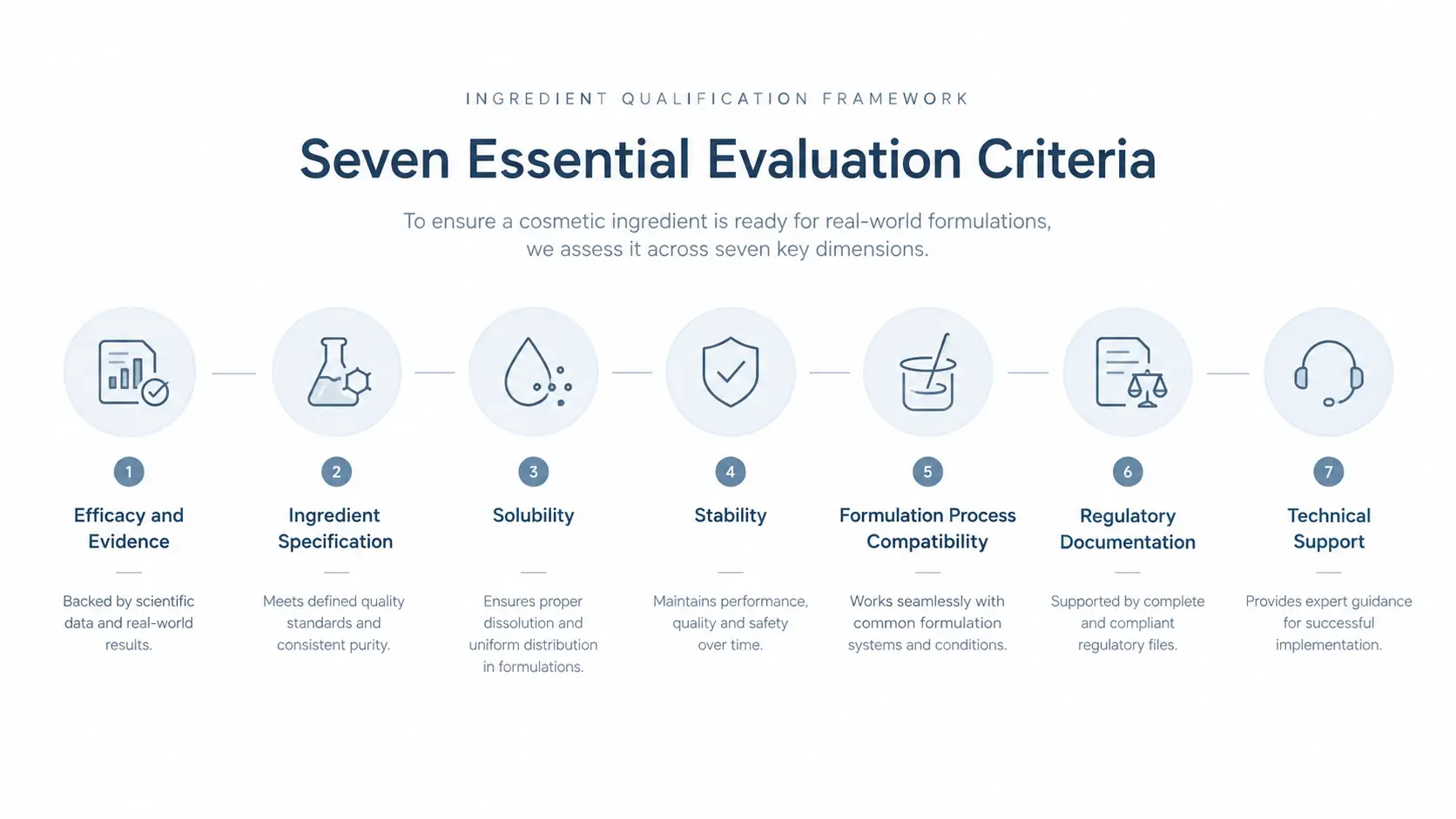
A cosmetic ingredient is not truly formulation-ready just because it demonstrates a promising benefit. It also needs a verifiable specification, condition-specific solubility and stability data, compatibility with the intended manufacturing process, appropriate market documentation, and responsive technical support.
Plamed's Seven-Gate Screen turns these seven questions into one qualification sequence. It separates three things formulators tend to blur: what the supplier has already supported with data, what still has to be verified, and what only your own base can answer.
Short answer
An ingredient is ready when seven things are true at once. The benefit must match a claim you can legally make. You must be able to measure what the material is. It must stay dissolved at your dose and stable in your base. It must survive your process. Its paperwork must cover your market. And someone at the supplier must still answer technical questions after the sample arrives. In Plamed's experience, most projects fail on one of the middle three gates — solubility, stability and process fit (gates 3, 4 and 5) — not on efficacy.
The Seven-Gate Screen for Cosmetic Ingredient Selection
Each gate is one question a supplier should be able to answer in writing. Read the last column as the minimum acceptable answer, not the ideal one.
Gate | Key question | Evidence to request | What the evidence should include |
1. Efficacy evidence | Does the evidence support the intended cosmetic claim? | Relevant efficacy study or test report | Test model, endpoint, conditions, comparator and limitations |
2. Identity and specification | Can the ingredient be consistently identified and tested? | TDS, specification and analytical methods | INCI name, composition, assay, acceptance limits and test methods |
3. Solubility | Will the ingredient remain dissolved or appropriately dispersed at the intended use level? | Solubility data or application study | Concentration, solvent system, pH, temperature and test conditions |
4. Stability | Does the ingredient remain suitable throughout the intended storage period? | Stability data | Sample type, storage conditions, duration and measured parameters |
5. Process compatibility | Can the ingredient tolerate the intended manufacturing process and formulation environment? | Application note or formulation trial data | Phase of addition, temperature, pH, processing conditions and compatibility observations |
6. Documentation and market access | Is the ingredient adequately documented for the intended market and application? | Applicable safety, quality and regulatory documents | Batch COA, SDS, TDS and market-specific status or supporting documents |
7. Technical support | Can the supplier help resolve formulation and quality questions? | Technical support and change-control information | Contact person, response process and notification of relevant specification or process changes |
Table: Plamed's Seven-Gate screen for cosmetic ingredient qualification.
Supplier documents answer questions about the ingredient. They never replace the finished-product safety assessment or your own stability data.
What does "formulation-ready" mean in practice?
It means the material works inside your formula and your market, not just in a brochure. The same extract can behave well at 1% in a pH 5.5 gel and badly at 2% in a hot-process emulsion. It may drift into the oil phase, change colour, or weaken the preservative. So "ready" is not a property of the ingredient. It is a property of the ingredient in your base. That is why the useful question is not "which ingredient is best" but "which conditions have to hold".
Why does choosing by efficacy alone fail?
Because efficacy is the easiest thing to show and the hardest thing to check. Efficacy data and batch quality records answer different questions. Efficacy studies help establish what a material may do under defined test conditions, while batch-specific analytical records help verify whether the supplied material meets its specification. Three gaps show up again and again:
• The data was generated on a development lot, not on the specification that ships.
• The test ran in water, not in your twelve-ingredient emulsion.
• The brochure describes the supplier's material, while your label makes a claim about your product.
If you find the gap at pilot, you pay for a reformulation, a repeat test and a delayed launch.
What should the brief say before you open a catalogue?
Six things, written down. Without them, every supplier in the category looks equally suitable.
1. The exact claim you want to make, in the exact market.
2. The dosage form.
3. The use level the claim needs — not the cheapest one.
4. The process window: pH range, phase of addition, top temperature, hot or cold.
5. The target market and sales channel.
6. Any sensory or stability limit, such as no colour drift.
One sentence does most of the work: "A soothing active for a gel serum at pH 5.5, cold process, EU and China, 24-month shelf life, no colour drift, 2% use level." That sentence removes more suppliers than a week of sample requests.
How do you check identity and specification?
Start here. It is the cheapest gate to check and the most expensive to skip. A specification is good enough when another lab can reproduce your result from the paper alone. That means every number carries a method, and every condition carries a value. "Cosmetic grade" means nothing on its own. The specification and its tests are what define it.
Here is a real specification page from Plamed: PCR® Supermolecular Escin. Every number on it carries a method, and every claim carries its limit.
INCI | ESCIN; HYDROXYPROPYL CYCLODEXTRIN |
CAS | 6805-41-0; 128446-35-5 |
Composition | escin 10%; hydroxypropyl cyclodextrin 90% — the feed ratio used to build the complex |
Assay | escin ≥6%, by HPLC — the measured escin content |
Appearance | white to off-white powder |
Reported aqueous solubility condition | Clear solution at 3% w/w in water at 25 °C and pH 4–6, under the stated test conditions. (This result describes the material under the stated aqueous test conditions. It does not, by itself, establish solubility or physical stability in every finished formulation, solvent system or processing condition.)
|
Moisture / ash | ≤10.0% / ≤7.0% |
Heavy metals | Pb ≤10 ppm; As ≤2 ppm; Hg ≤1 ppm; Cd ≤5 ppm |
Microbiology | TPC ≤1000 CFU/g; yeast & mould ≤100 CFU/g; P. aeruginosa, S. aureus, heat-resistant E. coli not detected |
Recommended use level | 0.1%–2.0% |
Human patch-test safety data | Tested at 2.0% in a 48-hour closed patch test involving 30 subjects, with a reported score of 0 (Report No. NMD2405-0184; available on request). This finding relates to the tested safety endpoint and conditions; it does not establish efficacy or prove suitability for every formulation. |
Storage | well-closed container, dry and ventilated, away from light and heat |
Shelf life | 36 months when stored properly |
Two lines need explaining. The stated composition describes the nominal feed ratio used to prepare the complex, whereas the HPLC assay reports the measured escin content against the finished-material specification. These figures describe different aspects of the material and should not be treated as interchangeable. The relationship between the nominal composition and the release specification should be confirmed against the applicable product specification and analytical method. The other two lines are conditions-bound: the solubility holds at the stated temperature and pH, and the 2.0% patch result is a safety end-point, not a performance claim.
How should you read efficacy data?
Read the test model before the percentage. A biochemical assay supports a mechanism sentence and stops there; cell culture, 3D skin and small-organism models each move up one level of proof; a human study supports a claim about that endpoint, in that population, in that formula. The full ladder — and what each level can and cannot prove — is covered in Botanical Extracts in Skincare: What Makes an Active Proven? Anything you publish beyond the tested system is your extrapolation, and your responsibility.
Plamed holds its own data to that label. An in-house laboratory runs the in-vitro and clinical work, and safety-critical studies go to independent third parties. Each report carries the laboratory's name and a report number you can quote back.
There is also a public yardstick. Group standard T/GDCA 088-2026 (Guangdong Cosmetic Association, effective 10 September 2026) fixes an ELISA method for evaluating anti-irritation claims on cosmetic raw materials, and an industry standard for TRPV1 activity testing is in development. A named method is what makes two suppliers' numbers comparable; the study design and controls still decide whether either number means anything. Plamed took part in both, which is why its own reports name the method rather than an in-house label.
Why do solubility and stability sink more projects than potency?
Because a material that precipitates or degrades delivers nothing, however strong its in-vitro data is. Solubility is not one number. It is a number with conditions attached: at what concentration it stays clear with margin, at what pH, at what temperature, and in which solvent mix. Many actives dissolve in one ionisation state and crystallise in another. Some dissolve at 80 °C and fall out on cooling. Stability has to be measured in the product you are selling, with the parameters listed. A colour photo is not a stability study. Neither is a report without a sample ID, a storage condition, a duration and an acceptance criterion. Compatibility is the third leg. Ingredient compatibility testing checks the active against the preservative system, the ionic charge of the base and the co-solvent load — in your formula, not in water — and it belongs in the application note, not in a phone call after the batch fails.
The same standard applies to technology claims. Plamed's supramolecular actives are characterised by TEM and XRD, cross-checked against a physical-mixture control, and the results indicate inclusion-complex formation rather than a simple blend. The method and the control design are published in Do Supramolecular Extracts Truly Form Inclusion Complexes? — ask any supplier claiming a delivery technology for the equivalent characterisation.
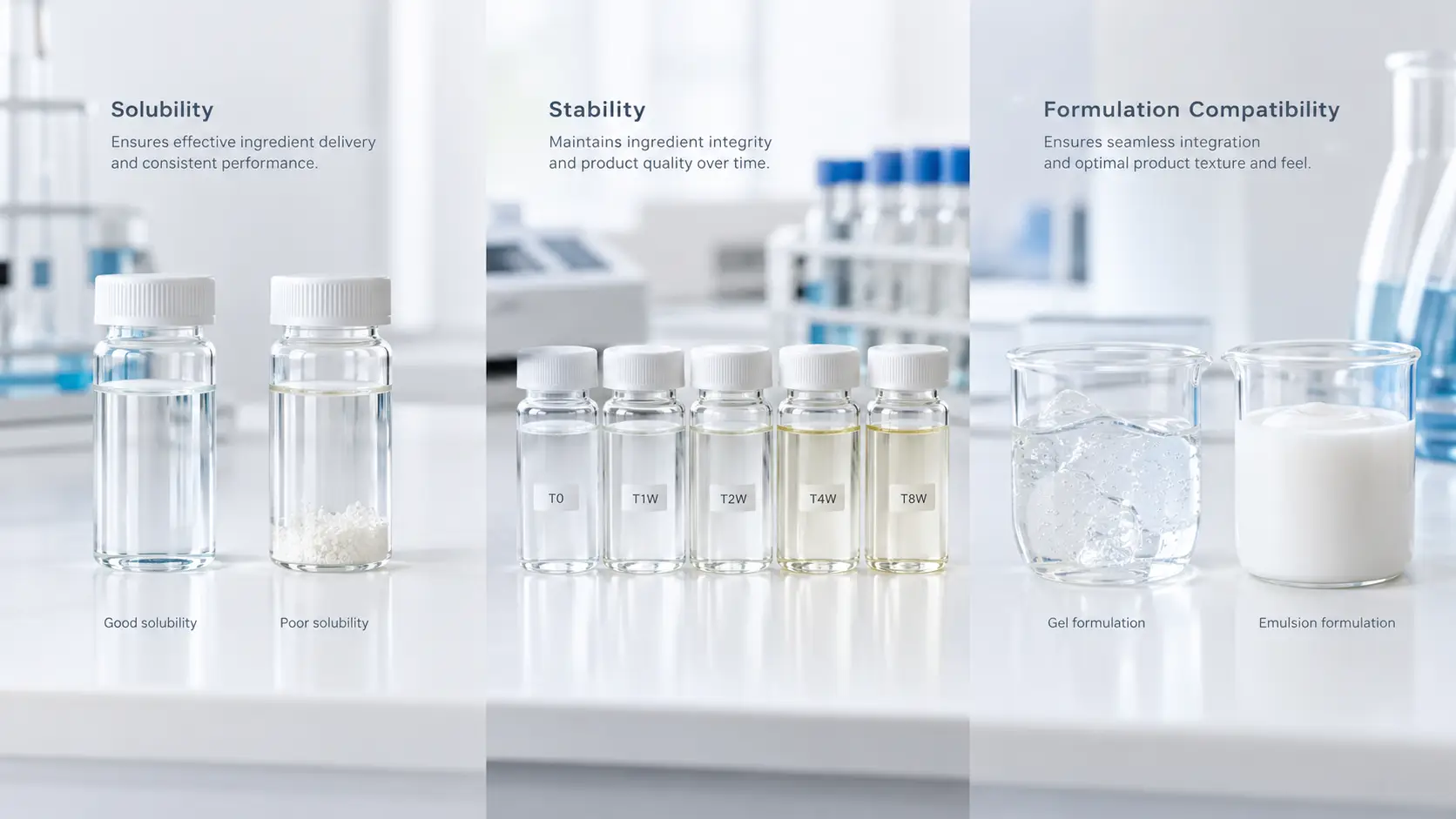
These are the values Plamed watches when it screens a candidate in a customer's own base. Treat them as triggers for a deeper look, not as pass or fail limits.
What you screen | Threshold used here | Why this threshold |
Solubility margin | Use level ≤ 70–80% of the measured limit, at the lowest pH and temperature the formula will see | Leaves room for pH drift and water loss |
pH drift | ≤ 0.3 units against control over the study | More than this usually means interaction or degradation |
Colour change | ΔE ≤ 2 against control | Below the level most people can see |
Assay retention | ≥ 90% of the starting value at the end of the accelerated period | Below this, real-time shelf life rarely recovers |
Accelerated run | ≥ 4 weeks at 40 °C to screen; ≥ 3 months before you claim a shelf life | Four weeks screens cheaply; three months supports a claim |
The thresholds in this table are Plamed's internal screening values, not an industry standard; each supplier should publish its own.
What documents should you ask for?
Four tiers. One never replaces another. An SDS is a safety document: its 16 sections are written for warehouse staff and emergency responders, and it says nothing about dose or efficacy. A TDS has no single legal format, which is exactly why its completeness tells you something. A COA without a batch number, a method and a limit is not a quality record. If one certificate covers several shipments, test on receipt before you release. Two more documents are easy to forget and hard to replace later: a finished safety assessment for the material, and a pesticide-residue screen for anything plant-derived. For market claims, the anchoring texts are Regulation (EC) No 1223/2009 and Regulation (EU) 655/2013 on common criteria for cosmetic claims.
The paperwork clusters into four tiers. A supplier that sends only tier 1 has shipped a material, not qualified one.
Tier | Documents | Question it answers |
1 Every batch | SDS, TDS, batch-specific COA | Is it safe, what exactly is it, and did this batch meet specification? |
2 Technical | Full composition, process description, analytical method standards | What else is in it, how was it made, how is it tested? |
3 Market access | Halal, non-GMO / vegan / no animal testing, REACH | Can I sell it in this market, and who holds the registration? |
4 China filing | IECIC listing status, ingredient safety information package | Simple filing, or new-ingredient registration first? |
Tier 4 is the one most briefs miss. China market access: Before selecting an ingredient for the Chinese market, verify its status against the current Inventory of Existing Cosmetic Ingredients in China (IECIC) and assess whether the specific ingredient falls under the applicable requirements for an existing ingredient or a new cosmetic ingredient. New cosmetic ingredients may be subject to registration or notification requirements, depending on their function and the applicable regulations. Confirm the pathway before you brief the formula team, not after the first batch.
Asked this way, the four tiers are also what a supplier qualification or supplier audit should return: the same documents in writing, checked before the first order rather than after the first complaint.
How do you run the screen in twenty minutes?
1. Write the six-part brief. Five minutes, and it removes most of the catalogue.
2. Pull the TDS for every candidate. Reject anything without numbers and methods.
3. Ask the solubility and stability gates (gates 3 and 4) in writing: “At what concentration does it stay dissolved at pH 5.5 and 25 °C?” A vague answer is your answer.
4. Check the dosage form against the real phase, temperature and compatibility limits.
5. Ask for the document set for your market, and for the name of the person who will answer after launch.
An ingredient that scores well on efficacy, price and story but cannot answer the solubility, stability, process-fit and documentation gates (gates 3 to 6) is a concept, not a raw material.
What commercial questions should you ask before the sample ships?
Five, in the same email as the technical questions:
1. Minimum order quantity and sample quantity — can the pilot run on grams instead of drums? Selected Plamed actives start at 10 g.
2. Lead time for the first order and for repeats, and what happens if a batch fails your check on receipt.
3. Change notification: will the supplier tell you before a specification, a process or a botanical source changes?
4. Continuity: one production site or two, and what is the retest policy for stock already in your warehouse?
5. Which documents are included in the price, and which are billed separately?
A supplier who answers these as readily as the solubility question is the one whose sample is worth formulating.
How does Plamed Green Science Group support these gates?
Plamed supports cosmetic ingredient qualification through ingredient-specific specifications, analytical data, application guidance and technical support. Depending on the ingredient, available information may include composition, assay, solubility conditions, recommended use level and relevant stability or efficacy findings.
For selected ingredients, Plamed offers water-dispersible, supramolecular and oil-soluble grades. The grade decides the phase you add it to, the solvent load you accept and the temperature you can reach — which is why the brief comes before the sample, not after.
Plamed's technical capabilities include SPEX® supramolecular encapsulation, synthetic-biology fermentation, molecular cocrystallization and liposome delivery. Its in-house research capabilities and collaboration with independent testing laboratories provide additional support for ingredient evaluation.
The practical objective is to help customers move from an ingredient concept to a documented technical assessment, identifying which properties are supported by existing data and which still require validation in the customer's own formulation.
When does the Seven-Gate Screen not apply?
Do not run all seven gates while you are still testing a concept. At that stage the question worth answering is whether the mechanism deserves a trial, so gate 1, a short solubility check and the market-access half of gate 6 are enough. The other gates only decide which grade to sample.
Do not re-run the full set for a material already in routine production with an unchanged specification. A batch COA against the existing specification, plus one stability check, covers it.
Run all seven when the material is new to you, when the claim is new, when the market is new, or when a supplier has changed a process or a botanical source. The difference is a screening step before the first sample, not a project.
Frequently asked questions
Is price the most important factor when choosing an ingredient?
No. Price per kilogram is not cost in use. A cheaper material that needs twice the dose, an extra co-solvent and a second stability run costs more. Compare at equal delivered performance, and include the cost of the tests it forces on you.
Is more efficacy data always better?
No. Relevance beats volume. A stack of in-vitro data cannot answer a formulation question and cannot support a consumer claim. One relevant study is worth more than ten impressive ones you cannot use.
What does a 28-day clinical result actually let me claim?
The measured endpoint, in the people who were tested, in the formula that was tested. A study showing a change at day 28 against a vehicle control supports a comparative claim about that parameter over that period. It does not support the everyday version of the same benefit, it does not transfer to another base, and it does not cover people who were not enrolled. Check the comparator and the endpoint before the percentage: beating vehicle and moving from baseline are different findings.
Can I just use the supplier's recommended level?
No. It is a starting point, not an approval. Check three numbers separately: the recommended level, the highest level actually tested, and the maximum allowed in your market. The lowest of the three usually decides, and none of them replaces your own stability result.
Can a safety test at 2% be used as proof that 2% works?
No. A patch test shows tolerance, not performance. A 48-hour closed patch on 30 people with a score of zero means the material did not irritate at that dose. It does not tell you whether 2% delivers the claim, in which base, or at which endpoint. Ask for both numbers, and ask for each one labelled.
Is an SDS enough to qualify an ingredient?
No. An SDS answers safety, handling and transport questions. It does not state the specification, the use level, the solubility or the market status. A supplier who sends only an SDS has sent you one of four tiers.
Does "water soluble" mean it penetrates the skin?
No. Solubility and penetration are different things. Four equivalences that look safe and are not:
• "water soluble" is not "penetrates";
• "inhibits the enzyme in vitro" is not "reduces redness in consumers";
• "supplier's recommended level" is not "the approved level";
• "REACH registered" is not "compliant for this product in the EU".
Each one is a compliance risk, not a wording preference.
Which single check removes the most unsuitable ingredients?
The specification check — gate 2 of Plamed's Seven-Gate Screen. If the specification has no numbers and no methods, you cannot re-order the material reliably, cannot verify it on receipt and cannot support a claim. That one gap predicts failures at gates 3 to 7.
Does Plamed claim its own materials pass all seven gates?
No, and that is the point of Plamed's Seven-Gate Screen. Plamed publishes what each material's tests prove and what they do not: the escin page above labels a patch-test result as a safety end-point, not a performance claim. The seven gates are questions for every supplier, Plamed included. The difference is that the answers arrive in writing, with report numbers.
Start with Your Formulation Brief
The test most cosmetic ingredients fail is not efficacy. It is whether anyone can prove what the material is, at your dose, in your process, for your market — before the sample ships.
Send the brief, not the product name: claim, dosage form, use level, process window, market and shelf-life requirement. That is enough to get the right grade, the matching specification, and solubility and stability data in a comparable base.
Send it through the Plamed contact page. The difference is a screening step before the first sample, not a project.
About Plamed Green Science Group
Plamed Green Science Group, founded in 2013 in Xi'an, China, develops and manufactures natural cosmetic active ingredients. Its technology platforms include SPEX® supramolecular encapsulation, synthetic-biology fermentation, molecular cocrystallization and liposome delivery. The group runs in-house in-vitro and clinical testing and works with independent accredited laboratories on safety-critical studies. Plamed supplies formulators and brands worldwide and has led or contributed to Chinese industry and group standards for kava root extract, salicin, TRPV1 activity testing and anti-irritation evaluation (T/GDCA 088-2026).