
The short answer: when does a multi-benefit claim actually hold?
Sometimes yes — but "multi-functional" describes a relationship between claims, not a property of the molecule. A multi-benefit claim holds up in only two situations: one upstream mechanism producing several effects measured together in one test, or several genuinely separate mechanisms each carrying its own independent evidence. Everything else is claim stacking — results from different doses, models or bases printed as a single sentence.
That distinction is the whole article. Below: the three ways a multi-benefit claim gets built, four questions that separate the two real ones from the third, and one ingredient scored honestly against them.
What does "multi-functional" actually mean for a botanical active?
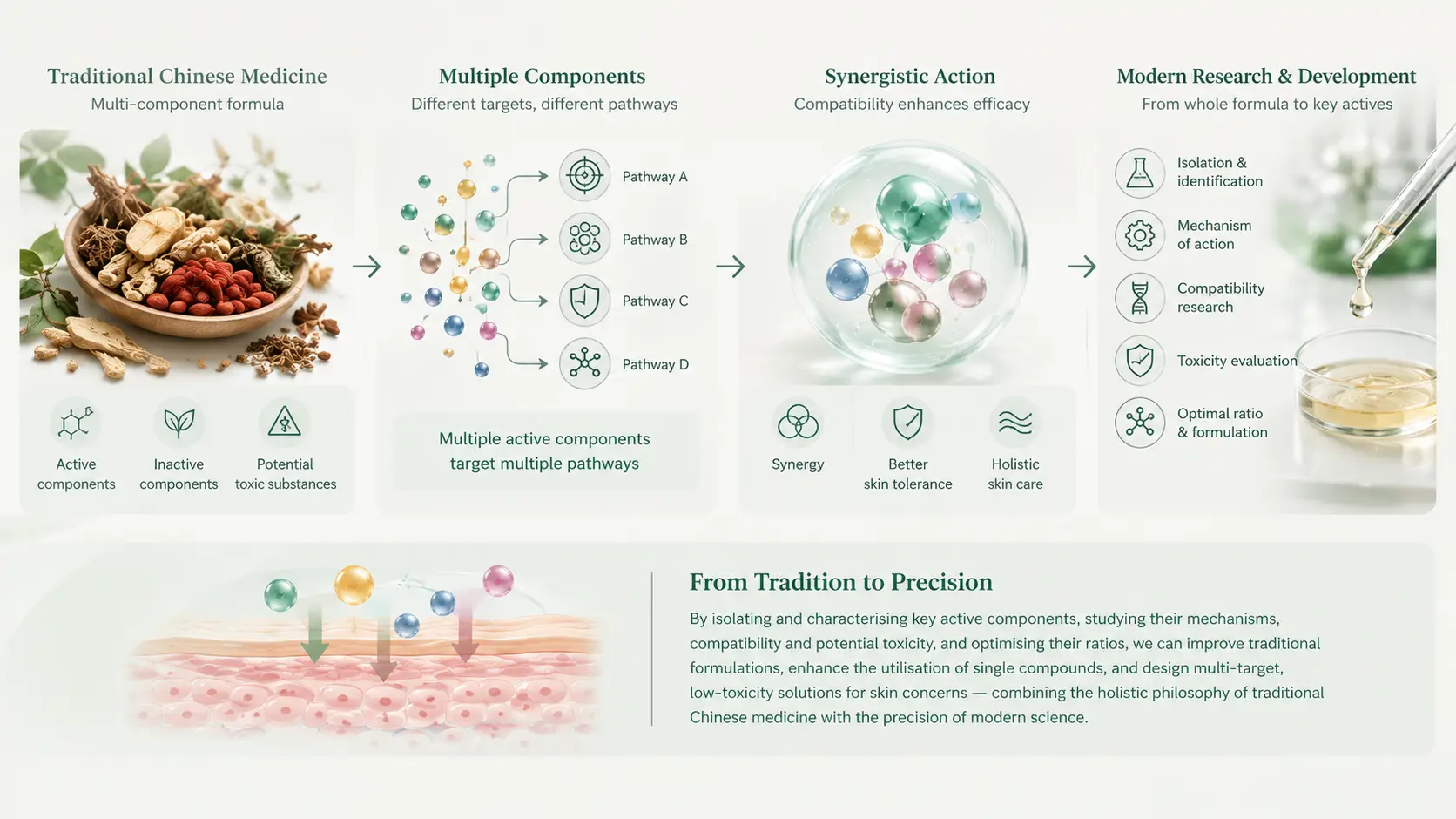
It can mean three different things, and suppliers often let all three blur into one. A multi-component extract contains many molecules; a multi-target active measurably engages more than one biological target; a multi-pathway effect means downstream pathways change as a result. Only the second and third are performance claims. The first is a composition fact, and it proves nothing on its own.
The reason the idea has become mainstream rather than promotional is that it now has a literature behind it. A 2025 bibliometric review of herbal ingredients in skincare mapped 1,593 publications from 1981 to 2024 and found that the field has moved decisively toward multi-target explanations. The authors describe the shift as "breaking the traditional thinking of 'one drug, one target, one disease'" and note that interest has moved "from a single-target paradigm to one involving multi-ingredient, multitarget, and multipathway" mechanisms (Deng et al., Journal of Cosmetic Dermatology 24(7):e70363, 2025).
One calibration, because it matters for how you cite it: this is a mapping study, not a set of experiments. It establishes that multi-target has become the dominant explanatory frame in the field — it does not individually validate any single plant as multi-functional. Treat it as evidence that the question is real, not as evidence for any particular answer.
And that is exactly the gap a buyer has to close. An extract being chemically complex is a reason to ask about multi-functionality, never a reason to assume it.
How are multi-benefit claims built — and which of the three structures holds up?
There are three structures behind the word. A shared-mechanism cascade delivers several effects from one upstream cause, tested together. A parallel multi-target claim rests on genuinely separate mechanisms, each with its own evidence. Claim stacking borrows the credibility of both by quietly changing the dose, the test model or the base between one claim and the next.
Type | What it means | How to recognise it | Strength |
① Shared-mechanism cascade ("one cause, several effects") | One upstream node feeds several downstream endpoints | All effects are measured in one study, at one dose, in one base; the mechanism diagram connects them | Strongest — the claims verify each other |
② Parallel multi-target | Separate mechanisms that each legitimately work, independent of each other | Each claim has its own report number, model and dose; the supplier can name the tier of each | Real, but each stands alone — no cross-borrowing |
③ Claim stacking | Three unrelated results printed as one headline | Dose changes between claims; endpoints come from different studies; an in-vitro result and a human result are listed side by side without distinction | Reject |
Claim stacking is the term worth having in your vocabulary: the presentation of results obtained under different conditions — different concentrations, different test models, or different formulation bases — as though they described a single performance of one ingredient. It is rarely dishonest sentence by sentence. It is the layout that does the work.
A useful tell: ask which number came from which panel. If the answer requires three separate documents to reconstruct, you are looking at type ③, regardless of the headline.
What four questions test a multi-function claim?
Ask four things before you accept one. Do the claimed effects share a mechanism? Do they hold at the one concentration you will actually use? Which finished formula produced the human result? And what evidence tier does each claim sit on? Four clean answers means you can proceed; three means you have a question mark to price in.
1. Same mechanism? If yes, the claims reinforce each other and you can treat them as one finding. If no, each needs independent proof.
2. Same concentration? This is where most portfolios quietly fail. A soothing result at 2% and a barrier result at 0.0625% are not two benefits of one dose — they are two experiments.
3. Same base? Human data always measures a finished formula, never a multifunctional skincare ingredient in the abstract. Ask what else was in it.
4. Same evidence tier? In-vitro, ex-vivo and human panels are not interchangeable, and a strong result at one tier does not lift a weaker one.
What to request from a supplier, in one message: the mechanism diagram; one report number per claim; any available concentration–response data; and the composition context of the human panel. A supplier who has done the work answers this in an afternoon. A supplier who answers with a rewritten brochure has told you what you need to know.
What does a multi-functional claim look like on a real ingredient?
Plamed's development effort goes into botanical actives whose mechanisms can be pinned down and tested rather than asserted, and PMSoothe® Kava97 came out of that work: a standardised kava root extract built around one measurable upstream node in sensory nerve signalling, with separately evidenced effects on barrier proteins and on expression lines — three claim structures, three evidence sets, and no cross-borrowing between them.
Field | Value |
Product | PMSoothe® Kava97 |
INCI | PIPER METHYSTICUM ROOT EXTRACT, HYDROXYPROPYL CYCLODEXTRIN |
Botanical source | Piper methysticum (kava) root |
Standardisation | Kavain ≥4000 ppm |
Composition | 15% kava root extract + 85% hydroxypropyl cyclodextrin (supramolecular encapsulation) |
Solubility / use level | Water-soluble / 0.1%–2% |
Here is every claim we make for it, with the mechanism, the tier, and the report number beside it. Nothing below is aggregated; each row is one study.
Claim | Mechanism | Evidence tier | Key result | Test level |
Immediate soothing — burning, stinging, itch, redness | Suppresses the nerve action potential; down-regulates TRPV1, up-regulates TRPM8 | Human, capsaicin challenge, 31 subjects | Burning/stinging relief reported by 100% of subjects, itch by 93.55%, redness by 83.87% | 2% |
Nerve-pathway verification | Action-potential frequency in dorsal root ganglion neurons | In vitro | Action-potential suppression ~89%; spike count −89.3% | 0.45% |
Barrier repair | Up-regulates barrier proteins and keratinocyte migration | Ex vivo 3D epidermis (no human data) | Filaggrin +47.22%, claudin-1 +35.71%, viable layer thickness +22.55% | 0.0625% |
Expression-line reduction | Reduces Ca²⁺ influx, VAMP2 and myosin at the neuromuscular junction | Human, half-face, 32 subjects, 14 days | Crow's-feet count −27.45%, firmness R0 −24.89% (lower R0 = firmer skin), elasticity R2 +13.15% | 2% in a finished cream |
Report numbers: soothing — Bureau Veritas (3324)248-0024; nerve pathway — PLA-2024090202; barrier — GT-0003696; anti-wrinkle — Intertek SHCJ25007215ACN.
Soothing is a shared-mechanism cascade
This is the clean type-① case, and it is worth understanding why. Sensory irritation — heat, sting, itch — travels along the same road: receptor activation generates an action potential, and the action potential is what the brain reads. Kava97 acts upstream of the split by suppressing that action potential. So all three endpoints fall together, and critically, they were measured together: one panel, one capsaicin challenge, one 2% dose. That is why three separate claims legitimately share one set of numbers here.
Where it stops. Itch carried by the histamine route rather than the ion-channel route is only partly addressed. We would rather you know that before writing an itch claim than after a launch. This does not weaken the soothing claim; it defines its boundary, which is what makes the claim usable.
Barrier repair and anti-wrinkle are parallel — and they do not borrow from it
Both are type ②, and neither can lean on the human soothing data.
Barrier repair currently rests on an ex vivo 3D epidermis model at 0.0625% — a different model, a different dose, and a tier below human. It supports a barrier claim at that tier, nothing more.
Anti-wrinkle has its own human data, a different mechanism entirely (the neuromuscular junction rather than the sensory nerve), and two honest caveats we would rather state first: the result belongs to the finished cream at 2%, and the mechanism addresses expression lines while the instrument reads a relaxed face, because measurement requires it. Different question, different evidence, different price.
Scored honestly, then: one clean demonstration of a shared mechanism, and two additional benefits sitting on separate evidence tiers they do not overstate. That is a narrower statement than "does everything" — and a far more auditable one.
What else must be true before a multi-functional active goes into a launch?
Four things sit outside the claim table and decide whether the formula ever ships. None of them is a marketing question, and all four are answered by documents.
Check | Position for Kava97 |
Safety margin | NOAEL of 200 mg/kg·bw/d established in a 90-day, three-concentration subchronic study; no adverse reactions in a 48-hour patch test at 2% across 30 subjects |
Formulation stability | A 1% aqueous solution held at 4 °C, ambient and 45 °C across pH for 7 months showed no colour change or sediment, with 95%–100% transmittance — relevant because water solubility is what allows it into the lightweight bases where soothing claims are usually sold |
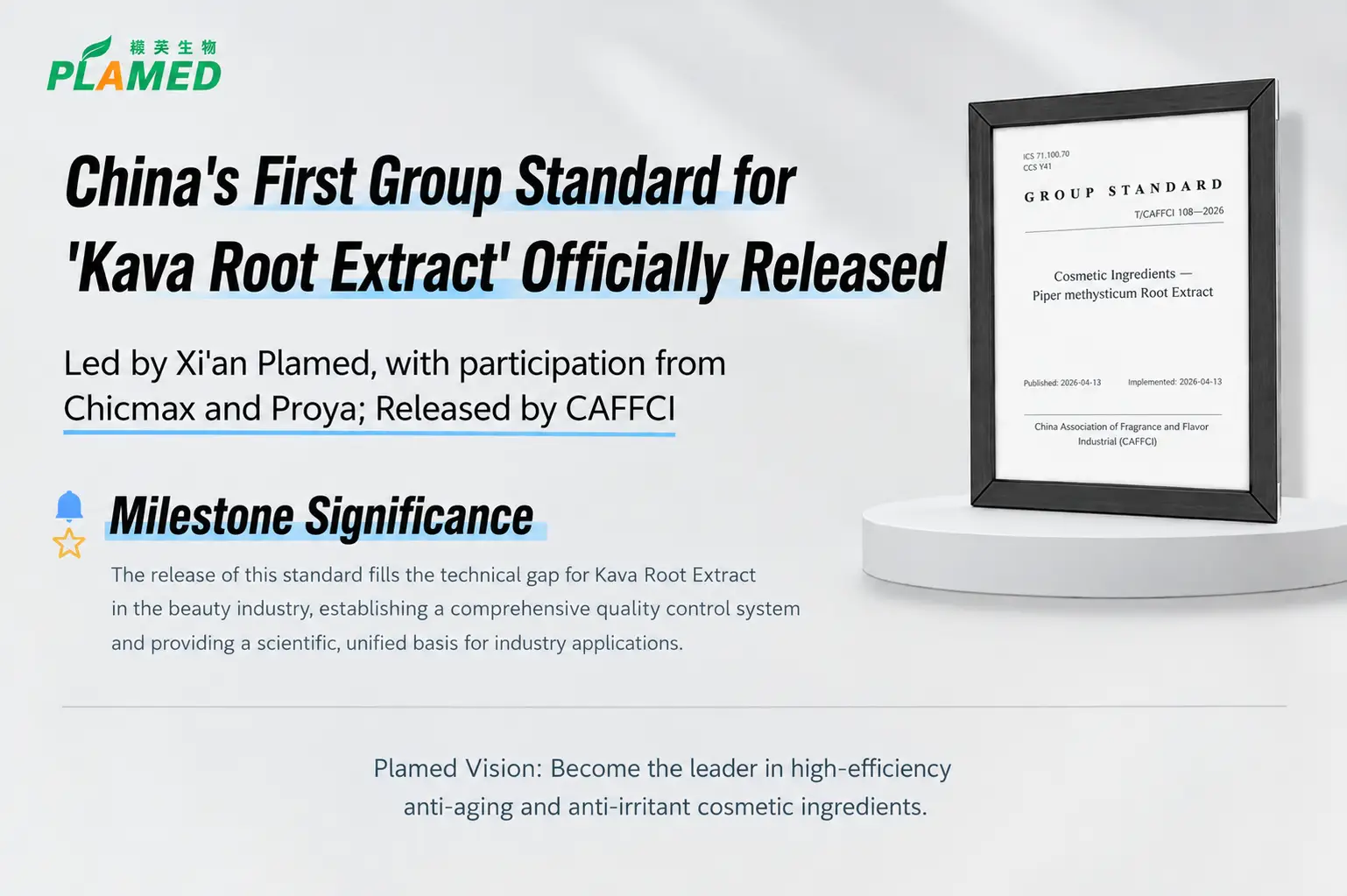
Standardisation & standards | Kavain-standardised; Plamed led the drafting of China's first group standard for kava root extract in April, 2026(T/CAFFCI 108-2026) |
Market access | Kava root faces restrictions in some markets. Confirm status per target market before building a claim plan |
Frequently asked questions
Can one ingredient replace several actives in a formula?
Sometimes, when the effects share a mechanism — that is the whole test. A single upstream effect on nerve signalling can replace two or three sensory-soothing actives at once. An effect on the neuromuscular junction will not replace your barrier lipid, because nothing about those two pathways is shared.
Is a chemically complex extract automatically multi-functional?
No. Complexity is a starting hypothesis, not a result. Multi-functionality is established per effect, per dose, per model — which means every additional claim needs its own evidence, not just its own sentence.
Does "multi-functional" mean I can use less of everything else?
It means you can use less of the things operating on the same mechanism. Nothing about this ingredient lowers the dose your preservative system or your emollient phase needs. If a supplier suggests otherwise, ask which study showed it.
What use level do I need for soothing versus anti-wrinkle?
Both were tested at 2% in their respective systems. The barrier data sits at 0.0625% in an ex vivo model and should not be read as a formulation dose — it is evidence of mechanism, not a use recommendation.
Is there an oil-soluble version for anhydrous systems?
Yes — PMSoothe® Kava-Oil is the oil-soluble grade of the same kava root extract.
Is kava safe in cosmetics?
On our own data, yes, with a wide margin. The published record is less settled, and both halves belong in the answer. The numbers: a NOAEL of 200 mg/kg·bw/d in a 90-day study, and no adverse reactions in a 48-hour patch test at 2%.
Two regulatory facts sit alongside those numbers, and you should have both before you build a claim plan. The CIR Expert Panel's final report on this ingredient carries an insufficient-data conclusion: the available dermal data did not allow the panel to reach a safety finding, with absorption and sensitisation named among the gaps (DOI 10.1177/1091581809350934). That is a data gap rather than a finding of harm. Separately, kava extracts are prohibited in Canadian cosmetics. Read the two together before you price the risk.
None of that makes kava a low-risk ingredient in every market — it makes the risk legible, which is the only thing a formulation brief can act on. If the target market clears the regulatory question, the remaining work is ordinary: confirm the use level against the report numbers above, and test the finished base rather than the raw material. The 7-gate screen for formulation-ready cosmetic ingredients is the checklist we use for that second step.