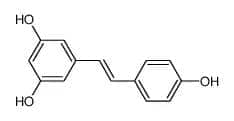
Resveratrol is a natural antioxidant present in plants. Its antioxidant mechanism is mainly to eliminate or inhibit free radicals production. Studies have confirmed that antioxidant effect of Resveratrol is stronger than that of vitamin C and vitamin E. It has strong function of scavenging free radicals and resisting lipid per-oxidation. Furthermore, it can regulate the activity of antioxidant related enzymes.
Study on aging of mice by Resveratrol shows that Resveratrol can scavenge free radicals; it can reduce H202 content in skin tissue, and increase the activity of ATP enzyme. The study proves that Resveratrol can resist skin aging caused by lipid peroxidation that is led by free radicals and their metabolites. Thus Resveratrol can improve body immunity, and delay tissue damage. It has certain anti-aging effect.
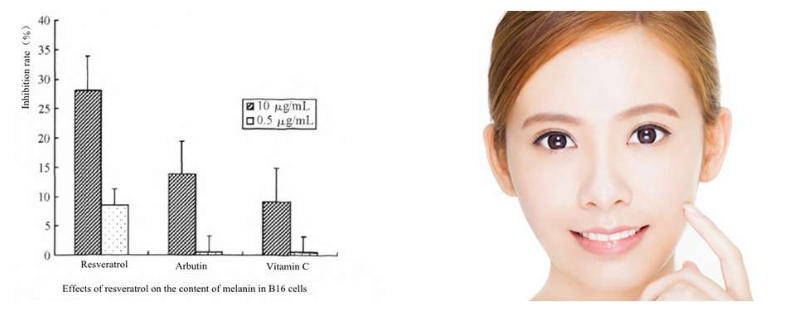
Resveratrol can inhibit cell proliferation. It can significantly inhibit tyrosinase activity, and reduce melanin content. Thus Resveratrol plays a role of whitening skin. In addition, Resveratrol has strong UV absorbency. It has maximum UV absorption at 366nm. It can reduce radiation damage to skin caused by ultraviolet light.
- Anti-inflammation and anti-microbial
Resveratrol has inhibitory effect on escherichia coli, pseudomonas aeruginosa and staphylococcus aureus, as well as skin fungi. Experimental result shows that Resveratrol has certain anti-HBV effect in vitro. Its mechanism of action is to inhibit DNA replication of HBV, and to induce apoptosis of cells infected with HBV, so as to exert its antiviral activity.

 Plamed focuses on natural cosmetic ingredients for more than 10 years. We have founded four subsidiary companies, which respectively develops different kinds of cosmetic raw material. Plamed is a company whose CEO is designated as the first secretary general of Shaanxi Plant Extraction Association.